
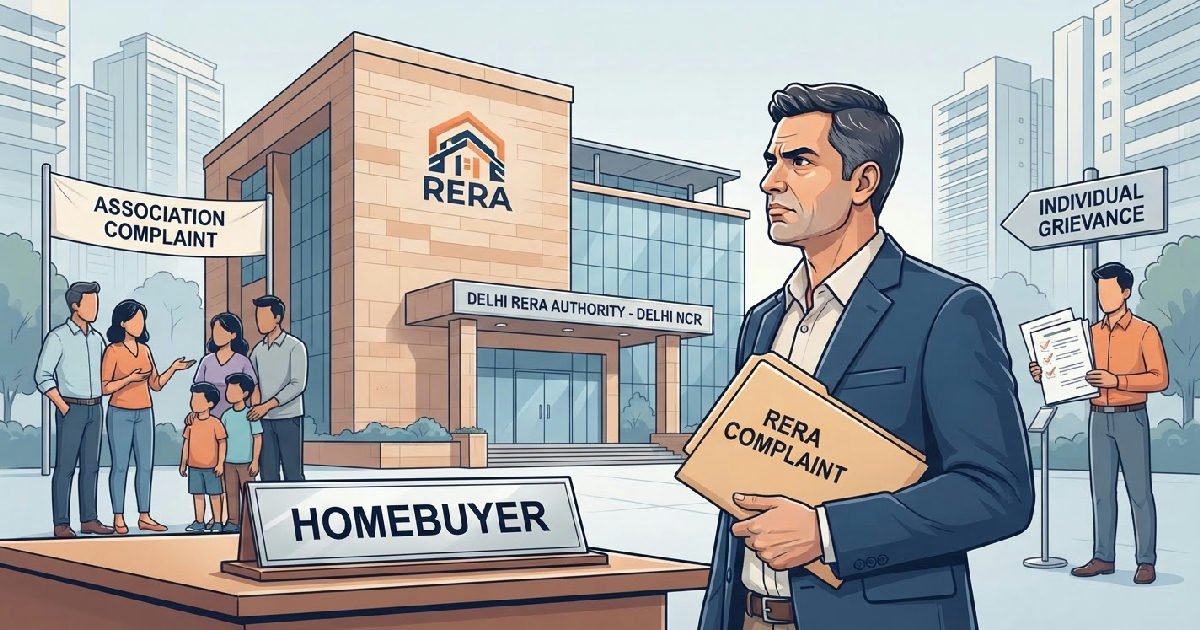
Filing a RERA complaint in Delhi NCR involves deciding between an individual complaint or an association-led approach for addressing grievances under the Real Estate (Regulation and Development) Act, 2016. This choice significantly impacts the nature and success of the claim, depending on whether the issue is a personal dispute or a widespread problem affecting an entire project.
The RERA Act provides recourse for “any aggrieved person,” a broad definition encompassing individual allottees, cooperative societies, and registered associations. But discerning the appropriate path is vital, as a misstep can prolong the resolution process or even lead to a rejected complaint.
RERA complaint in Delhi NCR: One Buyer or the Whole Association
For issues directly affecting a single property owner, an individual RERA complaint is generally the most effective route. These typically involve personal refunds, claims for delay interest, or specific problems related to the possession of a particular flat.
Grounds for Personal Claims
Homebuyers commonly encounter grounds for individual complaints such as delayed possession, outright refusal of a refund, or specific issues related to their unit. Other grievances can include arbitrary demands for additional payments and non-compliance with agreement terms.
These are matters where the direct contractual relationship between the buyer and the promoter is paramount. Acting alone ensures the focus remains on the personal claim without being diluted by broader project-wide concerns.
Impact of Individual Flat-Specific Issues
Issues like poor construction quality within a specific flat, misleading advertisements, or hidden charges also fall under individual grievances. Pursuing these as an individual can sometimes lead to swifter resolution for issues specific to one’s property.
Buyers seeking relief for personal financial losses, such as delay interest claims, find this approach most direct. The RERA framework is designed to protect individual allottees in these situations.
Common Defects: The Strength of Association Complaints
When issues affect multiple residents or the entire residential project, a registered association of allottees is often the preferred and more powerful entity to file a RERA complaint. These common defects might include a missing club, an undeveloped shared basement, or complications with the conveyance deed for the entire tower.
The Necessity of a Registered Association
It’s crucial to note that simply gathering a group of residents isn’t enough; the association must be formally registered. In one notable instance, a tribunal mandated individual members to file separate complaints because their association lacked official registration, highlighting the importance of proper legal standing.
This requirement underscores RERA’s emphasis on efficiency and appropriate representation for widespread issues. It reinforces the idea that collective problems demand collective solutions and proper collective representation.
Role of Cooperative Societies
Beyond registered associations, a cooperative society of flat owners also holds the legal standing to file a complaint on behalf of its members. This provides another avenue for collective redressal when common issues arise within a housing project.
These grievances typically involve shared amenities or infrastructure that impact the quality of life and value for many homeowners. Addressing these collectively provides a stronger voice and often carries more weight with regulatory authorities and developers.
Joint Complaints: A Collaborative Middle Ground
For situations where multiple, but not necessarily all, allottees are affected by a similar grievance, a joint complaint offers a robust alternative. This approach is particularly effective in larger housing societies where several buyers share identical issues with the same project or promoter.
Effectiveness in Large Housing Societies
Joint complaints are often effective in large housing societies. They allow multiple allottees impacted by the same project or promoter to combine their efforts, presenting a unified front.
A stronger joint complaint can pool resources and evidence, presenting a more formidable case than scattered individual filings. It also streamlines the process for the RERA authority, dealing with a single consolidated complaint rather than numerous identical ones.
Shared Issues and Unified Action
This strategy can be particularly useful for issues like a common builder delay affecting a specific block of apartments or an unexpected fee levied against a subset of buyers. It balances individual concerns with collective strength, offering a focused yet unified front against a promoter.
By filing jointly, homebuyers can share the burden of legal costs and coordinate their evidence, increasing their chances of a favorable outcome. This collaborative approach leverages collective power even when a full association isn’t involved.
Understanding Complaint Categories and Best Practices
Distinguishing between personal and collective grievances is the first step toward effective resolution under RERA. Misidentifying the nature of the complaint can lead to procedural delays and potential dismissals, costing valuable time and resources for homebuyers.
Differentiating Personal and Collective Grievances
Correctly categorizing a complaint ensures it is directed to the appropriate RERA authority and processed according to established protocols. This minimizes procedural back-and-forth, allowing for a more efficient and timely review of the grievance.
Such precision is vital for the smooth functioning of the regulatory framework and for ensuring that the complaint aligns with RERA’s provisions. Homebuyers must carefully assess the scope of their grievance before filing.
Strategic Benefits of Proper Categorization
Moreover, proper categorization isn’t just about adhering to procedure; it’s a strategic advantage for the homebuyer. It enables them to leverage the specific provisions of RERA designed for individual rights or collective redress.
This approach ensures the most impactful legal strategy and significantly increases the likelihood of a favorable outcome for their specific situation. Understanding these distinctions maximizes the potential for a successful resolution.
| Complaint Type | Typical Issues | Recommended Filing Entity |
|---|---|---|
| Individual Grievance | Refund, delay interest, flat possession, specific construction defects | Individual Homebuyer |
| Common Defect | Missing club, shared basement, overall project conveyance deed | Registered Allottee Association |
| Shared Grievance | Common builder delay impacting multiple buyers, collective fee dispute | Joint Group of Homebuyers |
The Peril of Individual Action on Common Defects
Attempting to file an individual complaint for a common defect, such as a missing amenity intended for the entire project, often proves futile. RERA tribunals may send such complaints back, instructing the individual to either join an association or gather other affected parties.
This procedural requirement underscores RERA’s emphasis on efficiency and appropriate representation for widespread issues. It reinforces the idea that collective problems demand collective solutions, not isolated efforts.
Navigating the RERA Filing Process in Delhi NCR
Regardless of whether one files individually or as part of a group, maintaining meticulous records is paramount. Homebuyers must keep all agreements, receipts, and correspondence, as these documents form the bedrock of any RERA complaint.
Meticulous Record-Keeping is Paramount
The process of filing a RERA complaint in Delhi NCR requires careful attention to detail. This includes diligently maintaining all agreements, receipts, and correspondence, as these documents form the bedrock of any RERA complaint.
This meticulous record-keeping is essential for building a strong and well-supported case. Without proper documentation, even valid grievances may face significant challenges in the RERA tribunal.
Seeking Professional Legal Guidance
While the RERA framework aims for accessibility, navigating its legal complexities, drafting a compelling complaint, and presenting evidence effectively often benefits from professional guidance. Consulting with legal experts specializing in real estate law can ensure all procedural and evidentiary requirements are met.
Such professional assistance can strengthen the case and potentially expedite the resolution. Expert guidance helps homebuyers understand their rights and obligations under the Act, leading to more successful outcomes.
What is the primary difference between an individual and an association RERA complaint?
An individual complaint addresses issues specific to a single property owner, such as delayed possession or a personal refund. An association complaint, conversely, tackles common defects or systemic problems affecting multiple residents or the entire project, like missing shared amenities or issues with the conveyance deed for the whole development.
Why is a registered association crucial for common defects?
A registered association holds legal standing and represents the collective interests of multiple allottees. Without formal registration, tribunals may require individual members to file separate complaints, significantly diluting the collective strength and potentially complicating the resolution process for widespread issues.
Can I file a RERA complaint for a minor issue?
RERA is designed to address grievances that stem from non-compliance with the Act or the terms of the sale agreement. While there’s no strict definition of “minor,” if the issue affects your contractual rights or the promised deliverables, it generally falls within RERA’s purview. However, it’s wise to assess the severity and potential impact before proceeding with a formal complaint.
Delayed flat, and the association is still “discussing”? Call or Whatsapp for consultation.