
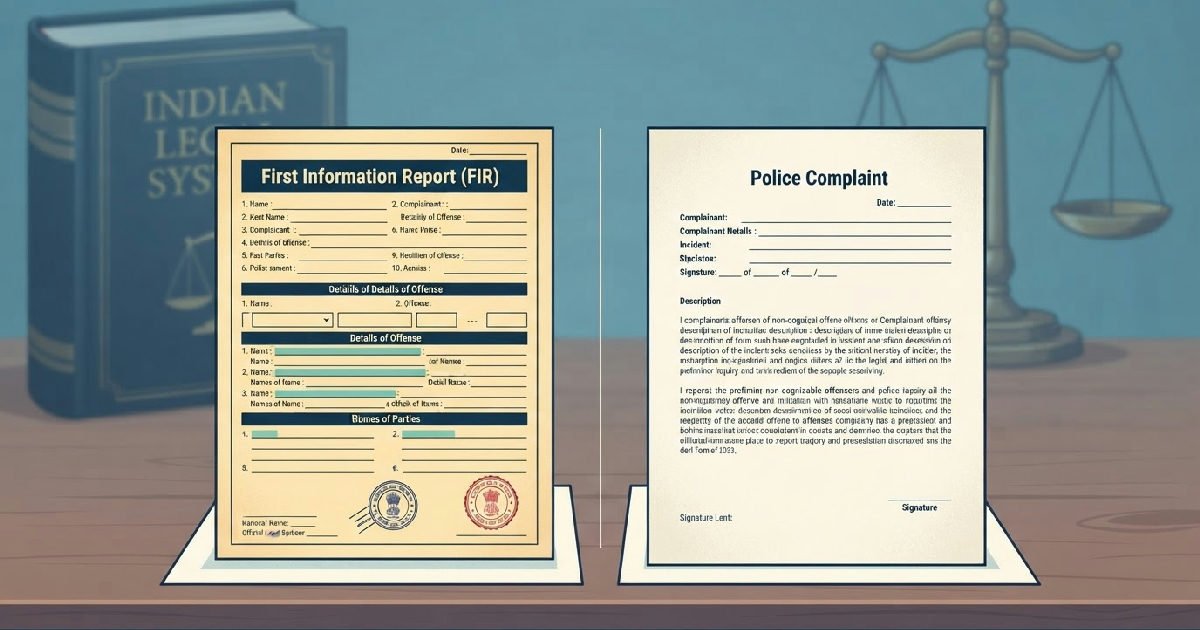
An FIR, or first information report, is a crucial document that initiates criminal proceedings, differing significantly from a general police complaint in India. Police Complaint is crucial for anyone engaging with the Indian legal system. While both are mechanisms for reporting incidents to the police, their legal standing, the types of offenses they address, and the subsequent police actions they trigger are fundamentally distinct.
An FIR formally initiates a criminal investigation for serious, cognizable offenses, making police action mandatory. A police complaint, however, serves as a broader, often less formal report that may or may not lead to an official investigation or the registration of an FIR, depending on the nature of the incident.
Understanding the FIR vs. Police Complaint distinction
A First Information Report (FIR) represents the initial official record police make concerning a serious, cognizable offense. This formal written document outlines the details of the crime, acting as the primary catalyst for the entire criminal process under Indian law.
The term “FIR” isn’t explicitly defined within the Code of Criminal Procedure, but it’s universally understood as the vital first piece of information about a cognizable offense provided to a police station’s officer in charge. After a First Information Report is filed, authorities are legally bound to investigate the matter promptly.
In contrast, a police complaint is a much broader and generally less formal report made to law enforcement. It can cover anything from minor disturbances and civil disputes to suspicious activities or non-serious offenses that don’t immediately warrant a full criminal investigation.
Unlike an FIR, lodging a police complaint does not automatically trigger a criminal investigation. Police may conduct preliminary inquiries, mediate, or advise on further steps, but they aren’t compelled to open a formal case based solely on such a complaint.
The legal framework: BNSS 2023
The framework governing these reports has seen significant updates with the introduction of the Bharatiya Nagarik Suraksha Sanhita, 2023 (BNSS). This new legislation replaced previous provisions of the Code of Criminal Procedure, consolidating and modernising criminal law procedures in India.
Under the BNSS, specific sections, notably Chapter 13, Section 173 onwards, delineate the procedures for police investigations following the registration of an FIR. This legislative shift aims to streamline processes and ensure clearer guidelines for both citizens and law enforcement.
Cognizable vs. non-cognizable offenses explained
The classification of an offense as either cognizable or non-cognizable is central to distinguishing an FIR from a police complaint. A cognizable offense is typically serious, allowing police to arrest an accused person without a warrant and begin an investigation without prior court approval.
Non-cognizable offenses, on the other hand, are less grave. For these, police generally cannot arrest without a warrant, nor can they initiate an investigation without a magistrate’s order. This fundamental difference dictates the initial response required from law enforcement.
Comparing legal mandates and outcomes
The divergent legal implications of an FIR and a police complaint are stark. One initiates a formal state response to serious crime, while the other serves as an informational or preliminary report.
This distinction shapes everything from the immediate actions police take to the long-term legal consequences for those involved. Understanding these differences can empower citizens to choose the appropriate reporting mechanism for their situation.
| Feature | First Information Report (FIR) | Police Complaint |
|---|---|---|
| Legal Basis | Bharatiya Nagarik Suraksha Sanhita (BNSS), 2023, Chapter 13 | Broader reporting mechanism, not explicitly defined by one specific section for initiation |
| Offense Type Addressed | Cognizable offenses (serious crimes) | Any grievance, including civil disputes, missing persons, non-cognizable offenses |
| Mandatory Police Action | Yes, police must register and investigate | No, police may conduct preliminary inquiry or advise |
| Magistrate’s Order for Investigation | Not required for initial investigation | Research does not specify requirement for investigation initiated by a complaint |
| Legal Consequence | Formal criminal proceedings initiated | May or may not lead to further legal action; often for record-keeping or mediation |
Once an FIR is registered, the police are legally obligated to commence an investigation, gather evidence, and eventually file a chargesheet or a final report in court. This process is time-bound and carries significant implications for the accused, including potential arrest and trial.
A police complaint, however, often remains an administrative record. For instance, if you’ve received a legal notice, filing a complaint might be a precursor to other actions rather than a direct trigger for criminal investigation. It can serve to document an incident without immediately escalating it to a criminal case.
A police complaint, while less formal, can still play a crucial role in documenting events. It may lay the groundwork for future legal actions, even if it doesn’t immediately trigger a full criminal probe. The differing standards for initiating investigations can sometimes lead to complexities for individuals, such as those seeking pre-arrest bail in sensitive cases.
Implications for citizens and law enforcement
For citizens, understanding when to file an FIR versus a police complaint is vital for ensuring the appropriate response from authorities. Reporting a cognizable offense through an FIR guarantees an investigation, leveraging the full force of the state’s criminal justice system.
Conversely, a police complaint offers flexibility for less severe issues, or for situations where one primarily seeks a record of an incident or preliminary police intervention without immediate criminal charges. This distinction empowers individuals to make informed decisions about how to seek redress or assistance.
What is the primary difference between an FIR and a Police Complaint?
The main difference lies in the nature of the offense and the resulting police action. An FIR is for cognizable (serious) offenses, mandating police to register and investigate immediately without a warrant. A police complaint is for any incident, including non-cognizable ones, and doesn’t automatically trigger a criminal investigation.
Can a Police Complaint be converted into an FIR?
Yes, a police complaint can evolve into an FIR. If, during a preliminary inquiry into a complaint, police determine that a cognizable offense has occurred, they are then legally bound to register an FIR based on the information gathered from that initial complaint.
What legal document governs FIRs and Police Complaints in India now?
As of 2023, the Bharatiya Nagarik Suraksha Sanhita (BNSS) primarily governs the procedures related to FIRs and police complaints. This new legislation replaced previous sections of the Code of Criminal Procedure (CrPC), modernising the legal framework for criminal investigations.