
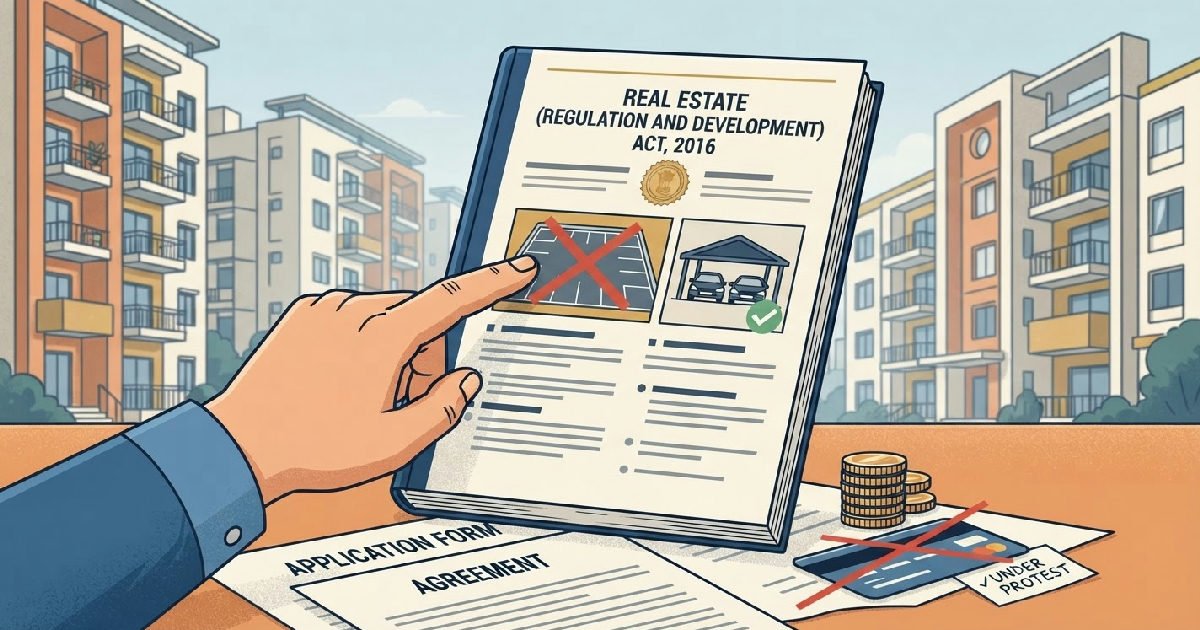
Homebuyers in Delhi NCR are frequently confronted with unexpected demands for additional parking charges after booking their flats, a practice often at odds with established real estate regulations. Regulations prohibit builders from selling open parking, a key point that forces many to question the legality of such fees, particularly prevalent in the burgeoning property market.
Fortunately, the Real Estate (Regulation and Development) Act, 2016 (RERA) provides significant protections and a clear framework for distinguishing legitimate parking sales from illegal ones.
RERA parking classifications and extra parking charges
RERA aims to bring transparency and accountability to the real estate sector, safeguarding the interests of homebuyers against unscrupulous practices.
The core of the conflict often lies in whether the parking space is classified as a “common area” or a “garage,” a distinction with profound legal and financial implications for property owners across Delhi, Noida, Gurugram, and other parts of the National Capital Region.
Buyers should verify if their project is a RERA registered project before making any payments.
The legality of an extra parking charge hinges entirely on the type of parking space involved. RERA, supported by a landmark Supreme Court judgment, draws a distinct line between what builders can and cannot sell separately to homebuyers.
This clarity is crucial for any buyer, as it directly impacts the final cost of their property and their rights as a homeowner. Understanding these definitions is the first step in challenging unwarranted demands.
Open and stilt parking: indisputable common areas
Builders are explicitly prohibited from selling or charging separately for open parking spaces. These areas are unequivocally classified as “common areas” under Section 2(n) of RERA. Their cost must be seamlessly integrated into the flat’s base price, not tacked on as an additional fee.
This principle was firmly established by the 2010 Supreme Court judgment in Nahalchand Laloochand Pvt. Ltd. v. Panchali Co-operative Housing Society Ltd. The ruling affirmed that such spaces are communal and cannot be alienated for individual sale.
Stilt parking spaces also fall under this classification, lacking the necessary three enclosing walls to be deemed a “garage” for separate sale. Any agreement forcing buyers to pay extra for these is legally invalid.
Upon a project’s completion, all open parking facilities must be handed over to the Resident Welfare Association (RWA). The RWA then takes responsibility for allotting these spaces equitably among residents, reinforcing their status as a shared amenity rather than a private saleable unit. This prevents builders from using parking as leverage.
Covered parking and garages: permissible sales under strict conditions
In contrast, fully enclosed garages, those featuring a roof and walls on at least three sides, can be legally sold as private units. This includes basement parking or other genuinely enclosed structures. The critical stipulation is that these sales must be explicitly detailed in both the agreement and the sanctioned plans of the project.
When a builder charges for covered parking or a garage, they are legally bound to provide comprehensive specifics. This includes dimensions, the exact location within the complex, and a unique numbering in both the allotment letter and the final sale agreement. The price for such a garage must also be clearly stated in the sale deed.
There is no defined cap on what a builder can charge for covered parking. Prices can reach significant sums, with ultra-luxury projects in major metropolitan areas like Mumbai or Delhi seeing charges as high as ₹25 lakhs. These prices are typically dictated by market demand and supply dynamics within premium residential developments.
Navigating extra charges: a buyer’s essential toolkit
When confronted with demands for extra parking fees, homebuyers possess several crucial avenues for recourse. The process begins with careful due diligence and extends to formal legal action if necessary.
Staying informed and meticulously documenting every step is vital. This proactive approach significantly strengthens a buyer’s position against potentially illegal demands for additional payments. Many buyers face similar issues, particularly concerning extra charges at possession.
Pre-booking vigilance: critical steps before committing
Before committing to a purchase, prospective buyers must undertake thorough checks. It’s imperative to review the project details on the relevant state RERA website to confirm its registration and verify sanctioned layout plans. A meticulous review of the Builder-Buyer Agreement is non-negotiable; ensure the type of parking (garage versus open) is unambiguously stated.
Crucially, buyers should outright refuse to pay any additional fees for open parking during the booking phase. Any attempt to levy such charges should be a red flag, prompting further investigation or reconsideration of the purchase. Transparency at this stage is key to avoiding future disputes.
Actions if charged post-booking: documentation is key
If a demand for an extra parking charge emerges after booking, the immediate step is to review all original documents. Check the application form, the initial agreement, and the price list from the date of booking to ascertain if a parking fee was included or explicitly excluded. These documents form the bedrock of any dispute.
Simultaneously, buyers should access the Delhi RERA website (rera.delhi.gov.in) to scrutinize the project’s registered details. This includes approved plans and any disclosures specifically related to parking. Navigate to the ‘Projects’ section, select ‘List of Registered Projects,’ and search using the project name, builder name, or RERA registration number to review all pertinent information.
This allows buyers to verify if the builder’s current demand aligns with their RERA-registered commitments.
The “pay under protest” strategy: preserving your rights
In situations where a builder insists on an extra payment for parking, and a buyer feels compelled to pay to avoid losing the unit, the “pay under protest” mechanism offers a critical legal safeguard. This strategy allows the buyer to proceed with the payment while explicitly reserving the right to contest its legality later.
It acts as a formal declaration that the payment is conditional and does not imply acceptance of liability. Courts have consistently upheld the validity of such payments, provided the protest is clearly documented at the time of transaction. This is a powerful tool against forced payments.
To implement this, homebuyers must lodge a formal protest in writing with the builder. This communication should unequivocally state that the payment is being made “under protest,” and that the buyer retains all rights to challenge the charge through legal means.
It’s essential to document this protest rigorously, ideally through an endorsement on the receipt or via a contemporaneous letter or email, ensuring a clear paper trail for future legal proceedings. This ensures the payment cannot later be construed as voluntary acceptance.
Filing a RERA complaint: state-specific guidance
Should a builder persistently demand separate payment for open or stilt parking, or for any parking not initially disclosed in the agreement, homebuyers have the right to file a formal complaint. This recourse is available through the State RERA Authority, which is specifically tasked with addressing such violations and protecting consumer interests.
The process is designed to be streamlined, though meticulous preparation of documents remains paramount. Knowing which RERA authority to approach is the first, crucial step in securing justice. For many, knowing how to file a RERA complaint can seem daunting.
Identifying the correct RERA authority
The critical factor in filing a complaint is determining the correct RERA jurisdiction. The complaint must be lodged with the RERA authority of the state where the project is physically located, not necessarily where the buyer resides. For instance, if the project is within Delhi (National Capital Territory), the Delhi RERA is the appropriate body.
However, if the project is situated in Noida, Greater Noida, or Ghaziabad, the complaint should be directed to the Uttar Pradesh RERA. Similarly, projects in Gurugram, Faridabad, or Sonipat fall under the jurisdiction of the Haryana RERA. Misdirection can lead to delays in resolution.
Delhi RERA complaint process
For projects falling under the Delhi RERA, the complaint process is primarily online. Homebuyers must visit the official Delhi RERA website, rera.delhi.gov.in. After registering or logging in, they should navigate to the ‘Online Complaints’ section and select ‘Complaint to Authority (Form M)’.
The form requires a clear articulation of the facts, the specific breach committed by the builder, and the desired relief. Essential supporting documents, including the allotment letter, the builder-buyer agreement, all payment receipts, and any relevant correspondence with the builder, must be attached.
After paying the prescribed complaint fee, the submission is complete, and the complainant should prepare for subsequent hearings. This detailed process ensures all information is captured accurately.
Evidentiary requirements and RERA timelines
The success of any RERA complaint hinges significantly on the strength and completeness of the evidence presented. Homebuyers must meticulously gather and organize all relevant documents to support their claims effectively. This systematic approach ensures that the RERA authority has a clear picture of the alleged violation, facilitating a faster and more favorable resolution.
Understanding the expected timeline for complaint resolution also helps manage expectations. While RERA aims for swift justice, complex cases can extend beyond initial estimates. Patience, coupled with robust documentation, is crucial throughout the process.
Essential documents for a strong case
To build a robust RERA complaint, buyers need a comprehensive set of documents. This includes the builder’s RERA registration details, the project’s approved layout plan specifically illustrating the parking spaces, and all related agreements or allotment letters. Any payment receipts for the disputed parking charges are also vital evidence.
Furthermore, any recordings of the builder’s commitments, or brochures and pamphlets mentioning parking allotments, can serve as powerful corroboration. Meticulous collection of these materials provides an undeniable factual basis for the complaint. These details help RERA assess the builder’s compliance with initial promises and registered plans.
Expected resolution period and remedies
RERA is explicitly designed to expedite the resolution of complaints, with a target disposition time of approximately 60 days. However, the complexity of certain cases can sometimes lead to longer processing periods. This timeframe provides a general expectation for buyers seeking redressal.
If the RERA authority finds a violation, it can direct the builder to refund the illegally collected amount for the parking space. This refund typically includes interest, along with potential compensation for the aggrieved buyer.
Should a party be dissatisfied with the RERA order, an appeal can be lodged with the Real Estate Appellate Tribunal within 60 days, with further appeal options to the High Court on questions of law. This multi-tiered appeal process ensures thorough judicial review.
RERA’s broader impact on residential transparency
The Real Estate (Regulation and Development) Act, 2016, fundamentally reshaped India’s property landscape. It was enacted with the primary goal of instilling transparency and accountability, directly addressing long-standing grievances of homebuyers. RERA mandates that nearly all real estate projects exceeding a certain size or unit count must be registered with their respective state RERA authority.
This registration requirement provides a public record of project details, including the number of parking lots available, preventing hidden costs and misrepresentations. The Delhi Real Estate Regulatory Authority (RERA Delhi), established in 2016 under this act, serves as a crucial watch dog for projects within the National Capital Territory. It ensures that developers adhere to stipulated guidelines, fostering a more equitable market for residential buyers.
| Parking Type | RERA Classification | Legality of Separate Sale | Builder Obligation | Maximum Charge |
|---|---|---|---|---|
| Open Parking | Common Area (Section 2(n)) | Illegal | Included in flat price, handed to RWA | ₹0 (cannot be charged) |
| Stilt Parking | Common Area | Illegal | Included in flat price, handed to RWA | ₹0 (cannot be charged) |
| Covered Parking / Garage | Private Unit | Legal (if specified in agreement/plans) | Mention dimensions, location, numbering in allotment letter/sale agreement; price in sale deed | No cap (market driven, up to ₹25 lakhs) |
Beyond individual complaints, RERA has set a precedent for standardized practices. The Ministry of Housing and Urban Affairs mandates a minimum of two Equivalent Car Spaces (ECS) per 100 square meters of residential floor area, influencing project design and parking provisions.
Furthermore, a January 2016 Delhi High Court ruling reinforced that parking should only be permitted in designated locations, generally favoring one parking spot per unit. These regulatory layers collectively empower buyers and curb opportunistic charging by developers, moving towards a more structured real estate environment in Delhi NCR.
Can a builder charge for open parking in Delhi NCR?
No, a builder cannot legally charge separately for open parking spaces in Delhi NCR. Under RERA, open parking is classified as a “common area,” meaning its cost must be included in the overall price of the flat and cannot be sold as an additional unit.
What is “paying under protest” when a builder demands extra fees?
Paying under protest is a recognized legal mechanism that allows a homebuyer to pay a demanded amount while formally stating in writing that they reserve the right to contest the charge. This ensures the payment isn’t seen as voluntary acceptance of liability, preserving the buyer’s legal options.
How long does RERA take to resolve parking charge complaints?
The Real Estate Regulatory Authority (RERA) is designed to resolve complaints efficiently, typically aiming to dispose of cases within approximately 60 days. However, more complex complaints or those requiring extensive investigation might take a longer period to reach a final resolution.
New parking demand on an NCR booking? Call or Whatsapp for consultation.