
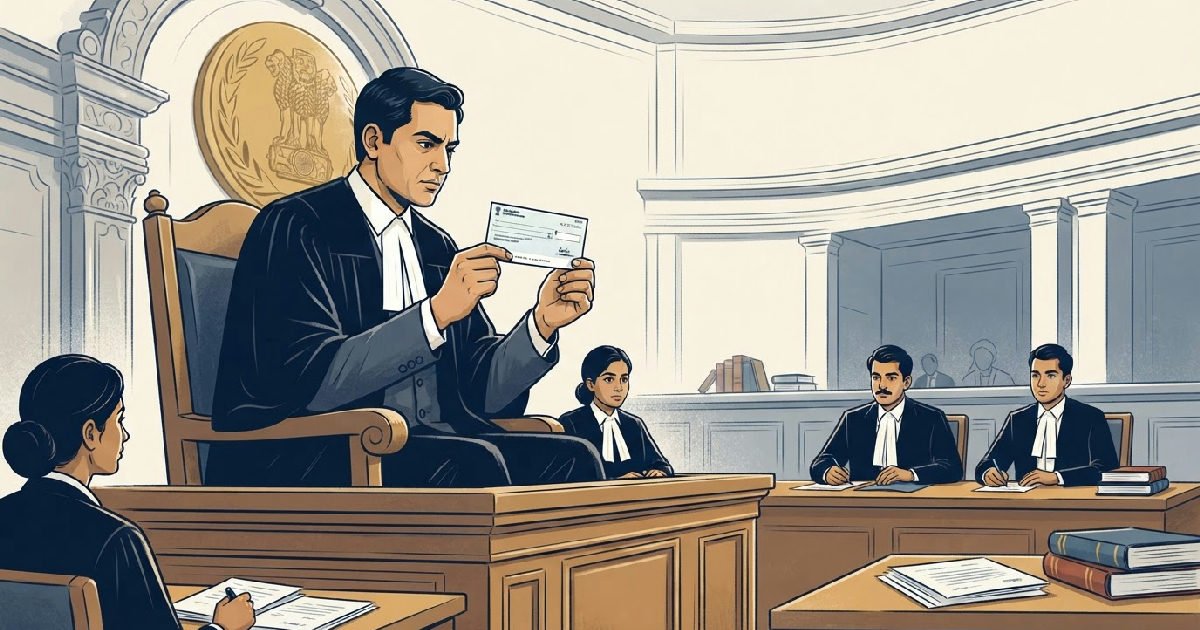
The Allahabad High Court has provided crucial clarity on cheque dishonour cases, specifically distinguishing between security cheques and those issued for Equated Monthly Instalments (EMI), under Section 138 of the Negotiable Instruments Act, 1881.
This distinction hinges on whether a “legally enforceable debt or liability” existed at the precise moment the cheque was presented for encashment, a nuance that has significant ramifications for both lenders and borrowers across the capital.
EMI Cheques and One Security Cheque: security vs. debt discharge
The court’s pronouncements aim to resolve long-standing ambiguities, particularly in scenarios where cheques are issued as collateral but later presented for payment. The rulings underscore that simply labeling a cheque as “security” does not automatically shield its issuer from the penal provisions of the NI Act if it was ultimately intended to discharge a real, existing financial obligation.
At the heart of the Delhi High Court’s clarification lies the fundamental difference between various types of cheques. Lenders often receive post-dated cheques, some explicitly marked as “security” to guarantee future payments or contractual performance. Others are specifically for debt repayment, such as EMI instalments.
The court, notably in the case of Suresh Chandra Goyal Petitioner v. Amit Singhal on May 14, 2015, established that cheques issued to settle an existing debt are very much subject to Section 138. This holds true even if they are colloquially referred to as “security cheques.” The critical factor is the underlying debt at the time of presentation.
When Security Cheques Become Actionable
A cheque provided purely as a security instrument, not intended for immediate deposit or encashment and merely to be shown to a banker, generally won’t attract Section 138 liability if dishonoured. This interpretation was reinforced by a more recent Delhi High Court ruling on December 02, 2025 (likely 2024 or 2023), which quashed complaints under such specific circumstances.
However, if the underlying obligation matures and becomes due, and the security cheque is then presented, it transforms into a cheque issued for a “legally enforceable liability.” This nuance ensures that borrowers cannot evade responsibility by merely labelling an instrument as security when a debt is clearly outstanding. A security cheque can certainly lead to a Section 138 case if the conditions are met.
The Pivotal Role of Legally Enforceable Debt
For any cheque bounce complaint under Section 138 of the NI Act to be valid, the cheque must have been issued to discharge, either partially or fully, a “legally enforceable debt or other liability.” This isn’t just a legal nicety; it’s the bedrock upon which these cases are built. Without this underlying debt, the penal provisions of the Act simply cannot apply.
The central question prosecutors and courts must address is whether such a liability existed on the date the cheque was presented for encashment. It’s not enough for a debt to have existed at the time the cheque was initially handed over; it must be valid and enforceable when the bank attempts to process the payment.
If, for instance, a contract was cancelled before the cheque was presented, the underlying transaction might have evaporated, rendering Section 138 inapplicable.
EMI Cheques: A Clearer Path to Liability
Post-dated cheques issued to cover EMI instalments for a loan represent a clear and unambiguous discharge of a legally enforceable debt. When such cheques are dishonoured, they almost invariably fall squarely within the ambit of Section 138.
The Delhi High Court has reiterated that partial EMI payments made before court proceedings do not automatically negate prosecution under this section, provided the debt was enforceable when the cheque was issued.
This provides a more straightforward path for lenders to pursue legal recourse against defaulters, reducing the ambiguity often associated with general “security” instruments. The consistent nature of EMI obligations simplifies the legal argument for an existing liability.
Mandatory Procedural Steps for Cheque Bounce Cases
Initiating a cheque bounce case under Section 138 of the NI Act requires strict adherence to specific timelines and legal notices. Any deviation from these prescribed steps can lead to the dismissal of the complaint, regardless of the merits of the underlying debt.
Upon receiving a ‘cheque return memo’ from the bank, indicating dishonour, the payee must issue a written legal demand notice to the drawer within 30 days. This notice formally demands payment of the cheque amount. The drawer then has a 15-day window from the date of receiving this notice to make the payment.
If payment remains outstanding after these 15 days, the payee gains another 30-day period to file a criminal complaint before the appropriate Magistrate. Missing any of these stringent deadlines can be fatal to the case, as highlighted in various legal precedents.
| Action Required | Deadline from Event | Consequence of Delay |
|---|---|---|
| Issue Legal Demand Notice | 30 days from Cheque Return Memo | Complaint dismissed |
| Drawer’s Payment Window | 15 days from Notice Receipt | Liability under Section 138 accrues |
| File Criminal Complaint | 30 days after Drawer’s Payment Window expires | Complaint dismissed |
Navigating Multiple Bounces and Notices
While a single complaint might cover multiple dishonoured cheques if they stem from the same transaction and are covered by a common statutory notice, each bounced cheque typically creates a distinct cause of action. The Supreme Court, in *Sumit Bansal v. M/s MGI Developers and Promoters & Anr.* on January 08, 2026, affirmed this principle.
This ruling overturned a prior Delhi High Court judgment that suggested parallel prosecution for the same liability was impermissible.
This means lenders must carefully track each dishonour event, noting the return memo date, and ensuring timely legal notices are issued for each. Deciding whether to combine or separate complaints then depends on the specific timelines and strategic considerations for enforcement. For multiple cheques bounced, understanding the distinct cause of action is vital.
Borrower Defences and the Presumption of Liability
A common defence employed by borrowers facing Section 138 complaints is that the cheque was issued purely as security and not for the discharge of a debt. However, the courts have consistently held that this defence alone is insufficient if a valid and legally enforceable debt existed at the time of the cheque’s presentation.
Section 139 of the NI Act establishes a statutory presumption: the cheque is presumed to have been issued in discharge of a legally enforceable liability. The burden then shifts to the accused to rebut this presumption.
This requires concrete evidence during trial, as an unsupported claim of issuing a blank security cheque will not typically suffice to overturn the statutory presumption. Defences must be robust, pointing to issues like the absence of an existing liability, cheque misuse, or defective legal notice.
Distinguishing Valid Defences
Borrowers can successfully defend a cheque bounce case if they can prove there was no legally enforceable debt when the cheque was presented. This could involve demonstrating that the underlying transaction was cancelled, that the cheque was misused contrary to agreed terms, or that a settlement was already made. Defective legal notices or evidence of forgery or coercion also constitute strong defences.
The Supreme Court of India, in *Sampelly Satyanarayana Rao v. Indian Renewable Energy Development Agency Ltd.*, clarified that even if a cheque is termed “security,” it represents a legally enforceable liability if a loan had been disbursed and instalments were due when the cheque was presented. Similarly, *Sripati Singh v.
State of Jharkhand* (referenced November 25, 2021) reinforced that a security cheque can attract Section 138 if it relates to a recoverable debt at the time of presentation. These rulings narrow the scope for simply claiming “security” as a blanket defence.
Penalties and Interim Compensation for Dishonoured Cheques
The consequences of a dishonoured cheque under Section 138 of the NI Act are significant and can include both financial penalties and imprisonment. This severity underscores the seriousness with which the Indian legal system views such financial defaults, aiming to instill confidence in commercial transactions.
A person convicted under Section 138 faces imprisonment for a term that can extend up to two years. Additionally, the court can impose a fine that may be up to twice the amount of the dishonoured cheque. In many cases, both imprisonment and a fine are levied.
Furthermore, under Section 143A, courts have the power to order interim compensation of up to 20% of the cheque amount during the pendency of the case, providing immediate relief to the payee. This provision aims to deter frivolous litigation and expedite resolution. Interim compensation is a crucial part of the legal process.
Implications for Financial Dealings in Delhi
These clarifications from the Delhi High Court and Supreme Court have significant implications for financial dealings across the region. Lenders now have a clearer framework for when to pursue Section 138 cases, particularly concerning EMI cheques and security instruments where an underlying debt has crystallised. This should encourage more rigorous documentation and clear agreements regarding the purpose of each cheque exchanged.
For borrowers, the rulings serve as a stark reminder that cheques, even those initially given as security, carry substantial legal weight once a debt becomes due. Understanding these distinctions is paramount to avoiding severe penalties. It also highlights the need for meticulous record-keeping and clear communication to avoid potential legal entanglements stemming from cheque dishonour.
What is the key difference between an EMI cheque and a security cheque under Section 138 NI Act?
The key difference lies in the presence of a “legally enforceable debt” at the time of presentation. EMI cheques are directly issued for existing debt instalments, making their dishonour almost always actionable. Security cheques, initially collateral, only attract Section 138 if the underlying debt they secure becomes due and payable when presented.
Can I combine multiple bounced cheques into a single legal notice?
While a single complaint might be maintainable for multiple dishonoured cheques if they originate from the same transaction and are covered by a common statutory notice, the Supreme Court has affirmed that each bounced cheque generally gives rise to a distinct cause of action. Lenders are advised to carefully track each cheque’s dishonour event and notice deadlines.
What are the typical penalties for a cheque bounce under Section 138?
Penalties for cheque bounce under Section 138 of the NI Act can include imprisonment for up to two years, a fine up to twice the cheque amount, or both. Courts may also order interim compensation of up to 20% of the cheque amount to the payee during the legal proceedings.
More than one cheque in a loan file, and one has bounced? Call or Whatsapp for consultation.
Related: https://arpitmarwah.com/cheque-bounce-lawyers-in-delhi/