
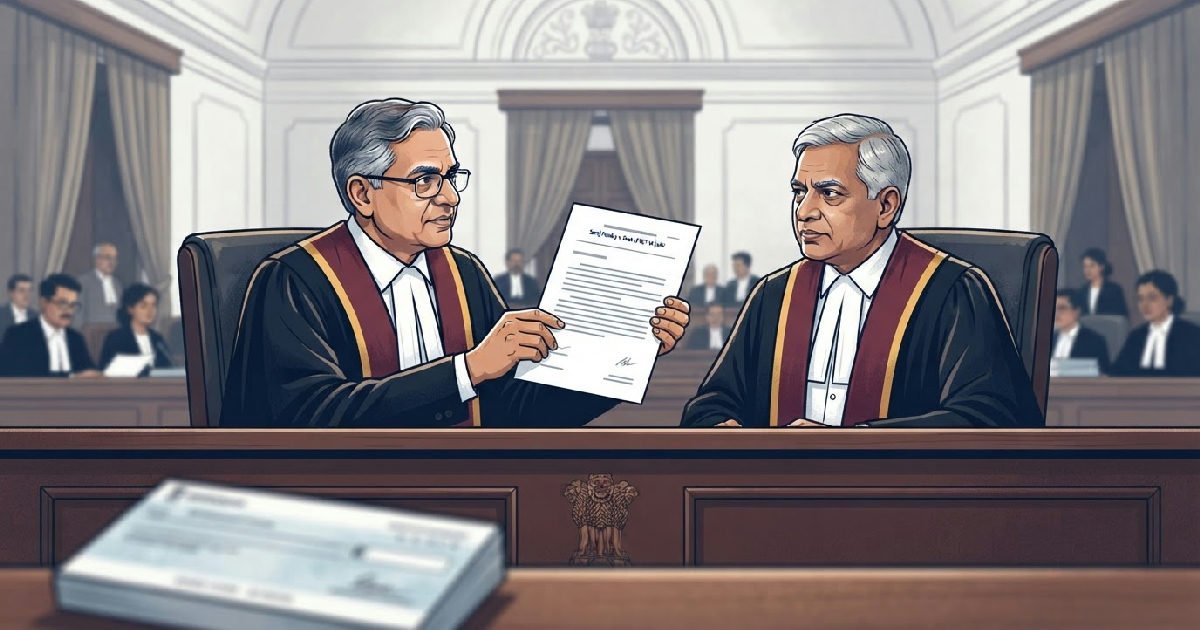
The Supreme Court of India delivered a significant ruling on April 9, 2026, clarifying the conditions under which a company director can be held criminally liable for cheque dishonour. In the case of Saroj Pandey v.
Govt of NCT of Delhi, the bench of Justice Sanjay Karol and Justice Augustine George Masih held that merely signing a Board Resolution does not automatically establish a director’s involvement in the day-to-day affairs of a company.
Clarifying director liability for cheque dishonour
This decision means such an act alone cannot justify prosecution under Section 138 of the Negotiable Instruments Act, 1881.
This pivotal judgment quashed criminal proceedings against a director, underscoring the necessity for specific allegations to prove direct responsibility. The Court reiterated that vicarious liability under Section 141 of the NI Act isn’t automatic for directors. Prosecutors must now explicitly demonstrate a director was “in charge of and responsible for the conduct of business” at the time of the alleged offense.
The Supreme Court’s recent pronouncement strengthens safeguards for directors against undue prosecution in cheque dishonour cases. It emphasizes a strict interpretation of the legal framework surrounding corporate criminal liability. The ruling ensures that liability is tied to active involvement, rather than a mere titular position.
This decision is particularly relevant for non-executive and independent directors. They often participate in strategic decision-making but are not typically involved in routine operational management. The verdict aims to protect these directors from being indiscriminately caught in legal battles concerning company finances.
The Saroj Pandey judgment specifics
In Saroj Pandey v. Govt of NCT of Delhi, the Court meticulously examined the legal basis for holding a director liable under the Negotiable Instruments Act. The core issue revolved around whether a director’s signature on a Board Resolution was sufficient evidence of their operational control. Justices Sanjay Karol and Augustine George Masih emphatically ruled it was not.
“Signing of a Board Resolution does not establish that a director was in charge of the company’s day-to-day affairs,” the bench stated. Board resolutions usually cover policy decisions, major corporate actions, or strategic matters. They don’t imply detailed knowledge or participation in daily transactions or routine business operations.
This means that for a complaint to succeed, specific pleadings are essential. It must clearly demonstrate how the accused director was, in fact, responsible for the company’s business conduct at the relevant time. This goes beyond just being a signatory to a single corporate document.
Navigating Sections 138, 141, and 142 of the NI Act
Understanding the interplay of these sections is crucial for grasping the significance of this judgment. Section 138 of the Negotiable Instruments Act criminalises the dishonour of cheques when issued for a legally enforceable debt. This provision ensures the sanctity of financial instruments in commercial transactions.
Section 141 then extends this criminal liability to companies and their officers. It specifies that every person who was in charge of, and responsible for, the conduct of the company’s business at the time of the offense shall be deemed guilty. This vicarious liability provision has been a frequent point of contention in courts.
Finally, Section 142 outlines the procedural requirements for a court to take cognizance of an offense under Section 138. It mandates a written complaint by the payee or holder in due course, typically within one month of the cause of action. These sections together form the backbone of cheque dishonour jurisprudence in India.
Historical judicial precedents on director accountability
The Supreme Court has consistently worked to refine the scope of vicarious liability for directors under the NI Act. This latest ruling builds on a series of landmark judgments over the past two decades. These earlier decisions aimed to strike a balance between holding individuals accountable and preventing the harassment of directors who have no direct operational control.
One foundational case was S.M.S. Pharmaceuticals Ltd. v. Neeta Bhalla (2005). Here, the Court established that a complaint must specifically aver that the accused was “in charge of and responsible for the conduct of the company’s business.” Mere designation as a director isn’t enough to trigger liability, a principle reiterated in the current judgment.
The principle was further cemented in Aneeta Hada v. Godfather Travels & Tours Pvt. Ltd. (2012). This case clarified that for vicarious liability to be established, the company as an accused must also be named in the complaint. Without the company as a primary accused, proceedings against directors alone are generally not maintainable.
More recently, K.S. Mehta v. M/S Morgan Securities and Credits Pvt. Ltd. (March 4, 2025) reinforced that non-executive and independent directors cannot be held liable without specific evidence of their involvement in financial decisions. This highlights the ongoing judicial effort to differentiate responsibilities.
Evolution of director liability under NI Act
The legal landscape for director liability has seen considerable evolution, moving away from a broad interpretation to a more nuanced one. Early complaints often included all directors without specifying their roles or involvement. This led to many directors facing criminal proceedings unfairly.
The judiciary has progressively tightened the requirements for initiating such proceedings. They now demand a clear link between the director’s role and the specific offense. This reflects a recognition of the diverse functions directors perform within a company structure.
For example, Hitesh Verma v. M/s Health Care at Home India Pvt. Ltd. (February 18, 2025) emphasized “twin conditions” under Section 141 of the NI Act. It stated that a director must be both “in charge of” the company and “responsible to the company” for the business conduct. Both aspects need to be explicitly pleaded.
| Case Name | Year | Key Principle Clarified | Impact on Director Liability |
|---|---|---|---|
| S.M.S. Pharmaceuticals Ltd. v. Neeta Bhalla | 2005 | Specific averments for liability | Mere designation insufficient |
| Aneeta Hada v. Godfather Travels & Tours Pvt. Ltd. | 2012 | Company must be an accused | Protects individual directors if company omitted |
| Hitesh Verma v. M/s Health Care at Home India Pvt. Ltd. | 2025 | “Twin conditions” for Section 141 | Requires explicit pleading of responsibility and control |
| K.S. Mehta v. M/S Morgan Securities and Credits Pvt. Ltd. | 2025 | Non-Executive Directors require specific involvement | Shields non-operational directors from vicarious liability |
| Saroj Pandey v. Govt of NCT of Delhi | 2026 | Signing Board Resolution not proof of day-to-day affairs | Further limits automatic liability for policy-level involvement |
Differentiating director roles and responsibilities
The Court’s distinctions between types of directors are becoming increasingly important in criminal law. Not all directors have the same level of involvement in a company’s daily operations. This has significant ramifications for their potential liability under statutes like the NI Act.
Managing Directors and Whole-time Directors, by the very nature of their roles, are generally presumed to be involved in the daily running of the business. Their liability often follows from their designated responsibilities. Detailed allegations regarding their daily involvement might not always be required in a complaint.
In contrast, Non-Executive and Independent Directors serve primarily for oversight and strategic guidance. They usually don’t participate in the company’s routine business operations or financial transactions. Therefore, establishing their vicarious liability requires far more specific allegations directly linking them to the alleged offense.
Impact on corporate governance practices
This ruling reinforces the importance of clear demarcation of duties and responsibilities within corporate boards. Companies will likely review their internal governance structures and board minutes more carefully. They’ll ensure that the roles of various directors are well-documented and reflect their actual involvement.
It also encourages a more robust system of due diligence for directors, particularly non-executive ones. They need to be aware of their specific responsibilities and ensure they are not inadvertently exposed to criminal liability for actions they didn’t control. This could lead to clearer guidelines for board members on their legal duties.
Implications for criminal proceedings
For individuals and entities pursuing cheque dishonour cases, this judgment presents a higher bar. Complainants can no longer rely on a director’s mere association with a company or their signature on a broad resolution. They must gather concrete evidence of the director’s active role in the specific transaction that led to the cheque’s dishonour.
This shift will likely reduce the number of frivolous complaints against directors. It will also streamline the judicial process by focusing on genuinely culpable individuals. The courts aim to prevent the misuse of the NI Act as a tool for recovery against all directors indiscriminately.
Legal practitioners will need to adapt their strategies for both prosecution and defence. Prosecutors must conduct more thorough investigations to establish the specific involvement of directors. Defence lawyers will find stronger grounds to challenge complaints lacking detailed averments about a director’s day-to-day role.
Ongoing legal questions and broader outlook
While this ruling provides significant clarity, other complex questions related to the NI Act continue to be debated. For instance, the Supreme Court has referred to a larger bench the issue of whether cheque bounce proceedings can be stayed during the moratorium period under the Insolvency and Bankruptcy Code (IBC). This question highlights the intersection of different legal frameworks.
Separately, a ruling from April 27, 2026, by the Supreme Court upheld a Bombay High Court order, stating that directors remain liable under Section 138 of the NI Act even if the company’s debt is resolved under the IBC. This indicates a continuing effort to hold individuals accountable, even as corporate entities navigate insolvency.
The evolving jurisprudence aims to foster a more nuanced understanding of corporate criminal liability. It seeks to ensure that the NI Act remains an effective deterrent against cheque dishonour without becoming an overly punitive instrument against directors who are not directly responsible for the offense. This will help maintain trust in financial transactions while upholding principles of natural justice.
What does the recent Supreme Court ruling mean for company directors?
The Supreme Court ruled that merely signing a Board Resolution does not automatically mean a director was involved in the company’s daily affairs. This means such a signature alone isn’t enough to prosecute them for cheque dishonour under the Negotiable Instruments Act.
Why is this distinction between executive and non-executive directors important?
Executive directors are usually involved in day-to-day operations, making them more likely to be liable. Non-executive or independent directors, however, primarily provide oversight. This ruling helps protect them from liability unless specific involvement in the offense is proven, reflecting their distinct roles.
How does this judgment affect future cheque dishonour complaints?
Complainants now need to provide specific allegations and evidence that a director was actively responsible for the company’s business operations at the time of the offense. Simply listing a director’s name or pointing to a board resolution will no longer be sufficient for prosecution in compoundable cheque bounce cases.