
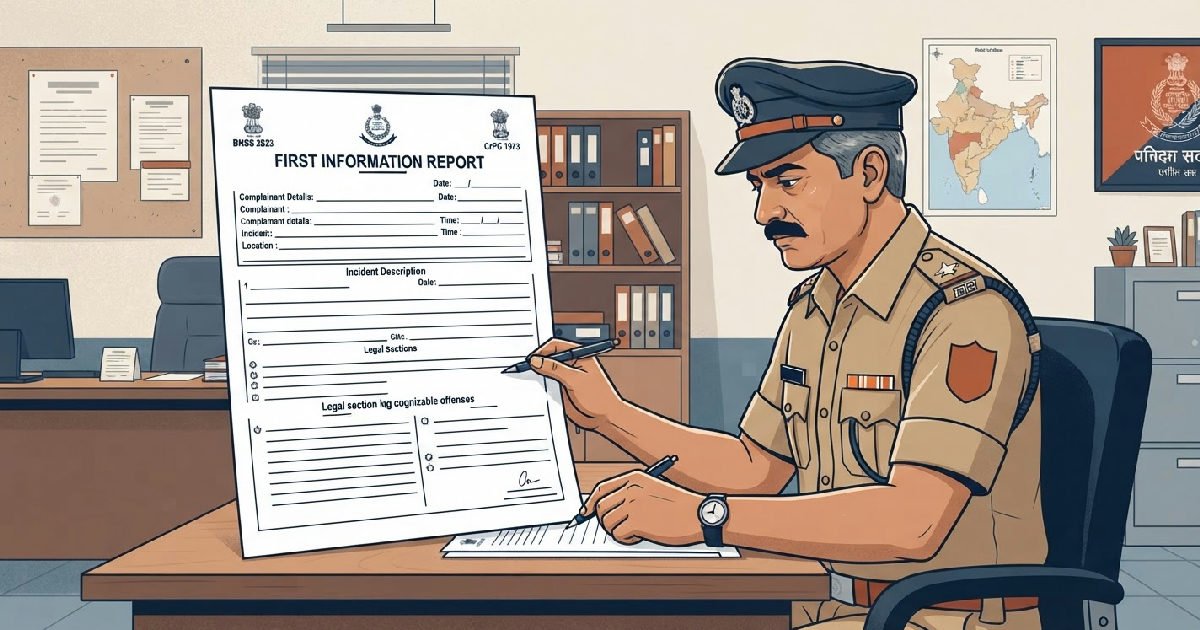
A First Information Report (FIR) stands as the foundational document in the criminal justice systems of nations like India, Bangladesh, and Pakistan. It marks the initial record of a cognizable offense, triggering the entire investigative process. Understanding the correct FIR format is crucial for anyone needing to report a serious crime, ensuring all necessary details are accurately captured from the outset.
This formal written document is meticulously prepared by the police upon receiving information about such an offense. Its precision directly impacts the subsequent investigation, making a clear and factual submission paramount for justice to proceed effectively.
Filing Your Complaint: What the Correct FIR Format Requires
When lodging a complaint that necessitates an FIR, the information provided must be specific and exhaustive. A well-structured FIR avoids ambiguity, steering clear of guesses, emotional language, or exaggerated claims. It focuses instead on objective facts, ensuring law enforcement has a solid basis for their inquiry.
The legal framework for criminal procedure in India has seen a significant transition. The Code of Criminal Procedure (CrPC), 1973, was replaced by the Bharatiya Nagarik Suraksha Sanhita (BNSS), 2023, effective July 1, 2024. Consequently, FIRs are now governed under Chapter 13, Section 173 onwards of the BNSS, replacing the previous Section 154 of the CrPC.
Key Information for a First Information Report
An accurate FIR is the bedrock of a successful criminal investigation. It demands precise details across several categories to ensure thoroughness. Omitting critical facts can hinder the investigative process from the start.
| Category | Essential Information to Include |
|---|---|
| Complainant/Informant Details | Name, address, contact information, Father’s/Husband’s Name, ID Proof (e.g., Aadhaar, Driving License) |
| Incident Details | Date and time of occurrence, exact place/location, nearby landmarks, police station jurisdiction, distance/direction from station |
| Description of the Offense | Brief and accurate narration of facts, nature of offense, actions of accused, number of people involved and their roles |
| Accused Details (if known) | Name(s) and description(s) of perpetrator(s), relation between perpetrator and informant (if any) |
| Witness Details (if available) | Names and contact details of any witnesses |
| Supporting Evidence (if available) | Photos, videos, screenshots, documents, medical reports, bank transaction details, call records, description of property involved, description of injuries |
| Legal Provisions | Enough detail in complaint for police to determine relevant legal sections (e.g., IPC/BNSS sections) |
| Signatures | Signature/Thumb Impression of Complainant/Informant, Signature of Police Officer recording the FIR |
Complainant and Incident Specifics
The initial sections of any FIR demand precise details about the complainant and the incident itself. This includes the full name, address, and contact information, along with the father’s or husband’s name. An ID proof, such as an Aadhaar or Driving License, is also essential for verification.
Equally vital are the specifics of the incident: the exact date and time of occurrence, the precise location including any nearby landmarks, and confirmation of the police station’s jurisdiction. Knowing the distance and direction from the police station can also prove beneficial for investigative purposes.
Describing the Offense and Accused
A concise and accurate narration of the incident is paramount, detailing precisely what transpired. This section should clearly state the nature of the offense, whether it be murder, theft, rape, or kidnapping. It must also outline the actions of the accused that constitute the crime, including the number of individuals involved and their respective roles, if known.
Should the perpetrator(s) be identifiable, their names and descriptions must be provided. Any known relationship between the informant and the accused can also offer critical context for the police investigation. This level of detail helps officers understand the dynamics of the reported crime.
Evidence and Witness Inclusion
Mentioning any available supporting evidence significantly strengthens an FIR. This can encompass physical evidence like photos, videos, screenshots, or pertinent documents. Medical reports become crucial in cases involving assault or injury, while bank transaction details or call records can be vital in financial or communication-based crimes.
A clear description of any property involved, such as stolen goods or weapons, is also required. If there were injuries, their nature and extent should be detailed. Furthermore, the names and contact details of any witnesses can provide corroborating accounts, aiding the police in their inquiry into the incident.
Navigating the FIR Filing Process
The mechanical process of filing an FIR is designed to be accessible, though it requires specific steps to ensure formal registration. Initially, the person reporting the crime should approach the nearest police station, ideally one within the jurisdiction where the offense took place. This ensures prompt handling by the relevant authorities.
Once at the station, the complainant must share all pertinent facts about the incident, covering the “when, where, and how” of the crime, alongside details about those involved. This information can be conveyed orally, in writing, or via electronic communication, offering flexibility in reporting methods. A step-by-step guide can help clarify the process further.
If the information is given orally, the police officer on duty is obligated to record it accurately. The officer must then read the written statement back to the complainant for verification, ensuring it perfectly matches the informant’s account.
The complainant should carefully read the recorded FIR to ensure it is correct and complete before signing it. Refusal to sign an FIR by the informant is punishable under Section 180 of the IPC but does not void the report.
Police must provide a free copy of the registered FIR, and an FIR number is assigned, making the case an official investigation.
It’s worth noting that the law is inclusive regarding who can file an FIR. It’s not necessary for the person filing to be the victim or an eyewitness; any individual with knowledge of a cognizable offense can lodge one.
This broad allowance ensures that serious crimes can be reported and investigated promptly, regardless of who initially becomes aware of them. The importance of an FIR in India’s justice system cannot be overstated, as it formally initiates the investigative process.
What is a First Information Report (FIR)?
A First Information Report (FIR) is a formal written document prepared by the police upon receiving information about a cognizable offense. It is the initial step that triggers a criminal investigation in countries like India, Bangladesh, and Pakistan.
What essential details are required when filing an FIR?
When filing an FIR, you must provide specific and detailed information. This includes your name, address, and contact information, the date and time of the incident, its exact location, a description of the offense, details of the accused if known, and any available witness information or supporting evidence.
Who can file a First Information Report (FIR)?
Anyone with knowledge of a cognizable offense can lodge an FIR. The law is inclusive, meaning it is not necessary for the person filing the report to be the victim or an eyewitness to the crime.