
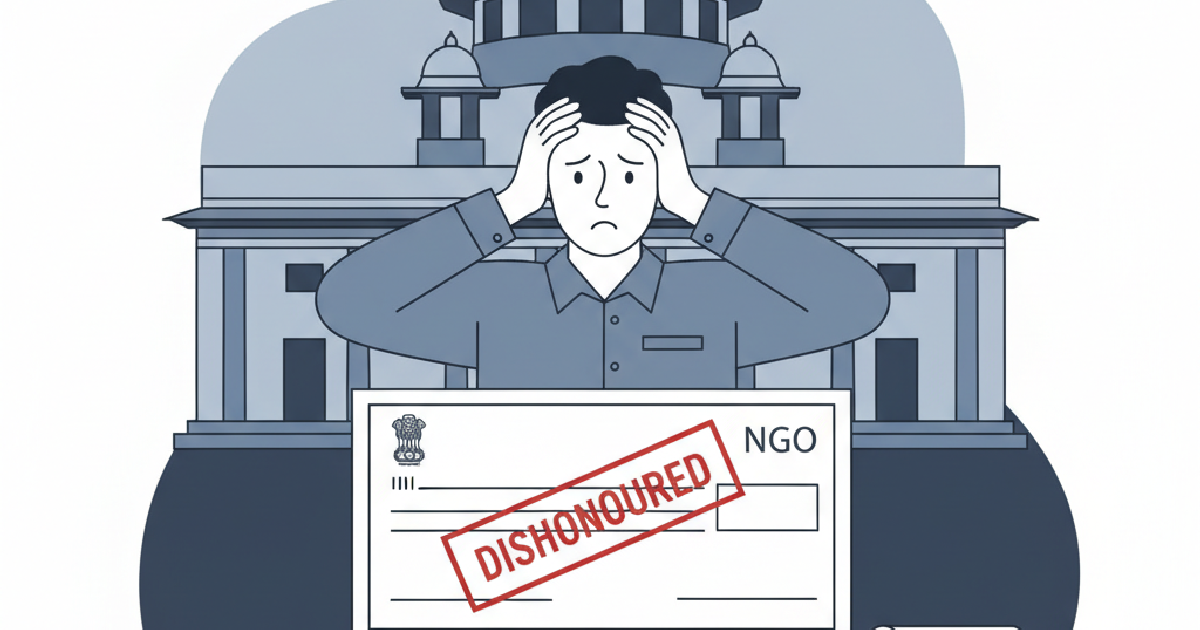
A cheque dishonour case involving an NGO treasurer highlights the critical intersection of personal liability and organizational financial management under Indian law. In recent proceedings, the Supreme Court of India clarified that while a Non-Governmental Organization (NGO) is a separate entity, the individuals who act as its “front face”—specifically the authorized signatories—cannot escape criminal prosecution when a cheque bounces.
The treasurer, as an office-bearer responsible for managing bank accounts and ensuring financial compliance, typically holds what the courts describe as plenary control. When an NGO issues a cheque signed by such an official that is subsequently returned by a bank, the signatory bears direct responsibility under the Negotiable Instruments Act, 1881.
Supreme Court reaffirms personal liability for NGO treasurers
A significant ruling by the Supreme Court of India in K. Ranganayakulu v. State of Telangana & Ors. (2026 INSC 555) has reinforced the stance on individual accountability in cheque dishonour cases involving non-governmental organizations. Justices Prashant Kumar Mishra and N.V. Anjaria affirmed that an authorized signatory, such as an NGO treasurer, can indeed be held criminally liable under Section 138 of the Negotiable Instruments Act, 1881.
This ruling specifically applies if the signatory effectively acts as the organization’s “front face” and is empowered by an agreement, such as a Memorandum of Understanding (MOU), to control financial transactions. The Court was unequivocal, stating that such individuals cannot “hide behind an administrative title” when a cheque bounces. This closes a potential loophole where individuals might have tried to deflect responsibility onto the organization itself.
Understanding the implications of the K. Ranganayakulu ruling
The Supreme Court’s decision means that the level of control and authority vested in an NGO treasurer or other authorized signatory is paramount. If an individual has significant power over an NGO’s financial dealings, they must exercise that power responsibly. This judgment serves as a strong reminder that holding an administrative title comes with serious legal duties.
It also underscores the importance of clear demarcation of financial responsibilities within NGOs. Organizations should review their MOUs and internal financial control documents. This ensures that the roles and liabilities of signatories are well-defined and understood by all parties.
The mechanics of cheque dishonour cases in India
In India, the dishonour of a cheque due to insufficient funds is not merely a civil matter; it carries criminal implications under Section 138 of the Negotiable Instruments Act, 1881. This specific legislation aims to instill confidence in financial transactions by providing a strong legal deterrent against issuing cheques without proper backing.
The process begins when a cheque, presented within its three-month validity period, is returned unpaid by the bank. The bank then issues a “Cheque Return Memo” to the payee, detailing the reason for the non-payment. This document is crucial for initiating further legal steps.
Navigating the legal process after a bounced cheque
Once a cheque is dishonoured, the payee must act swiftly. They need to send a legal demand notice, in writing, to the drawer of the cheque within 30 days of receiving the Cheque Return Memo. This notice formally requests payment of the cheque amount, giving the drawer a specific window to rectify the situation.
The drawer then has 15 days from the receipt of this legal notice to make the payment. Failing to do so within this period completes the offense under Section 138. At this point, the payee can proceed with formal legal action, filing a criminal complaint.
Filing a criminal complaint in magistrate court
A criminal complaint must be filed before a Metropolitan Magistrate or Judicial Magistrate within 30 days of the expiry of the 15-day notice period. This complaint needs to meet specific criteria. It must show that the cheque was for a legally enforceable debt, presented within its validity, and dishonoured due to insufficient funds.
Crucially, it must also demonstrate that the drawer failed to pay even after receiving the legal demand notice. These steps are vital for the court to take cognizance of the offense and proceed with the case. The Delhi High Court has clarified that a specific demand of the cheque amount is mandatory for a valid notice under Section 138 of the Negotiable Instruments Act.
Potential penalties for cheque dishonour
If found guilty in a cheque dishonour case, the consequences for the drawer can be significant. The Negotiable Instruments Act, 1881, prescribes penalties that include both imprisonment and monetary fines. This dual approach emphasizes the seriousness with which such financial transgressions are viewed.
An individual convicted under Section 138 may face imprisonment for a term of up to two years. Additionally, a fine can be imposed, which may extend to twice the amount of the cheque. In some cases, courts may opt for both imprisonment and a fine, depending on the specifics and severity of the offense.
Interim compensation and other considerations
The law also provides for interim compensation to the complainant. Under Section 143A of the NI Act, inserted in 2018, a Magistrate can direct the accused to pay up to 20% of the cheque amount as interim compensation within 60 days if they plead not guilty. This provision offers some immediate relief to the payee and incentivizes early resolution.
While the offense is bailable, meaning the accused can be released on bail during the trial, the potential for imprisonment serves as a strong deterrent. The judicial system prioritizes financial restitution, often imposing substantial fines to compensate the wronged party.
Defining the role of an NGO treasurer
The treasurer of a Non-Governmental Organization plays a pivotal role in its operations, acting as the primary guardian of its financial health. This office-bearer is entrusted with significant responsibilities that go beyond mere record-keeping. They are central to maintaining the financial integrity and public trust placed in an NGO, which typically relies on donations and grants.
Their duties involve overseeing bank accounts, ensuring meticulous record-keeping of all transactions, and preparing and adhering to budgets. A critical aspect of their role is advising the board on financial strategy and ensuring compliance with financial regulations and internal controls. This level of control often makes them the focal point for any financial discrepancies.
The “drawer” and “payee” in NGO contexts
In a cheque transaction, the drawer is the person or entity who writes and signs the cheque, while the payee is the person or entity to whom the cheque is made payable. In an NGO context, the NGO itself is the primary drawer, but the treasurer or another authorized signatory acts on its behalf.
The distinction becomes crucial in cheque dishonour cases, as the law focuses on the individual responsible for signing the instrument. The payee, typically a vendor, service provider, or beneficiary, expects the cheque to be honored and suffers direct consequences when it is not.
Common reasons for cheque dishonour
Cheque dishonour, often colloquially termed a “cheque bounce,” occurs when a bank refuses to process a cheque presented for payment. This can happen for several reasons, leading to financial inconvenience and potential legal ramifications for the cheque issuer. Understanding these reasons is crucial for both those issuing and receiving cheques to avoid legal complications.
The most frequent cause for a cheque bouncing is insufficient funds. This happens when the drawer’s account simply doesn’t have enough money to cover the amount written on the cheque. But it’s not the only reason. Other issues can also lead to a cheque being returned unpaid by the bank.
| Reason for Dishonour | Description | Potential Impact |
|---|---|---|
| Insufficient Funds | Account lacks adequate money to cover the cheque amount. | Most common cause, leads directly to Section 138 action. |
| Signature Mismatch | Signature on cheque does not match bank’s specimen. | Can be rectified, but payee may suffer delays. |
| Post-Dated Cheque | Presented for payment before the date written on it. | Bank will reject; must be presented on or after the date. |
| Stale Cheque | Presented after its validity period (usually 3 months). | No payment; payee loses payment opportunity. |
| Account Closed | Drawer’s bank account has been closed. | Strong indicator of deliberate non-payment or negligence. |
| Stop Payment Instruction | Drawer instructed bank to halt payment. | Legal ramifications for drawer if debt is valid. |
| Material Alterations/Errors | Overwriting, corrections, missing details. | Cheque is invalid; bank will refuse to process. |
Avoiding dishonoured cheques
To avoid the legal complexities and penalties associated with cheque dishonour, individuals and organizations must maintain diligent financial practices. For NGOs, this means regular reconciliation of accounts and robust internal control mechanisms. Treasurers should ensure that sufficient funds are always available in the account before issuing any cheque.
It’s also crucial to double-check all details on a cheque before signing, including the date, amount in words and figures, and payee name. Any discrepancies or alterations can lead to the cheque being returned. Ensuring that signatures match bank records is also a simple yet critical step in preventing dishonour due to technicalities. Even in cases of potential dispute, a photocopy can be admissible as secondary evidence, as clarified by the Madras High Court.
The Negotiable Instruments Act, 1881
The Negotiable Instruments Act, 1881, stands as a cornerstone of commercial law in India. It predates many modern financial instruments but remains highly relevant in regulating transactions involving promissory notes, bills of exchange, and crucially, cheques. Chapter XVII, specifically Sections 138 to 148, was later added to address the growing issue of cheque dishonour, transforming it from a civil dispute into a criminal offense when due to insufficient funds.
Before these amendments, cheque dishonour was primarily a civil matter, often leading to protracted recovery suits. The introduction of Section 138 provided a more potent legal recourse for payees, aiming to strengthen trust in cheque transactions. This legislative move reflected a broader intent to ensure financial discipline and protect against fraudulent practices.
Impact of the Act on financial discipline
The criminalization of cheque dishonour has had a profound impact on financial discipline within India. It places a significant burden on the drawer to ensure the availability of funds. This legislative framework encourages responsible financial management, particularly for entities like NGOs that handle public or donor funds.
For treasurers and other authorized signatories of NGOs, understanding the nuances of this Act is not just an organizational best practice but a personal legal imperative. Their signatures carry the weight of potential criminal liability, underscoring the importance of their role in financial governance. The Supreme Court has upheld the applicability of cheque bounce cases under Section 138 for cash loans exceeding ₹20,000.
Frequently Asked Questions
What is a cheque dishonour case?
A cheque dishonour case arises when a bank refuses to pay a cheque presented to it, usually because the account lacks sufficient funds. Legal action can then be initiated under Section 138 of India’s Negotiable Instruments Act, 1881.
Can an NGO treasurer avoid liability by resigning?
No, resignation typically does not absolve a treasurer of liability for cheques signed and issued during their tenure. Liability under Section 138 focuses on the individual responsible for the cheque at the time of its issuance.
What is the maximum penalty for cheque dishonour in India?
The maximum penalty for cheque dishonour under Section 138 includes imprisonment for up to two years, a fine up to twice the cheque amount, or both. The offense is bailable.