
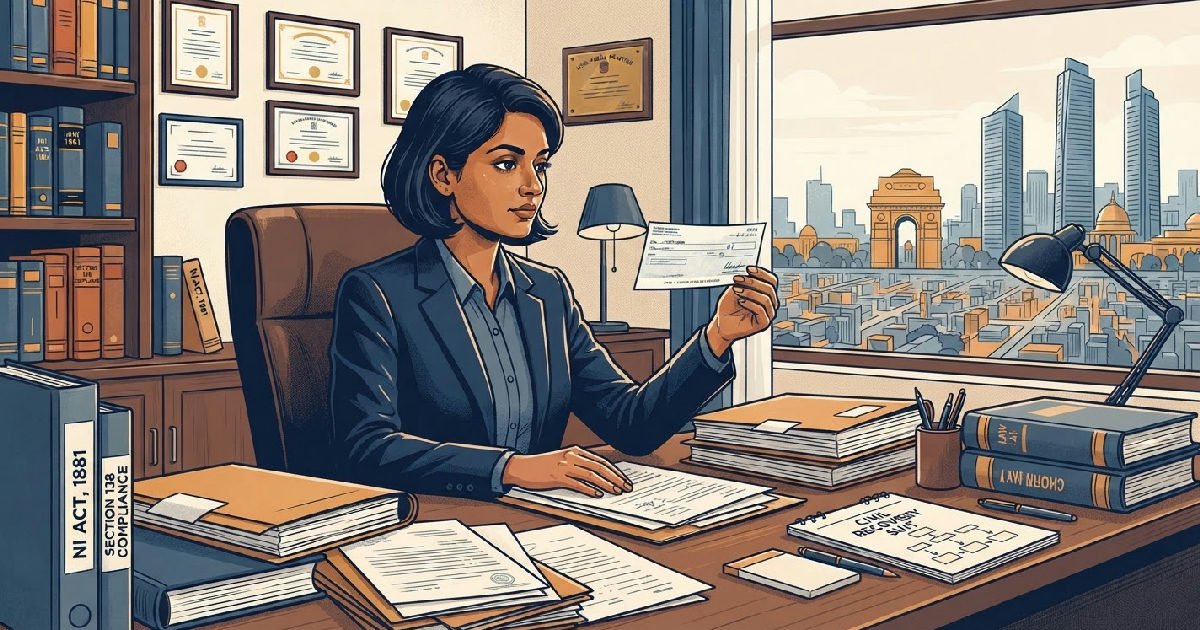
Individuals and businesses in Delhi grappling with dishonoured cheques often seek best cheque bounce lawyer in Delhi to navigate the intricate legal landscape. Success or failure in these cases under the Negotiable Instruments Act, 1881 (NI Act) frequently hinges on meticulous preparation. This critical groundwork must be completed long before any formal complaint reaches a Metropolitan Magistrate court.
The preliminary phase, whether initiating a complaint or mounting a defence, is where seasoned legal professionals earn their stripes. They conduct exhaustive due diligence, ensuring every procedural requirement and statutory timeline is met. Failing to undertake these stringent checks can invalidate an otherwise legitimate claim or defence, leading to costly and time-consuming setbacks.
Best Cheque Bounce Lawyer for legal standards
The legal framework for cheque dishonour in India is primarily governed by Section 138 of the Negotiable Instruments Act, 1881. This provision establishes criminal liability for the drawer of a cheque that bounces due to insufficient funds or similar reasons. But the application of this law demands precise adherence to its stipulations.
A thorough legal practitioner will meticulously examine every facet of the case against the strictures of the NI Act. This proactive approach helps prevent procedural missteps that could undermine the entire legal action. Without such careful vetting, even strong claims can fall apart on technicalities in court.
Establishing a Legally Enforceable Debt
A fundamental prerequisite for any Section 138 complaint is the existence of a “legally enforceable debt or other liability.” This debt forms the very foundation of criminal culpability under the Act. It typically encompasses loan repayments, payments for goods or services, or outstanding business invoices.
Cheques issued as mere gifts, donations, or solely as security without a clear, due amount might not attract Section 138. The onus rests squarely on the complainant to demonstrate this foundational element. Failure to establish a clear, enforceable debt can lead to the complaint’s dismissal.
The Supreme Court has clarified that this “debt or other liability” can even arise after the cheque’s issuance but before its presentation for encashment. Furthermore, even cash loans exceeding ₹20,000, which breach Section 269SS of the Income Tax Act, can still constitute a legally enforceable debt for NI Act purposes.
While such a transaction might incur an income tax penalty, it doesn’t automatically negate the debt’s validity under Section 138.
Prudent Steps for Complainants: Navigating Timelines and Notices
For those seeking redress for a dishonoured cheque, a rigorous adherence to procedural timelines is non-negotiable. Any deviation from these stipulated periods can prove fatal to a case, rendering it time-barred. This precision begins the moment a cheque is presented for payment.
The cheque must be presented to the bank within its validity period, typically three months from the date of issue. Upon its dishonour, the bank will issue a ‘cheque return memo’ detailing the reason for the bounce. This memo’s date triggers a chain of critical legal deadlines.
Strict Adherence to Timelines
Upon receiving the bank’s dishonour memo, the complainant must issue a written legal demand notice to the drawer within 30 days. This notice demands payment of the cheque amount. Missing this specific 30-day window can effectively extinguish the right to prosecute under Section 138.
The drawer then has a 15-day period from the date of receiving this notice to make the payment. If payment isn’t made within this specific timeframe, a criminal complaint under Section 138 must be filed. This filing must occur within 30 days after the expiry of the 15-day notice period. These stringent rules highlight the need for a meticulous approach to notice deadlines.
The maximum outer window from the return memo to the complaint filing date is a tight 75 days. Any complaint filed prematurely, during the 15-day grace period for the drawer to pay, will be deemed invalid and subsequently thrown out by the courts.
Crafting a Valid Legal Demand Notice
The legal demand notice itself must be meticulously drafted and delivered. It must be in writing; verbal notifications carry no legal weight in these proceedings. The notice should detail the cheque number, its date, and the exact amount.
Crucially, it must also include the bank details and the precise reason for dishonour as stated in the bank’s return memo. A clear demand for payment of the cheque amount within 15 days of receiving the notice is essential. The notice must explicitly warn of criminal action under Section 138 if payment isn’t received.
Proper service of this notice is equally vital. It should be sent via Registered Post or Speed Post, and the acknowledgment receipt must be preserved as proof of delivery. Sole reliance on a WhatsApp PDF, for instance, does not constitute a statutory notice under the Act.
Jurisdictional Clarity for Delhi Courts
In Delhi, cheque bounce cases are heard by Metropolitan Magistrate courts located within various district court complexes. Correct jurisdiction is not a matter of convenience; it’s a legal requirement. The complaint must be filed in the court that has local jurisdiction over the bank branch where the payee presented the cheque for payment.
This jurisdictional clarification was solidified by the Negotiable Instruments (Amendment) Act, 2015, which came into effect retrospectively on June 15, 2015. Prominent Delhi courts include Tis Hazari, Saket, Rohini, Dwarka, Karkardooma, and Patiala House. An informed cheque bounce lawyer in Delhi will always confirm the appropriate court.
Establishing Liability: Corporations and Directors
When a cheque originating from a company account is dishonoured, determining who is legally liable can become complex. Typically, the company itself is named as the principal drawer in the complaint. However, individual directors can also face criminal prosecution under specific circumstances.
Mere directorship is generally insufficient to establish personal liability. The complaint must contain specific and concrete allegations regarding the director’s role and direct involvement. This includes demonstrating they were “in charge of and responsible for the conduct of company business” at the time of the offence.
Corporate vs. Individual Responsibility
Directors who signed the dishonoured cheque, consented to the transaction leading to the cheque’s issuance, or were negligent in preventing the offence can be held personally liable. Non-executive and independent directors often enjoy protection unless clear involvement in financial operations is alleged.
An experienced legal professional understands the nuances of prosecuting or defending directors. They ensure that specific allegations are robustly supported by evidence, preventing cases from being dismissed for lack of specificity. Vague accusations against directors rarely stand up in court.
Directors’ Liability Amidst Insolvency Proceedings
The Supreme Court has unequivocally affirmed that company directors remain subject to criminal prosecution under Section 138 of the NI Act. This holds true even if the company undergoes debt resolution or liquidation processes under the Insolvency and Bankruptcy Code (IBC). The director’s personal liability is distinct from the company’s corporate insolvency. This stance highlights the importance of thorough director liability clarifications.
This ruling prevents directors from using insolvency proceedings as a shield against individual accountability for dishonoured cheques. It underscores the severity with which the law views such financial misconduct.
Mounting a Robust Defence Against Cheque Bounce Allegations
For those accused in a cheque bounce case, the immediate priority must be to engage with the legal process. Ignoring a legal notice or court summons is a grave error. This can lead to the issuance of warrants and even an ex-parte decision, as attendance is mandatory in these criminal proceedings.
A common misstep for accused individuals is making admissions of debt, particularly in writing, such as via WhatsApp. These admissions, even late-night promises to pay, can be used as compelling evidence against them in court. Silence or a carefully worded response is often the wiser course.
Proactive Defence Strategies
The defence strategy often involves scrutinising the same procedural gates that complainants must pass. The core defence frequently revolves around demonstrating the absence of a “legally enforceable debt.” If the cheque was given as security, a gift, or for an illegal purpose, Section 138 may not apply.
The accused bears the burden of rebutting the presumption of debt. This involves presenting credible evidence that the debt either never existed or has already been repaid. Specific details and documentation are crucial for this defence.
Challenging Procedural Irregularities
Defective or time-barred notices represent another potent line of defence. If the legal notice wasn’t dispatched within 30 days of the dishonour memo, or if it was improperly served, the entire complaint could be invalidated. The notice must also contain all mandatory details.
The timing of the cheque’s presentation is also critical. If the cheque was presented after its validity period – typically three months from issue – it is considered stale-dated. Such a cheque cannot form the basis of a Section 138 prosecution.
Furthermore, challenges to jurisdiction can succeed if the complaint was filed in a court that does not have the proper authority. The court must be located where the payee’s bank branch presented the cheque. Any failure to comply with the strict procedural requirements of Section 138 can thus serve as a valid defence.
Strategic Alternatives and Case Resolution
While Section 138 provides a powerful criminal remedy, it’s not the only tool available for debt recovery. For substantial unpaid accounts, particularly where one cheque doesn’t cover the entire ledger, a commercial recovery notice or a civil suit might be a more comprehensive approach.
The primary objective of Section 138 is to ensure recovery of the money owed, not merely to punish. It carries potential imprisonment of up to two years and/or a fine up to twice the cheque amount. However, the true success for a complainant often lies in getting their funds back.
Beyond Section 138: Civil Remedies
Civil recovery suits offer a broader scope for claiming the full debt amount along with interest. These suits typically involve different legal timelines compared to the strict deadlines of Section 138. Choosing between a criminal complaint and a civil suit depends on the specific circumstances and the complainant’s ultimate goal.
A skilled legal counsel will advise on the most effective strategy for debt recovery. This can involve assessing the nature of the debt, the potential for recovery, and the associated legal costs. Understanding these options is key to informed decision-making.
The Value of Compounding Offences
Should the debt be genuine and the accused willing to settle, compounding the offence offers a cleaner, quicker resolution than prolonged litigation. This involves a settlement, often leading to the withdrawal of the complaint, which can help avoid the uncertainties and delays of a full trial.
This approach allows for an amicable resolution while reducing the burden on the judicial system. It provides a practical pathway for both parties to conclude the matter outside of protracted court proceedings.
| Feature | Section 138 NI Act Case | Civil Recovery Suit |
|---|---|---|
| Nature of Action | Criminal Proceeding | Civil Proceeding |
| Primary Relief | Imprisonment or Fine (up to double the cheque amount), or both | Recovery of the debt amount with interest |
| Proof Required | Dishonour of cheque for a legally enforceable debt, proper notice, failure to pay | Existence of debt, breach of contract/agreement |
| Jurisdiction | Metropolitan Magistrate courts | Civil Court of competent jurisdiction |
| Timeline for Filing | Strict deadlines (30 days for notice, 1 month for complaint after notice period) | Different legal timelines apply, generally longer than Section 138 deadlines |
What constitutes a cheque bounce case under the NI Act?
A cheque bounce case, under Section 138 of the Negotiable Instruments Act, 1881, occurs when a cheque issued by a person for the discharge of a debt or other liability is returned unpaid by the bank due to insufficient funds, stop payment instructions, or other reasons.
For a case to be valid, specific procedural steps and timelines must be strictly followed, including sending a demand notice to the issuer.
What are the critical timelines to remember in a cheque bounce case?
There are several crucial timelines. The cheque must be presented to the bank within three months (or six months if older validity) from its issue date. Upon dishonour, the payee must send a legal demand notice to the drawer within 30 days of receiving the ‘cheque return memo.’
The drawer then has 15 days from receipt of the notice to make the payment. If payment isn’t made, the payee has one month from the expiry of the 15-day notice period to file a complaint in court.
Can a cheque issued as security for a future debt lead to a Section 138 case?
The Supreme Court has held that a cheque issued as security for a future debt or liability can still attract Section 138 provisions if, on the date of its presentation, the debt or liability has matured and become legally enforceable.
The crucial aspect is that a legally enforceable debt or liability must exist at the time the cheque is presented for encashment, not necessarily at the time it was issued.
Need this check before you file or reply in Delhi?
WhatsApp or call for a free consultation.
Related Service: https://arpitmarwah.com/cheque-bounce-lawyers-in-delhi/