
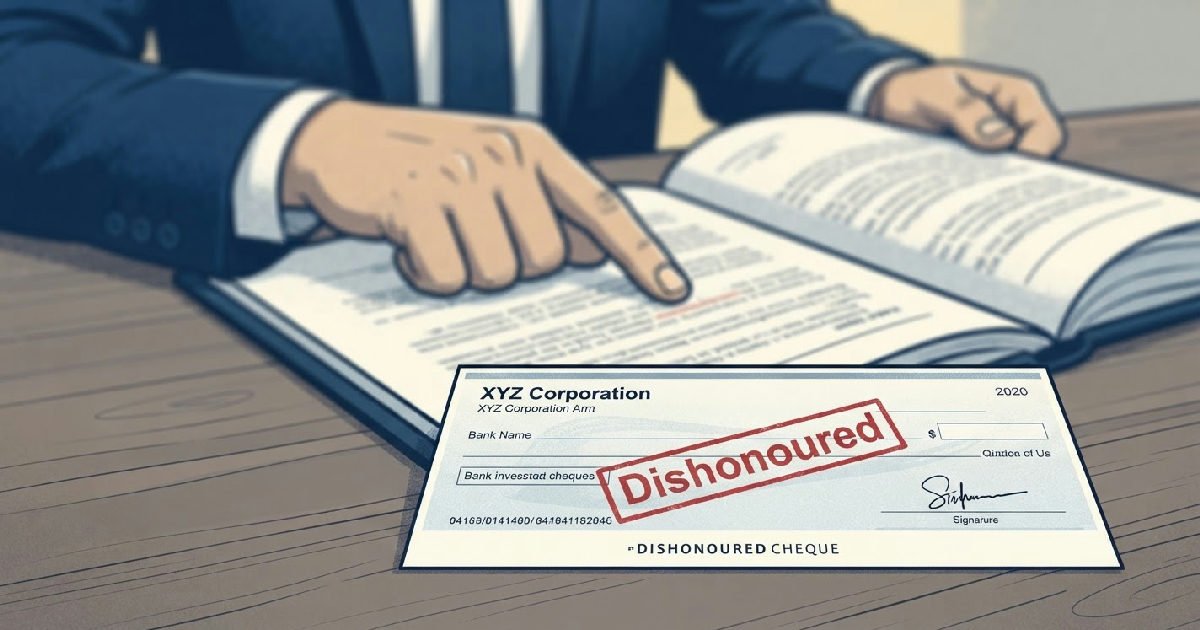
Navigating the legal intricacies of a dishonoured company cheque signed in a personal capacity demands a precise understanding of who can be held accountable. Recent clarifications under Sections 138 and 141 of the Negotiable Instruments Act, 1881, underscore that companies are primarily liable when their cheques bounce. However, individual directors also face potential prosecution, but only under specific circumstances where their direct involvement and responsibility are clearly established.
Legal experts in Delhi consistently advise complainants to name both the company and the responsible individuals in cheque bounce cases. This dual approach aims to ensure that no avenue for justice is inadvertently closed due to technical defects in the complaint. The distinction between corporate and individual culpability forms the bedrock of these complex legal proceedings, preventing unnecessary procedural hurdles.
Company cheque signed in a personal capacity: corporate accountability
When a cheque drawn from a company’s bank account is dishonoured, the company itself assumes the role of the primary offender. This foundational principle is critical for understanding the subsequent layers of liability under Indian law. The legal framework unequivocally identifies the company as the drawer of the cheque, placing it at the forefront of any potential prosecution.
It’s imperative that the company is named as an accused in the complaint if prosecution is sought under Section 138 read with Section 141 of the Negotiable Instruments Act. Failing to implead the company can render the entire complaint fatally defective, often leading to dismissal. This means that any action against individual directors or officers may not be maintainable, regardless of their alleged culpability.
The Company as the Primary Drawer and Offender
The law is clear: a company issuing a cheque from its official account is the principal party responsible if that cheque bounces. This is a direct liability arising from the banking instrument itself, making the corporate entity directly answerable to the law. The company’s legal existence makes it a distinct entity capable of incurring such obligations and facing legal repercussions.
Even if a director signs the cheque, the primary liability remains with the corporate entity. The director acts as an agent for the company, and their signature merely authenticates the company’s instruction to its bank. This distinction is vital for proper legal drafting and prosecution strategy in cheque bounce cases, influencing how a case proceeds.
Understanding the distinct roles of a company and its directors in cheque dishonour cases is paramount. The table below illustrates the key differences in their liability:
| Aspect | Company Liability | Director Liability |
|---|---|---|
| Primary Responsibility | Direct (drawer of the cheque) | Vicarious (responsible for company’s business) |
| Requirement in Complaint | Mandatory, without which case may fail | Specific proof of involvement required |
| Basis of Offense | Cheque drawn from company account | “In charge of and responsible for” company’s business at time of offense |
| Nature of Proof | Proof of cheque dishonour and valid notice | Proof of active role, consent, or connivance |
Why Naming the Company is a Non-Negotiable Requirement
The prosecution of directors or other company officers cannot proceed effectively if the company itself is not a party to the legal proceedings. This is because the liability of individuals is vicarious; it presupposes that the company has first committed the offense. Without the primary offender being arraigned, the secondary liability cannot stand.
Courts consistently uphold this requirement, treating the omission of the company as an accused as a significant procedural flaw. This strict adherence ensures that due process is followed and that liability is correctly attributed according to the statute, preventing arbitrary accusations. Therefore, neglecting to name the company is a common pitfall for complainants, potentially derailing their case.
Unpacking Vicarious Responsibility for Company Directors
While the company bears primary responsibility, Section 141 of the Negotiable Instruments Act extends liability to individuals closely associated with the firm. This section targets those who, at the time the offence was committed, were “in charge of, and were responsible to the company for the conduct of its business.” It casts a wider net but requires specific proofs to ensure fair application.
Establishing this vicarious liability is more complex than simply proving the cheque bounced. It demands concrete evidence of the individual’s active role, consent, or connivance in the commission of the offense. Mere designation as a director isn’t enough; prosecutors must demonstrate actual involvement in the company’s financial affairs or the specific transaction.
Navigating the ‘In Charge’ Mandate: Defining Director Responsibility
The phrase “in charge of, and responsible to the company for the conduct of its business” is central to holding individual directors liable. This isn’t a blanket provision. The complaint must contain specific averments, detailing precisely how a director fulfilled this role at the time of the offence. Generic allegations often fall short in court.
For instance, non-executive and independent directors generally receive protection from liability unless specific allegations demonstrate their direct involvement in financial decision-making or day-to-day business conduct. Their roles are typically advisory or oversight-focused, making direct involvement in a cheque transaction less likely. Understanding who is in charge in such cases is paramount.
This nuanced approach prevents indiscriminate targeting of all directors, focusing instead on those with operational control or direct oversight of financial matters. The burden of proof lies with the complainant to convincingly demonstrate this active responsibility. Such specificity ensures that justice is served to those truly accountable.
When Personal and Company Cheques Intersect: A Closer Look at Liability
The scenario of a director signing a company cheque with an added “signed in personal capacity” line, or issuing a personal cheque for a company debt, often creates confusion regarding liability. Delhi courts have provided clarity on these situations, reinforcing the principles of corporate and individual responsibility.
If a cheque is drawn on a company account, the company remains the primary drawer, irrespective of any annotation by the signatory indicating personal capacity. The core legal principle under Section 138 hinges on the account from which the cheque is drawn. The account name is paramount, not the signatory’s personal annotation.
The Myth of “Signed in Personal Capacity” on Company Cheques
Many signatories mistakenly believe that adding “signed in personal capacity” to a company cheque absolves the company or shifts liability entirely to them. This is a significant misconception. The liability under Section 138 primarily rests with the drawer of the cheque, which is the company in this scenario.
The Delhi High Court has affirmed this stance, emphasizing that the nature of the account—corporate or personal—determines the primary drawer. While such a line might be interpreted in other legal contexts, it generally doesn’t alter the fundamental liability structure in a cheque bounce case under the NI Act. This means the company remains the accused.
Company cheque, and only one name is on the complaint? Call or Whatsapp for consultation.
Related: https://arpitmarwah.com/cheque-bounce-lawyers-in-delhi/