
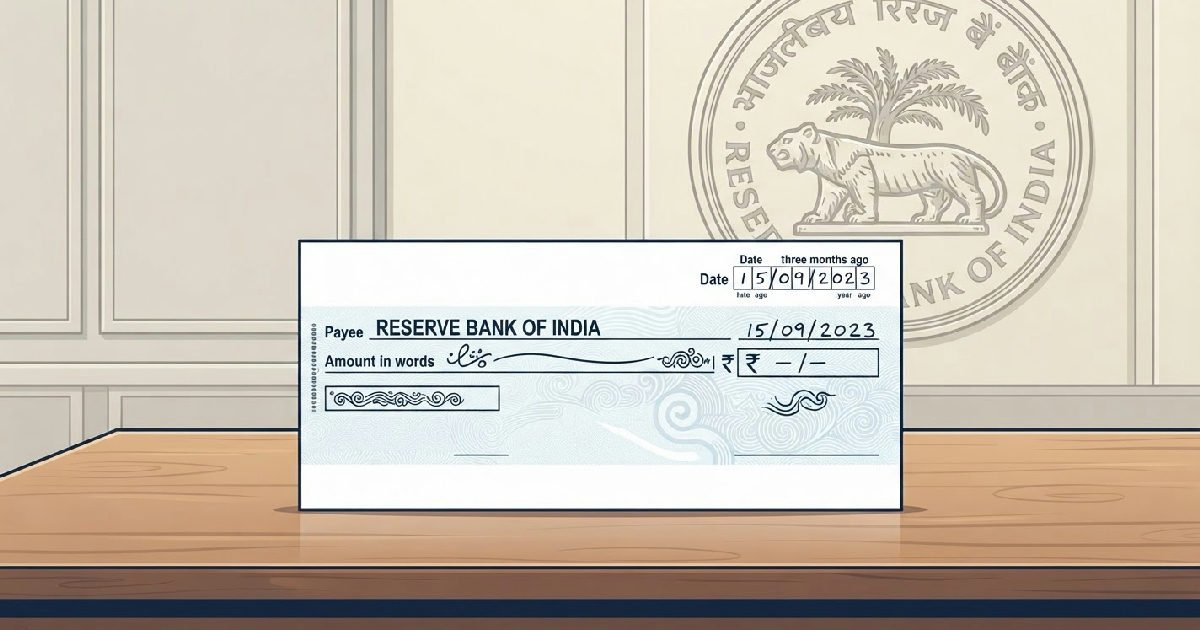
On April 1, 2012, India’s financial landscape saw a pivotal shift when the Reserve Bank of India (RBI) significantly altered the validity period for cheques. This directive reduced the lifespan of a cheque from six months to just three months from the date written on the cheque itself, profoundly affecting the prosecution of criminal cases under Section 138 of the Negotiable Instruments Act, 1881.
The change meant that timely presentation became more critical than ever. Now, if a cheque presented after three months window, it automatically becomes a “stale cheque.” Its subsequent dishonour cannot form the basis for a criminal complaint, fundamentally reshaping Section 138 cheque validity parameters.
The RBI Mandate: Reshaping Cheque Validity in India (Cheque Presented After Three Months)
The Reserve Bank of India did not implement this crucial policy change in a vacuum. It reflected a strategic move to infuse greater discipline into the country’s payment systems. The goal was to accelerate the cheque clearing cycle and curb the practice of cheques circulating as informal currency for extended periods.
This decision, effective April 1, 2012, was a deliberate step towards modernising financial transactions. It also aimed to mitigate potential risks associated with prolonged cheque validity. The RBI sought to ensure prompt settlement and reduce uncertainty for both individuals and businesses.
From “Reasonable Time” to Strict Timelines
Before the 2012 circular, the Negotiable Instruments Act, 1881, vaguely stipulated that cheques must be presented within a “reasonable time.” This lack of a precise definition often led to ambiguities and disputes. It left room for varied interpretations regarding when a cheque might become too old for presentation.
The RBI’s intervention provided much-needed clarity, replacing subjective interpretation with a strict, unambiguous three-month deadline. This eliminated any grey areas regarding a cheque’s active lifespan. It created a clear legal and operational standard for all financial institutions and their customers.
Driving Efficiency in the Financial System
Reducing the validity period was a direct effort to enhance the efficiency of India’s banking operations. It compelled payees to deposit cheques more quickly, leading to faster reconciliation of accounts. This also reduced the administrative burden on banks handling older instruments.
The move also aligned India’s practices with international banking standards, which often favour shorter validity periods for negotiable instruments. Such measures are crucial for improving liquidity management and bolstering the overall stability of the financial sector. This proactive regulation underscored the RBI’s commitment to a robust payment infrastructure.
Understanding Cheque Dishonour Under Section 138
Section 138 of the Negotiable Instruments Act, 1881, serves as a powerful deterrent against cheque bouncing. It provides legal recourse for payees whose cheques are dishonoured. However, its application is contingent on several specific conditions being met.
Crucially, the promptness of cheque presentation now stands as a primary requirement. Missing this deadline can effectively invalidate any claim under this vital criminal provision. Understanding these prerequisites is essential for anyone dealing with cheques in India.
Legally Enforceable Debt
For a Section 138 case to be maintainable, the cheque must have been issued to discharge a legally enforceable debt or other liability. This excludes gifts or payments for unlawful activities. Courts scrutinise this condition carefully to prevent misuse of the law.
Without a clear, legitimate financial obligation, the provision cannot be invoked. This ensures the law is applied specifically to genuine commercial transactions. It maintains its integrity as a tool for enforcing financial commitments rather than casual promises.
Timely Cheque Presentation
One of the most critical conditions, especially after the 2012 RBI circular, is that the cheque must be presented to the bank within its validity period. This means within three months from the date written on the cheque. Presentation after this period disqualifies it from Section 138 protection.
For instance, a cheque dated January 1 is valid only until March 31. Presenting it on April 1, even if funds are available, renders it stale. This specific timeframe directly influences whether a criminal case can proceed for cheque dishonour.
Dishonour and Formal Notification
After timely presentation, the cheque must be dishonoured by the bank due to reasons like insufficient funds or the amount exceeding the arrangement. The bank will then return the cheque with a memo indicating the reason for dishonour.
The payee must then receive this official information from the bank regarding the dishonour. This notice is a crucial precursor to initiating legal action. It formally confirms the cheque has bounced, triggering subsequent procedural steps.
Demand Notice and Drawer’s Response
Upon receiving notification of dishonour, the payee must issue a written demand notice to the drawer. This notice must be sent within 30 days of the payee receiving the bank’s information about the bounced cheque. It requests payment of the dishonoured amount.
The drawer then has a window of 15 days from the receipt of this demand notice to make the payment. Failure to pay within this specified period opens the door for the payee to file a criminal complaint under Section 138. The stringent timeline ensures prompt resolution.
The Critical Impact of a Stale Cheque
The three-month validity rule has profound implications for how cheque dishonour cases are handled. Crucially, a cheque that is presented after its expiry date — becoming a “stale cheque” — fundamentally alters the legal landscape for both parties involved.
This is where the distinction between administrative and criminal dishonour becomes paramount. The timely presentation requirement isn’t just a technicality; it’s a gateway to invoking Section 138. Missing it means foregoing significant legal leverage against the drawer.
Administrative Dishonour vs. Criminal Offense
When a cheque is presented after its three-month validity period, banks will return it marked as “stale cheque” or “exceeds validity period.” This is an administrative dishonour. It signifies that the bank cannot process the payment due to a procedural lapse by the payee.
This differs significantly from a dishonour due to insufficient funds or account closure, which are typically grounds for criminal proceedings. An administrative return means no criminal offence has occurred. The bank simply cannot execute the payment request for an expired instrument.
No Section 138 Liability for Stale Instruments
Because a stale cheque’s dishonour is administrative, it does not attract criminal liability under Section 138 of the Negotiable Instruments Act, 1881. The fault lies squarely with the payee for failing to present the cheque within the prescribed time. This means the drawer cannot be prosecuted.
This is a critical legal point that often catches unwitting payees off guard. The moment a cheque becomes stale, the criminal avenue under Section 138 effectively closes off. It underscores the importance of adhering strictly to the three-month window.
| Condition | Before RBI’s 2012 Circular | After RBI’s 2012 Circular (Effective April 1, 2012) |
|---|---|---|
| Cheque Validity Period | 6 months from date on cheque | 3 months from date on cheque |
| Section 138 Applicability if Presented Late | Possible if within 6 months | Not applicable for “stale cheques” |
| Status of Cheque Presented After Validity | Varies, could still be processed by bank | Automatically “Stale Cheque” |
| Reason for Dishonour (Stale Cheque) | Less common, ambiguous | Administrative, no criminal liability |
Navigating Post-Dated Cheques and Revalidation
The nuances of cheque validity extend to instruments like post-dated cheques, which are commonly used in various financial arrangements. Understanding how the three-month rule applies to these specific scenarios is vital for both drawers and payees to avoid legal pitfalls and maintain proper financial conduct.
Moreover, the process of rectifying an expired cheque has strict guidelines. Attempting to alter a cheque’s date or revalidate it through informal means can lead to further complications and render the instrument unusable. Adherence to formal procedures is paramount.
Post-Dated Cheques: When Validity Begins
Post-dated cheques function initially as bills of exchange. They only transform into cheques on the date written on them. From this stated date, the clock starts ticking for their three-month validity period. This means a post-dated cheque dated October 1 becomes a cheque on that day and is valid until December 31.
Payees holding such instruments must be acutely aware of this activation date. It dictates the precise window within which they must present the cheque to the bank for payment. Missing this deadline will result in the cheque becoming stale and losing its Section 138 enforceability.
The Impermissibility of Date Alteration
One common misconception is that a stale cheque can simply be revalidated by altering its date. However, under the Cheque Truncation System (CTS) rules, this is generally not accepted. Banks are wary of altered instruments and typically reject them as irregular.
Attempting to modify the date can render the cheque invalid. It may even raise suspicions of fraud, further complicating matters for the payee. The proper and legally sound solution for a stale cheque is to request a fresh instrument from the drawer, ensuring full compliance with banking norms.
Legal Alternatives and Recourse for Payees
Discovering that a cheque has gone stale can be frustrating for a payee expecting payment. However, the inability to pursue a criminal case under Section 138 does not mean all avenues for recovery are closed. Other legal and practical options remain available to secure the owed funds.
It’s crucial for payees to understand these alternative pathways to ensure they can still recover their legitimate dues. While the criminal route might be blocked, the civil justice system offers remedies. There are also informal solutions that can often resolve the issue efficiently.
Requesting a Fresh Cheque
The most straightforward and recommended solution for a stale cheque is to simply ask the drawer for a fresh one. This approach avoids legal complexities and is often the quickest way to resolve the situation. It assumes a cooperative relationship between the parties.
A new cheque, correctly dated and presented within its three-month validity, re-establishes the payee’s right to payment. It also allows for the possibility of invoking Section 138 if the new cheque is subsequently dishonoured. This is the cleanest fix for an expired instrument.
Pursuing Civil Remedies
If the drawer is unwilling to issue a fresh cheque, the payee can pursue civil remedies for recovery of the debt. This typically involves filing a civil suit for money recovery based on the underlying contractual obligation. Such suits fall under the jurisdiction of civil courts.
While civil litigation can be a more prolonged process than a Section 138 criminal complaint, it remains a viable option for recovering the debt. It provides a legal pathway to enforce the original financial liability. Payees should consult legal professionals to assess the best course of action for time-barred debt recovery.
Penalties and Judicial Perspective on Cheque Bouncing
When a cheque dishonour case successfully navigates the complex conditions of Section 138, the law provides for significant penalties against the defaulting drawer. These sanctions underscore the seriousness with which India’s legal system treats breaches of financial trust. The provisions aim to uphold the sanctity of negotiable instruments.
The punitive measures are designed not just to compensate the aggrieved payee but also to act as a deterrent. They discourage the casual issuance of cheques without sufficient funds. This helps maintain confidence in the cheque as a reliable payment mechanism within the economy.
Sanctions for Defaulting Drawers
If all conditions are met and a Section 138 case is proven, the drawer may face severe consequences. This includes imprisonment for a term that can extend up to two years. Additionally, a fine of up to twice the amount of the dishonoured cheque can be imposed.
In certain circumstances, the court may also order the drawer to pay interim compensation. This can amount to up to 20% of the cheque value, as per Section 143A of the Act. These penalties highlight the robust legal framework in place to enforce financial obligations and discourage fraudulent practices, providing a strong deterrent against misuse of blank cheques.
The Burden of Pending Cases
The policy change regarding cheque validity also needs to be viewed in the context of India’s overwhelmed judicial system. As of October 2008, a staggering figure of over 38 lakh (3.8 million) cheque bouncing cases were pending at the Magistrate level across the country.
This immense backlog underscored the need for measures to streamline the process and reduce unnecessary litigation. The RBI’s decision, while aimed at financial efficiency, also indirectly sought to reduce the sheer volume of cases clogging the courts. It prompted more diligent cheque handling.
What is the current cheque validity period in India?
As of April 1, 2012, the Reserve Bank of India (RBI) mandates that cheques are valid for three months from the date written on the cheque itself. This means the cheque must be presented for payment within 90 calendar days of that date.
Can I file a Section 138 case if my cheque is dishonoured after three months?
No, you cannot file a criminal case under Section 138 of the Negotiable Instruments Act if the cheque is presented after its three-month validity period. Such a cheque is considered “stale,” and its dishonour is an administrative return, not a criminal offense.
What should I do if my cheque has become stale?
If a cheque has gone stale, the recommended course of action is to request a fresh cheque from the drawer. Banks will not process stale cheques, and altering the date is generally not permissible. You can also pursue civil remedies for debt recovery if a fresh cheque isn’t provided.
Cheque date is old and it just bounced? Call or Whatsapp for free consultation.
Related: https://arpitmarwah.com/cheque-bounce-lawyers-in-delhi/