
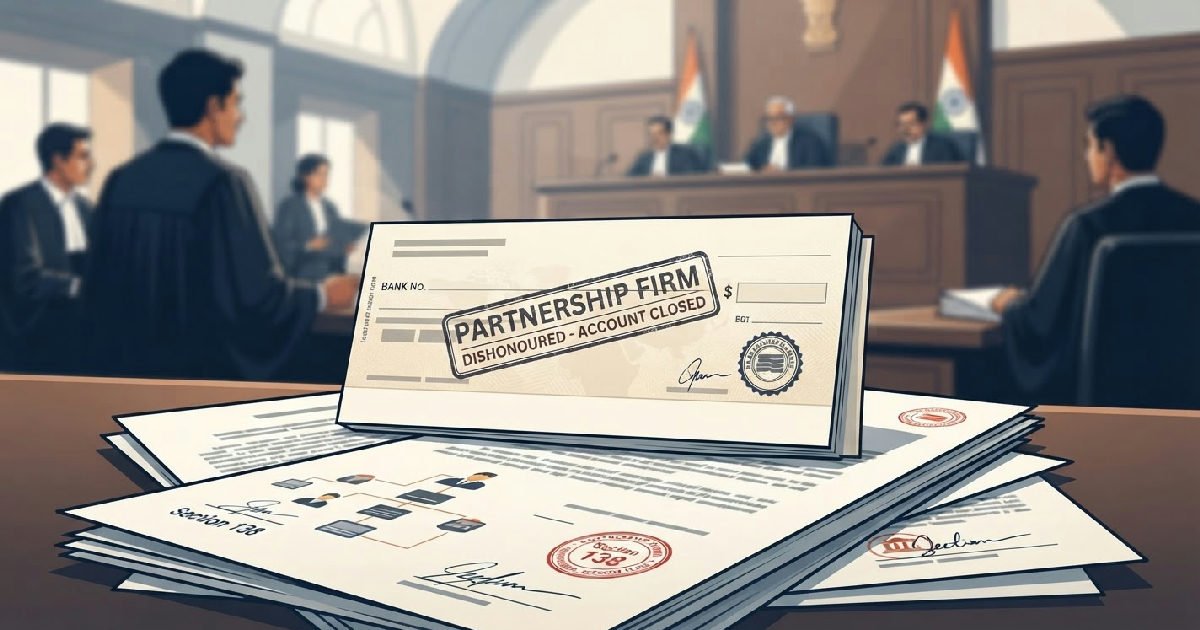
Delhi Courts Tighten Rules on Cheque Bounce Liability for Partnership Firms and the Cheque Bounce Case Against a Partnership
In a significant development for commercial jurisprudence in India, courts in Delhi are providing clearer guidelines on accountability in cheque bounce cases involving partnership firms.
Recent rulings from both the Supreme Court of India and the Delhi High Court have streamlined how complainants can pursue justice under Section 138 of the Negotiable Instruments Act, 1881, particularly concerning the liability of individual partners and the formal naming of the firm in legal proceedings.
These judicial clarifications, issued in July and September 2025, underscore that partners cannot easily shield themselves from responsibility simply because a partnership firm is not a distinct legal entity. Businesses operating as partnerships, especially in a bustling commercial hub like Delhi, now face reinforced legal clarity on their financial obligations and the personal liabilities of their partners when cheques are dishonored.
Understanding the implications surrounding a cheque bounce case against a partnership is crucial for all stakeholders involved.
Navigating Cheque Bounce Cases Against Partnership Firms
The legal framework for cheque bounce cases across India, including Delhi, primarily revolves around Section 138 of the Negotiable Instruments Act, 1881 (NI Act). This pivotal section criminalizes the dishonor of cheques under specific circumstances, such as insufficient funds, a stop payment directive from the issuer, or if the account is closed. Such instances represent a significant breach of financial trust.
When a cheque bounces, the bank issues a return memo detailing the reason for the refusal to process payment. This document is crucial, as it serves as primary evidence for any subsequent legal action. Understanding these initial steps is critical for any party seeking to enforce payment obligations.
Understanding Section 138 of the NI Act
Section 138 of the NI Act is designed to enhance the credibility of negotiable instruments in commercial transactions. It specifically addresses situations where a cheque, issued for the discharge of a legally enforceable debt or liability, is returned unpaid by the bank. Reasons for dishonor can range from insufficient balance to technical issues like mismatched signatures or presentation after the cheque’s validity period.
The law provides a robust mechanism for redressal, aiming to deter unscrupulous practices and ensure that financial commitments made through cheques are honored. The criminal aspect of the statute provides significant leverage for payees seeking to recover their dues.
| Category | Supreme Court Rulings (2025) | Delhi High Court Rulings (2025) | Implication for Partners |
|---|---|---|---|
| Firm Mention in Complaint | Not strictly necessary to name firm. | Omission is a curable defect. | Direct liability for individual partners. |
| Liability Basis | Partners are the firm. | Technicalities don’t negate liability. | Personal responsibility reinforced. |
| Case Dismissal Risk | Lowered due to broader interpretation. | Reduced significantly by allowing amendments. | Increased chances of successful prosecution. |
| Procedural Complexity | Simplified for complainants. | Flexibility in rectifying errors. | Focus shifts to substantive merits. |
Essential Steps for Filing a Complaint
Initiating a cheque bounce case requires adherence to a strict timeline and specific procedural steps. The complainant must first obtain the bank’s return memo, which formally explains why the cheque was dishonored. This memo is the bedrock of the entire legal process.
Following this, a legal demand notice must be dispatched to the cheque issuer within 30 days of receiving the return memo. This notice must clearly detail the cheque, the amount, its purpose for a legally enforceable debt, and demand payment within 15 days of its receipt. Proof of dispatch, typically via registered post, is essential for proving compliance with this critical deadline.
If the issuer fails to make payment within that 15-day window, the complainant then has a subsequent 30 days to file a criminal complaint before a Magistrate Court. Missing any of these deadlines can be fatal to the case, highlighting the importance of timely action and meticulous record-keeping.
For comprehensive guidance on these procedures, exploring resources on how to file a cheque bounce case can be invaluable.
Recent Judicial Clarifications on Partner Liability
The landscape of liability for partnership firms in cheque bounce cases has seen important clarifications from India’s highest courts. These rulings address long-standing ambiguities, particularly regarding whether individual partners can be pursued even when the partnership firm itself isn’t explicitly named as an accused in the initial complaint.
These judicial pronouncements aim to prevent partners from evading responsibility by exploiting technicalities, thereby strengthening the protection afforded to creditors under the NI Act. They reflect a broader legal trend towards piercing the veil of organizational structures where true liability resides.
Supreme Court on Naming Individual Partners
The Supreme Court of India, through rulings on July 19, 2025, and July 31, 2025, provided definitive clarity: complaints under Section 138 are indeed maintainable directly against individual partners, even if the partnership firm itself is not named as an accused.
The Court reasoned that a partnership firm lacks a separate legal identity distinct from its partners; it is merely a “compendious name” representing the individuals who constitute it.
This means that notice served to the partners is effectively deemed as notice to the firm. This significant interpretation simplifies the filing process and makes it harder for partners to argue that liability cannot attach to them without the firm being explicitly included in the complaint.
Delhi High Court on Curable Defects
Further solidifying this position, the Delhi High Court, in decisions on September 03, 2025, and September 05, 2025, ruled that the omission of a partnership firm as an accused in a Section 138 complaint is not a fatal flaw.
Instead, it deemed such an omission a “curable defect,” allowing complainants to amend their filings to include the firm, often subject to nominal costs, such as ₹35,000/-.
This pragmatic approach by the Delhi High Court ensures that genuine claims are not dismissed on technical grounds. It offers a crucial lifeline to complainants who might have inadvertently left out the firm
What is Section 138 of the Negotiable Instruments Act?
Section 138 of the Negotiable Instruments Act, 1881, is a crucial legal provision in India that makes the dishonor of a cheque a criminal offense under certain conditions. It aims to promote the credibility and reliability of cheques as a mode of payment.
For a case to fall under Section 138, the cheque must have been issued for a legally enforceable debt or liability, and it must have been returned unpaid by the bank due to reasons such as insufficient funds or account closure.
Can I sue an individual partner directly in a cheque bounce case?
Yes, recent rulings from the Supreme Court of India have clarified that a complaint under Section 138 of the NI Act is maintainable directly against individual partners of a firm, even if the partnership firm itself is not explicitly named as an accused. This is because a partnership firm is considered a “compendious name” for its partners, meaning individual partners can be held directly liable.
What if I forget to name the partnership firm in my cheque bounce complaint?
According to recent decisions by the Delhi High Court, the omission of a partnership firm as an accused in a Section 138 complaint is not considered a fatal defect. Instead, it is deemed a “curable defect.”
This means that complainants may be allowed to amend their filings to include the firm, often by paying nominal costs, ensuring that genuine claims are not dismissed on mere technicalities.
CTA: Need cheque bounce lawyers in Delhi for a firm or company cheque? Call or Whatsapp for free consultation.
Related Service: https://arpitmarwah.com/cheque-bounce-lawyers-in-delhi/