
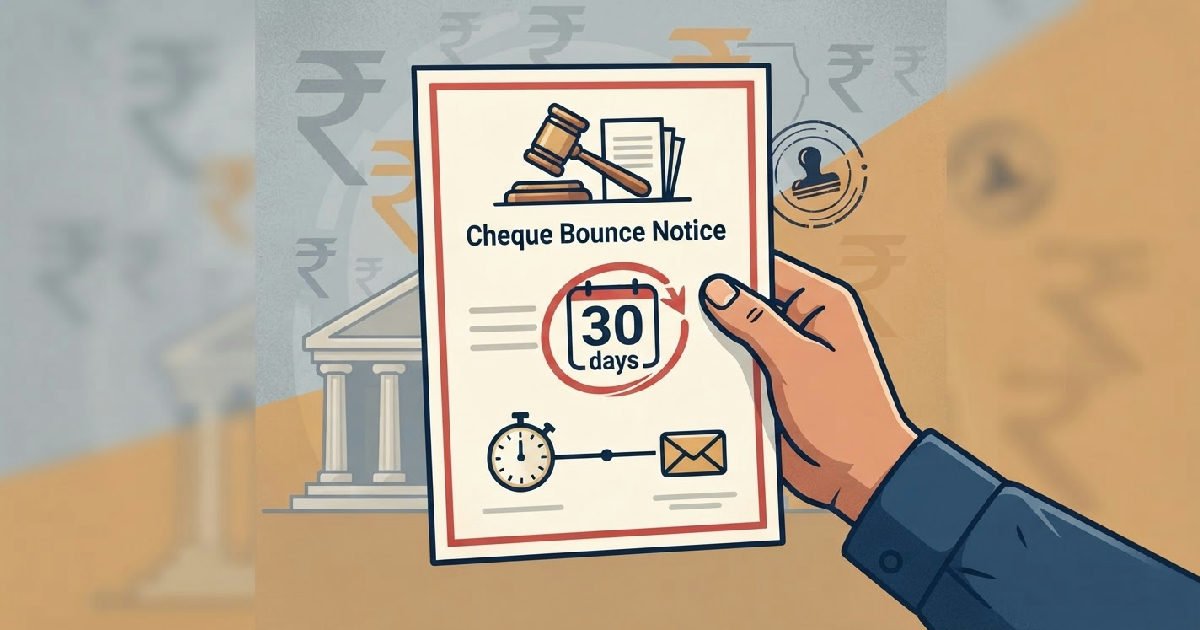
Navigating a bounced cheque in India demands immediate and precise legal action, primarily governed by Section 138 of the Negotiable Instruments Act, 1881. The cornerstone of this legal process is the strict cheque bounce notice time limit of 30 days.
Payees must dispatch a formal demand notice to the drawer within this crucial window after receiving the bank’s dishonour memo, or risk forfeiting their right to pursue criminal charges.
The Critical 30-Day Cheque Bounce Notice Time Limit
This stringent timeline isn’t merely a procedural formality; it’s a critical determinant of a case’s viability. Missing the 30-day deadline can effectively close the door on Section 138 proceedings, leaving aggrieved parties to explore more protracted civil remedies. Understanding these precise legal steps and their corresponding deadlines is paramount for anyone seeking justice for a dishonoured cheque.
The 30-day period for issuing a legal demand notice is arguably the most pivotal step in a cheque bounce case under Section 138. This timeframe commences not from the cheque’s issue date, but precisely from the moment the payee receives official notification from their bank regarding the cheque’s dishonour. This notification typically arrives as a dishonour memo or return memo.
Many businesses and individuals inadvertently lose this crucial window. They often spend valuable time attempting to secure payment directly from the drawer through informal requests. By the time legal counsel is sought, the statutory 30 days have frequently elapsed, jeopardising the entire case.
For a deeper understanding of the initial legal considerations, one might consult what a cheque bounce lawyer in Delhi checks before filing a Section 138 case.
Understanding the Cheque Dishonour Process
Before any notice can be contemplated, the cheque must have been presented to the bank within three months of its date of issue, or within its overall period of validity, whichever occurs earlier. This initial presentation is a non-negotiable prerequisite for triggering subsequent legal actions under the Negotiable Instruments Act.
Upon presentation, if the cheque cannot be honoured, the bank issues a dishonour memo. This document is vital, as it formally states the reason for non-payment. Common reasons include insufficient funds, signature mismatches, a stopped payment order, overwriting, or an expired cheque.
The bank’s return memo serves as the official trigger for the 30-day notice period. Without this document, the payee cannot legally initiate the Section 138 process. It’s a crucial piece of evidence that must be carefully preserved.
Contents and Dispatch of the Legal Demand Notice
Once the dishonour memo is received, the payee must act swiftly to dispatch a formal legal demand notice within the 30-day window. This notice is a statutory requirement, formally informing the drawer of the cheque’s dishonour and demanding payment of the exact cheque amount.
The notice must clearly specify essential details, including the cheque number, date, amount, and the bank on which it was drawn. It must also explicitly state the reason for dishonour as communicated by the bank. Crucially, the notice must demand payment of the cheque amount within 15 days, clearly intimating legal action if payment is not received.
For legal validity, the notice should be dispatched via Registered Post or Speed Post. This provides a verifiable record of dispatch and delivery, which is indispensable in court. While email or WhatsApp can serve as supplementary communication, postal proof remains the primary legal requirement.
Drawer’s Crucial 15-Day Payment Window
Upon receiving the legal demand notice, the cheque drawer is granted a statutory 15-day grace period to make the payment. This period is critical; if the drawer settles the full cheque amount within these 15 days, the offense under Section 138 does not arise. Consequently, no criminal complaint can be filed against them.
Conversely, initiating a criminal complaint before this 15-day period has fully elapsed is considered premature. Such a complaint faces a high likelihood of dismissal by the court. This premature filing would necessitate the payee restarting much of the arduous legal process, highlighting the absolute necessity of precise timing.
The law provides this window to allow the drawer an opportunity to rectify the situation without facing criminal prosecution. It underscores that the primary aim is often to secure payment, with criminal charges serving as a potent enforcement mechanism only after non-compliance.
Navigating the Complaint Filing Deadline
If the drawer fails to make the payment within the 15-day grace period after receiving the legal notice, a “cause of action” officially arises on the 16th day. This marks the point from which the payee can initiate criminal proceedings.
From this date, the payee has a further 30 days to file a criminal complaint under Section 138. The complaint must be lodged before a Judicial Magistrate or Metropolitan Magistrate with appropriate jurisdiction. Missing this subsequent 30-day window can also lead to the dismissal of the case unless a valid reason for delay is presented.
The total timeline for filing a case can therefore range from approximately 45 days (15 days for payment plus 30 days for filing) from the date of issuing the notice, to roughly 75 days from the date of dishonour, depending on when the notice was sent within its initial 30-day window. Precision at each stage is paramount.
Jurisdiction and Court Proceedings
Cheque bounce cases are generally handled in the Magistrates Court and are designed to be tried summarily, aiming for a quicker resolution. The Supreme Court provided critical clarification on jurisdiction in its landmark 2025 judgment, Jai Balaji Industries Ltd. v. M/s HEG Ltd. (2025 SCC Online SC 2581).
For account payee cheques, jurisdiction now lies with the court within whose local jurisdiction the branch of the bank where the payee maintains their account is situated. This ruling brought clarity, consolidating where such complaints should be filed and preventing forum shopping.
| Action Stage | Time Limit | Starting Point | Consequence of Missing Deadline |
|---|---|---|---|
| Cheque Presentation to Bank | 3 months | Cheque Issue Date | Cheque becomes stale, cannot be presented |
| Issuing Legal Demand Notice | 30 days | Receipt of Bank Dishonour Memo | Loss of right to initiate criminal proceedings under Section 138 |
| Drawer’s Payment Period | 15 days | Receipt of Legal Demand Notice | If paid, no Section 138 offense arises |
| Filing Criminal Complaint | 30 days | Expiry of 15-day Payment Period | Complaint may be dismissed; requires condonation of delay application |
Severe Consequences of Missing Statutory Deadlines
Failure to adhere to the prescribed timelines under Section 138 of the Negotiable Instruments Act carries significant repercussions. The most immediate and critical consequence is the forfeiture of the right to initiate criminal proceedings under this section.
If the legal demand notice is not dispatched within the initial 30-day window from receiving the bank’s return memo, the payee loses their primary recourse for a criminal complaint. Similarly, a complaint filed beyond the subsequent 30-day statutory limitation period (after the 15-day payment window) is generally not maintainable.
Such belated complaints are liable to be quashed unless a written application for condonation of delay, supported by a valid reason, is filed under Section 142(b) of the NI Act. Courts are typically strict about these deadlines, underscoring the need for timely action. For detailed procedural guidance, understanding how to file a cheque bounce case step-by-step is essential.
Punishment for Cheque Dishonour
If the drawer is found guilty under Section 138, the penalties can be severe. The law provides for imprisonment for a term that may extend to two years. Alternatively, or in addition, a fine may be imposed, which can extend to twice the amount of the dishonoured cheque.
This dual punishment reflects the seriousness with which the legal system views the breach of trust involved in cheque dishonour. It serves as a deterrent against issuing cheques without sufficient funds or intent to pay.
Alternative Legal Avenues for Recovery
Even if the strict deadlines for a Section 138 complaint are missed, or if the circumstances do not fit its specific criteria, other legal avenues remain open for the recovery of funds. These alternatives, while often civil in nature, provide a fallback for aggrieved parties.
One primary option is to pursue a civil recovery suit under Order 37 of the Code of Civil Procedure. This is also known as a summary suit, designed for faster adjudication in specific commercial disputes. Such a suit can typically be filed within three years from the date the cause of action arises, offering a much longer limitation period compared to Section 138.
Other Legal Recourse Options
Beyond summary suits, payees can explore other legal pathways. This includes filing a criminal complaint under Sections 406 (criminal breach of trust) and 420 (cheating) of the Indian Penal Code, 1860. These sections can be invoked if there’s evidence of fraudulent intent or misappropriation.
Furthermore, if the underlying contract between the parties includes an arbitration clause, initiating arbitration proceedings can be a viable and often quicker dispute resolution mechanism. These alternatives highlight that even if the specific criminal remedy under Section 138 is unavailable, legal recourse for debt recovery generally persists.
Sometimes, it’s important to understand when you should not file a cheque bounce case under Section 138 and explore other options.
Expert Perspectives and Strategic Advice
Legal experts consistently stress the importance of timely and precise action in cheque bounce cases. Advocate B.K. Singh at Legals365 advises clients to “move quickly, but never go faster than the law.” This adage encapsulates the delicate balance required: swiftness combined with strict adherence to legal procedures and timelines.
Engaging legal counsel early is crucial. An experienced lawyer can guide payees through the intricate process, ensuring all deadlines are met and notices are correctly drafted and dispatched. Advocate Paresh M Modi of Ahmedabad, Gujarat, is one such legal professional who offers consultations for cheque bounce cases, highlighting the specialized expertise often required.
The complexities of the Negotiable Instruments Act mean that even slight procedural errors can have significant consequences. From calculating the 30-day notice period accurately to ensuring the complaint is filed within its 30-day window, every step demands meticulous attention to detail to secure a favourable outcome.
What is the initial deadline after a cheque bounces in India?
After a cheque bounces, the payee must issue a legal demand notice to the drawer within 30 days of receiving the bank’s dishonour memo. Missing this initial 30-day cheque bounce notice time limit can lead to the forfeiture of the right to file a criminal complaint under Section 138 of the Negotiable Instruments Act.
What happens if the drawer pays within the 15-day period after receiving notice?
If the cheque drawer makes the full payment of the demanded amount within 15 days of receiving the legal demand notice, the offense under Section 138 does not arise. In such a scenario, the payee cannot file a criminal complaint against the drawer.
Are there any legal options if I miss the Section 138 deadlines for a cheque bounce?
Yes, even if the deadlines for Section 138 criminal proceedings are missed, other legal avenues remain. You can pursue a civil recovery suit under Order 37 of the Code of Civil Procedure within three years, or file a criminal complaint under Sections 406 and 420 of the Indian Penal Code, depending on the circumstances and evidence.
Check your notice deadline. Contact for free consultation.
Related Service: https://arpitmarwah.com/cheque-dishonor-lawyer/