
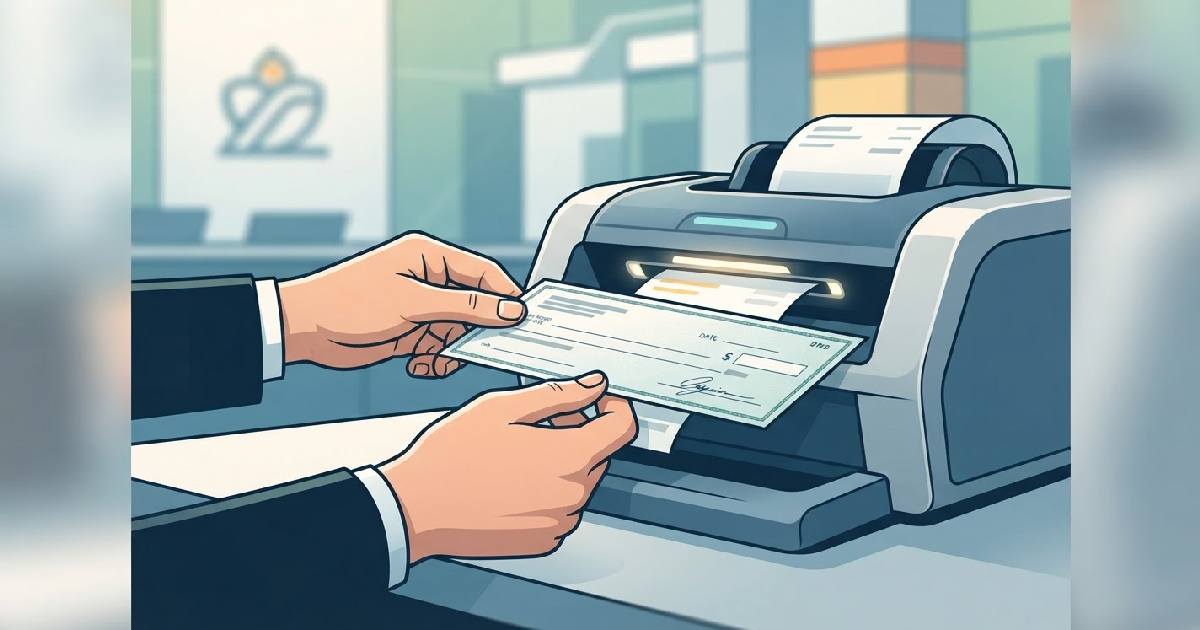
Cheque processing outlines the systematic path a cheque takes from its initial deposit by a payee until the funds are successfully transferred from the drawer’s account, culminating in its clearance. This once paper-heavy procedure has largely transitioned to advanced electronic systems, significantly boosting both processing speed and overall efficiency within the financial sector.
Understanding this process is crucial for anyone engaging in financial transactions via cheques, ensuring clarity on how funds move and what mechanisms are in place to secure these transfers in the modern banking environment.
The Fundamentals of Cheque Processing Terminology
To grasp cheque processing fully, it’s important to define the core components involved in every transaction. A cheque itself is a written order instructing a bank, building society, or credit union to pay a specific amount of money.
The individual or entity who writes and signs this order is known as the drawer, authorizing payment from their account. Conversely, the payee is the intended recipient, the person or entity who receives the funds specified on the cheque.
The drawee refers to the bank or financial institution on which the cheque is drawn. This institution holds the drawer’s account and is responsible for honoring the cheque and facilitating the payment.
Technical Innovations Streamlining Cheque Clearance
Modern cheque processing relies heavily on sophisticated technologies to ensure rapid and accurate transactions. These innovations have largely moved banking away from manual, paper-based handling towards digital efficiency.
MICR Technology: The Backbone of Automated Processing
Magnetic Ink Character Recognition (MICR) is a foundational technology developed in the 1950s that enables high-speed automation. It utilizes specially designed magnetic ink characters printed at the bottom of cheques.
These characters encode vital information such as the cheque number, bank routing number, and account number. MICR allows specialized equipment to automatically read and process cheques, drastically reducing errors and speeding up the entire system.
Electronic Evolution with CTS and Check 21 Act
The Cheque Truncation System (CTS), also known as image-based clearing, represents a significant leap forward. It converts a physical paper cheque into a digital image for electronic transmission to the paying bank.
This system removes the necessity for physical movement of cheques, resulting in reduced processing times and lower operational costs. In the United States, the Check Clearing for the 21st Century Act (Check 21 Act), enacted in 2004, specifically facilitated this transition by permitting banks to process electronic images of cheques, known as “substitute checks,” instead of original paper documents.
Further enhancing efficiency is Remote Deposit Capture (RDC), a service allowing financial institution customers to deposit cheques electronically. This often involves using desktop scanners or mobile devices to capture and transmit cheque images to their bank, offering unparalleled convenience.
The Step-by-Step Journey of a Cheque
The mechanical process of cheque clearance involves several distinct stages, each critical to the successful transfer of funds. These steps have been optimized by digital advancements but retain their fundamental purpose.
From Deposit to Settlement
The journey begins with the deposit of the cheque by the payee into their bank account. Once deposited, the collecting bank prepares the cheque for presentment to the drawee (paying) bank. Presentment is the formal demand for payment.
Following successful presentment, settlement occurs. This is the actual transfer of funds between financial institutions, fulfilling the payment obligations from the cheque transaction. A clearing house, often comprising multiple banks, acts as an intermediary, centralizing the exchange and settlement of payments to reduce risk.
Handling Return Items and Legal Considerations
Sometimes, a cheque may fail to clear, becoming a return item. This usually happens if the drawer’s account lacks sufficient funds, if a stop payment order was issued, or due to other discrepancies.
Understanding these potential pitfalls is key to responsible cheque usage. Legal frameworks are in place to govern these situations, defining the rights and duties of all involved parties.
Legal Frameworks Governing Cheque Transactions
The complexities of cheque processing are underpinned by robust legal frameworks designed to protect all parties and ensure smooth operation. These regulations define the rights and duties of banks, drawers, and payees.
In the United States, for example, Uniform Commercial Code (UCC) Article 4 provides the legal backbone for bank deposits and collections. It sets the rules for how banks process cheques and other payment items, ensuring consistency and fairness across financial institutions. The Check 21 Act further solidifies the legality of electronic cheque processing.
It legally validates the use of “substitute checks” (electronic images of original paper cheques) as equivalent to the original documents, accelerating clearance and reducing the costs associated with physical cheque transport. Navigating complex return item incidents requires careful attention to these established rules and procedures.
Comparing Cheque Processing Evolution
The transition from traditional paper-based methods to modern electronic systems marks a significant evolution in banking efficiency and security. Here’s a comparison of key aspects:
| Aspect | Traditional Paper Processing | Modern Electronic Processing (CTS/RDC) |
|---|---|---|
| Physical Movement | Required (cheque transported between banks) | Eliminated (only digital image transferred) |
| Processing Speed | Slower, due to physical transport | Faster, due to electronic transmission |
| Cost | Higher (transportation, manual labor, storage) | Lower (reduced logistics and human intervention) |
| Error Reduction | Potential for errors | Reduced errors (due to MICR) |
| Risk Management | Inherent physical risks | Reduced risk (via clearing house mechanisms) |
This table illustrates the profound impact of technological advancements on the cheque processing ecosystem. The shift towards digitization has not only made the process faster but also more secure and cost-effective for financial institutions and their customers alike.
What is a clearing house and what is its function?
A clearing house is a financial institution or organization, often made up of banks, that acts as an intermediary to facilitate the exchange and settlement of payments. It centralizes and standardizes the steps leading to payment, reducing risk and ensuring transactions are finalized between different banks.
How does MICR technology contribute to faster cheque processing?
MICR (Magnetic Ink Character Recognition) technology uses specially designed magnetic ink characters printed on cheques. These characters allow high-speed magnetic recognition equipment to process cheques automatically, thereby reducing errors and speeding up the overall process.
What is the Check 21 Act and why is it important for cheque processing?
The Check Clearing for the 21st Century Act (Check 21 Act) is U.S. federal legislation enacted in 2004. It’s important because it allows banks to process electronic images of cheques, known as “substitute checks,” instead of requiring the original paper documents for clearance.