
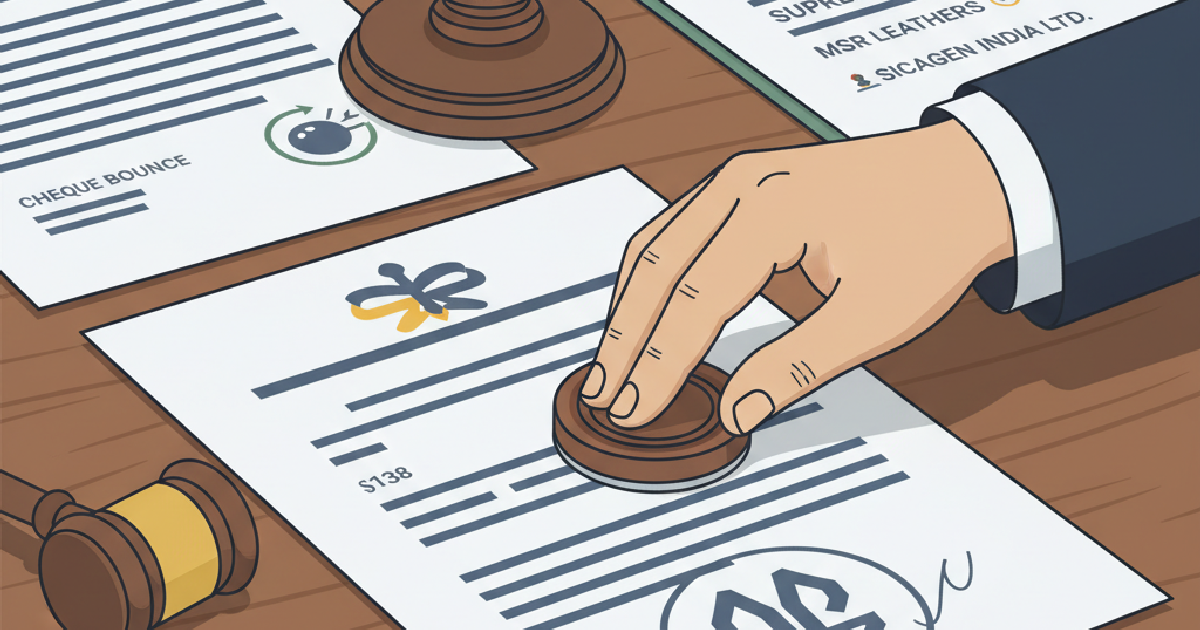
The Supreme Court of India has solidified the legal standing of creditors by confirming that second statutory notice validity remains a core component of criminal proceedings under the Negotiable Instruments Act, 1881. This ruling permits a payee to re-present a dishonoured cheque within its validity period and pursue a fresh cause of action, even if they opted not to prosecute after an initial bounce.
The recent ruling on Cheque Bounce Complaint emphasizes the need for creditors to remain vigilant in their collection efforts.
This ruling may significantly impact the approach to filing a Cheque Bounce Complaint, providing additional avenues for creditors.
This decision provides businesses with a vital window to resolve disputes through negotiation before escalating to the judiciary. By allowing successive presentations, the court has removed technical hurdles that previously rewarded defaulting debtors for a creditor’s leniency. The clarity ensures that the right to seek justice is not lost simply because a party attempted to settle a debt amicably first.
Re-presentation of cheques and second statutory notice validity
Section 138 of the Negotiable Instruments (NI) Act serves as the primary criminal mechanism for addressing cheque dishonour in India. It creates a strict liability for the drawer if a cheque is returned unpaid due to insufficient funds or for exceeding the arranged credit limit. The law requires a specific sequence of actions to be followed before a criminal complaint is considered maintainable.
A cheque must be presented to the bank within its validity period, which is typically three months from the date of issue. If the cheque is returned unpaid, the payee receives a return memo from the bank. This memo serves as the formal evidence of dishonour and triggers the timeline for legal notices.
The payee must then issue a demand notice in writing to the drawer within 30 days of receiving this information from the bank. The drawer has 15 days from the receipt of this notice to make the payment. A criminal cause of action only arises if the drawer fails to pay the demanded amount within this 15-day grace period.
Questions often arose regarding whether a payee could restart this entire process if the cheque was presented again. Recent rulings confirm that the statute does not forbid successive presentations. As long as the cheque is within its validity period, a second dishonour can create a fresh opportunity to issue a statutory demand.
Shifting away from the restrictive Sadanandan Bhadran precedent
For many years, the Indian judiciary operated under a restrictive interpretation established in the earlier Supreme Court judgment of Sadanandan Bhadran vs Madhavan Sunil Kumar. In that case, the court held that while a cheque could be presented multiple times, a payee could only issue a statutory notice once.
If the payee failed to act on that notice, they effectively forfeited their right to criminal prosecution.
This “one-shot” approach created significant hardships for creditors who were often persuaded by debtors to hold off on legal action in exchange for a promise of payment. If the debtor broke that promise, the creditor found themselves without a criminal remedy. The judiciary eventually recognized that this interpretation inadvertently encouraged default.
The 2013 landmark ruling in MSR Leathers vs. S. Palaniappan and Another finally overturned this narrow view. A three-judge bench of the Supreme Court of India clarified that there is nothing in the NI Act that prevents a fresh cause of action from being created. This remains true even if a previous notice was sent but not followed by a formal court filing.
Legal experts note that this shift was essential for maintaining the fluidity of commercial transactions. However, complainants must still ensure they do not file premature cheque bounce complaints before the 15-day notice period has expired. Filing even one day early can still lead to the dismissal of the case on technical grounds.
Reaffirming the second notice principle in Sicagen India Ltd
The principle of second statutory notice validity was further reinforced in the case of Sicagen India Ltd vs. Mahindra Vadineni. In this matter, three cheques were dishonoured in 2009, leading to an initial statutory notice being issued on August 31, 2009. Rather than filing a complaint immediately, the payee re-presented the cheques at a later date.
Following a second dishonour, a second statutory notice was issued on January 25, 2010. The Supreme Court ruled on January 17, 2019, that the complaint based on this second notice was entirely maintainable. This decision underscored that the “cause of action” mentioned in Section 142 of the NI Act is not a one-time event tied to the first notice.
The court’s logic rests on the fact that the underlying debt remains unsatisfied despite the passage of time. Forcing a creditor to abandon their criminal remedy because they showed leniency would reward defaulting debtors. Every valid instance of dishonour followed by a failure to pay within the notice period constitutes a fresh offence.
The service of the notice remains a critical factor in these proceedings. If a first notice is unserved, a second notice can effectively reset the limitation period, as clarified in D. Vinod Shivappa v. Nanda Belliappa. The goal is to ensure the drawer has genuine notice of the demand before criminal liability attaches.
Statutory timelines and requirements for maintainable complaints
While the law now allows for a second statutory notice, it does not permit a free-for-all regarding procedural requirements. Every individual notice must strictly adhere to the requirements of Section 138. The notice must be in writing and must demand the specific amount mentioned on the face of the cheque.
Failure to state the exact amount can lead to the dismissal of the case entirely. Courts have previously ruled that a demand notice is invalid without a specific amount being requested from the drawer. The clarity of the demand is the foundation of the criminal charge and cannot be vague or misleading.
Once the 15-day payment window expires, the payee has exactly 30 days to file a complaint in court. This timeline is strictly enforced because Section 138 is a technical offence. If a creditor waits until the 31st day to file their complaint, the case will generally be barred by limitation unless there are exceptional grounds for a delay.
The 2002 amendment to the NI Act introduced sections 143 to 147 to plug existing loopholes. These sections were designed to make the law more stringent against drawers who deliberately default. They also streamlined the process for courts to handle these cases more efficiently as the volume of litigation increased.
Can a creditor send a second notice if the first one was ignored?
A creditor can issue a second statutory notice if the cheque is re-presented and dishonoured again within its validity period. This creates a fresh cause of action, allowing the payee to initiate criminal proceedings even if they did not act on the first notice within the original 30-day window.
How does the June 2025 Supreme Court guideline affect current trials?
The June 2025 guidelines prioritize speeding up trials through digital filing and tracking systems. They aim for a quicker and more effective resolution of cheque bounce cases by reducing adjournments and utilizing technology to streamline the service of summons and case management.
What is the maximum interim compensation a court can award?
Under Section 143A of the Negotiable Instruments Act, a trial court can order the drawer to pay up to 20% of the cheque amount as interim compensation. This amount is usually ordered at the stage where the drawer pleads not guilty, providing the complainant with partial recovery during the trial.