
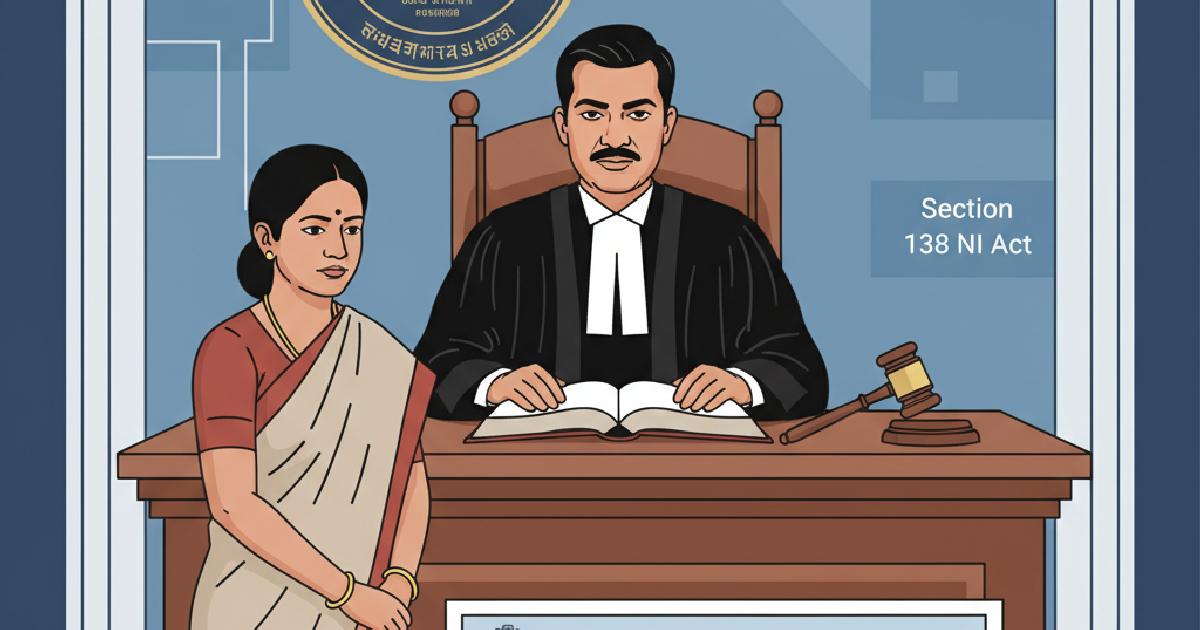
The Karnataka High Court has delivered a definitive ruling in the case of Parvathamma M. vs. Chandrakala V., establishing that an accused person cannot escape liability in a cheque dishonour case by merely raising peripheral doubts during trial. Presiding judge Justice Ramachandra D. Huddar overturned a lower court’s acquittal of Chandrakala V., clarifying that the rebuttable presumption under the Negotiable Instruments Act (NI Act) requires the presentation of credible, cogent evidence rather than speculative questioning.
The High Court convicted the accused under Section 138 of the NI Act, sentencing her to pay a fine of Rs. 9,00,000, double the original cheque amount of Rs. 4,50,000. This judgment, delivered on June 20, 2024, underscores the stringent evidentiary standards expected from defendants seeking to rebut statutory presumptions in cheque dishonour cases.
Setting the precedent: credible evidence is paramount
Justice Ramachandra D. Huddar’s ruling is a significant clarification for cases involving Section 138 of the Negotiable Instruments Act. He emphasized that while the presumption against an accused is indeed rebuttable, this rebuttal demands more than simply casting doubt or offering a denial. Accused individuals must adduce concrete, believable evidence.
This decision means that trial courts must look beyond unsubstantiated claims made during cross-examination or statements by the accused. The High Court found that the trial court’s acquittal of Chandrakala V. was based on “fundamental errors in factual assessment and approach,” failing to correctly apply the legal principles surrounding rebuttable presumptions.
The specific case: Parvathamma M. vs. Chandrakala V.
The case originated from a loan of Rs. 4,50,000 extended by Parvathamma M. to Chandrakala V. in early November 2012. The purpose of this loan was to assist Chandrakala V. with “urgent commitments and family needs.” As security, Chandrakala V. issued a cheque for the same amount, drawn on Syndicate Bank.
However, when Parvathamma M. presented the cheque, it was dishonoured on August 31, 2013, with the reason cited as “Payment stopped by the Drawer.” Despite a legal notice issued on September 5, 2013, Chandrakala V. neither responded nor repaid the amount.
Trial court’s error in acquittal
The trial court had initially acquitted Chandrakala V., primarily swayed by doubts raised during cross-examination and the accused’s testimony. It appears the lower court accepted that merely creating suspicion about the complainant’s case was sufficient to overcome the legal presumption.
But the Karnataka High Court disagreed. This highlights a crucial distinction in cheque dishonour cases: mere doubt is not the same as a probable defense. The Supreme Court has consistently reinforced the stringency of these provisions, ensuring the integrity of financial transactions.
Understanding the Negotiable Instruments Act and its presumptions
The Negotiable Instruments Act, 1881, is a cornerstone of India’s commercial law, designed to bolster confidence in instruments like cheques. Notably, the 1988 amendment introduced Chapter XVII, which criminalized cheque dishonour under Section 138.
This criminalization was a strategic move to address the prevalent issue of cheque bouncing, which previously only carried civil liability. Further amendments in 2002 enhanced the Act, aiming to streamline legal processes and introduce heftier penalties. These changes underscore the legislative intent to protect financial credibility.
Section 139: the core presumption
Central to cheque dishonour cases is Section 139 of the NI Act. This section mandates a legal presumption: if a cheque is issued and signed, it’s presumed to be for a legally enforceable debt or liability. This shifts the burden of proof onto the accused to demonstrate otherwise.
The Supreme Court, in cases like Hiten P. Dalal vs. Bratindranath Banargee (2001), has affirmed that courts “shall presume” the drawer’s liability once the cheque’s execution is established. Therefore, simply denying the debt doesn’t dismantle this strong legal presumption.
What constitutes a credible rebuttal?
To rebut the presumption under Section 139, an accused must present a “probable defense” based on a “preponderance of probabilities,” not “beyond a reasonable doubt.” This means they need to convince the court that their version of events is more likely true than not.
This can be achieved through various means, including presenting direct or circumstantial evidence, or by exposing significant flaws in the complainant’s evidence during cross-examination. For instance, challenging the complainant’s financial capacity to lend, if done specifically and with supporting facts, could be a valid defense. The Kerala High Court has ruled that a complainant must prove the underlying financial deal’s validity if the accused raises specific objections.
High Court’s verdict and its implications
The Karnataka High Court, after reviewing the evidence and the trial court’s judgment, reversed the acquittal. The court found Chandrakala V. guilty under Section 138 of the NI Act, imposing a substantial fine.
The fine was set at Rs. 9,00,000, which is double the amount of the dishonoured cheque. This reflects a common punitive measure in such cases, aiming to deter cheque dishonour. The court also specified a default sentence of one year of simple imprisonment if the fine is not paid within one month.
Accused’s conduct during the appeal
Adding to the High Court’s decision was the conduct of the accused, Chandrakala V., during the appeal process. She failed to appear through her counsel despite being afforded multiple opportunities.
Her own admission of issuing the cheque and acknowledging her signature further strengthened the complainant’s case. Such actions often work against the accused when trying to rebut a statutory presumption.
The broader impact on cheque dishonour cases
This ruling from the Karnataka High Court reinforces the principle that while the presumption in cheque dishonour cases is rebuttable, the burden on the accused is significant. It’s not a mere procedural formality or a simple denial.
Litigants in cheque dishonour cases, both complainants and accused, must understand the stringent requirements for evidence. This judgment aligns with other recent rulings, including a Supreme Court clarification (September 25, 2025) which stated that even cash transactions violating Income Tax Act provisions do not automatically invalidate the debt under Section 138 of the NI Act.
This judicial stance fortifies the efficacy of Sections 138 and 139 of the NI Act, promoting greater accountability in financial dealings involving negotiable instruments. Indian law has become increasingly stringent on cheque dishonour, extending even to non-resident Indians (NRIs).
| Case Aspect | Trial Court Decision | High Court Decision |
|---|---|---|
| Accused’s Status | Acquitted | Convicted |
| Rebuttal Evidence Standard | Doubts from cross-examination sufficient | Credible evidence required |
| Penalty Imposed | None | Fine of Rs. 9,00,000 |
| Default on Fine Payment | N/A | One year simple imprisonment |
Frequently Asked Questions
Is merely denying the debt enough to win a cheque bounce case?
No, simply denying that you owe money is not sufficient. Under the Negotiable Instruments Act, the court presumes the debt is valid once the check and signature are proven. The accused must provide “credible evidence” or point to specific facts that make the debt highly improbable to rebut this presumption.
What happens if I cannot pay the fine within the court’s deadline?
If a convict fails to pay the fine within the time frame set by the court (in this case, one month), they must undergo the “default sentence.” For Chandrakala V., this would involve one year of simple imprisonment. Paying the fine is the only way to avoid this jail time after a final conviction.
Does a “Stop Payment” order protect me from criminal charges?
Actually, it does not. A “Stop Payment” instruction is considered a form of dishonour under Section 138 of the NI Act. If the cheque was issued for a legally enforceable debt, you can still be prosecuted and convicted even if you were the one who told the bank not to clear the cheque.