
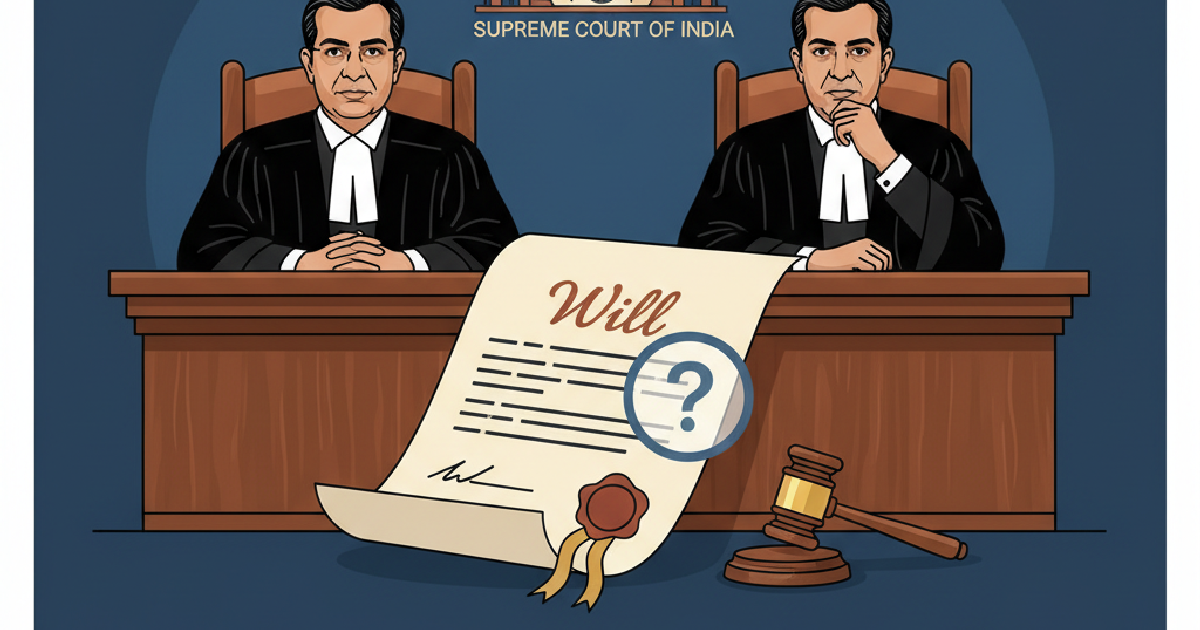
The Supreme Court of India ruled on Monday, July 6, 2026, that the mere testimony of attesting witnesses is insufficient to prove the validity of a Will when suspicious circumstances surround its execution.
A bench comprising Justice Manoj Misra and Justice KV Viswanathan held that the propounder of a Will carries the additional burden of satisfying the court’s conscience that the document represents the free and informed wishes of the testator.
Supreme Court clarifies burden of proof for Wills
The Supreme Court’s recent ruling clarifies a crucial aspect of Indian inheritance law, particularly concerning the burden of proof when the genuineness of a Will is questioned. This decision, delivered by a bench of Justice Manoj Misra and Justice KV Viswanathan, emphasizes that simply proving attestation through witnesses isn’t enough if there are surrounding circumstances that cast doubt on the Will’s authenticity.
This judgment directly overturned a decision by the Himachal Pradesh High Court, which had upheld a 1974 Will based primarily on the attesting witness’s testimony. The Supreme Court found that the High Court had overlooked several significant doubts surrounding the Will’s execution.
Overturning the Himachal Pradesh High Court judgment
The case, Sardari Lal v. Bishan Dass & Ors., centered on a 1974 Will executed by an illiterate agriculturist who could only thumbmark documents. The Himachal Pradesh High Court had concluded that since attestation of the Will was duly proved, its execution stood established and it should not have been discarded, especially as it was a registered document.
However, the Supreme Court disagreed, asserting that proving a Will goes beyond mere procedural compliance with Section 63 of the Indian Succession Act, 1925. It necessitates satisfying the court that the testator signed the Will by free will, fully aware of its contents and the implications of its dispositions.
The essence of a genuine Will in legal scrutiny
The Supreme Court emphasized that proving a Will is more than a technical exercise of verifying signatures and attestation. It’s about ensuring the testator’s true intent was captured without coercion or undue influence. This means the propounder must proactively address and dispel any “suspicious circumstances” that emerge.
Such circumstances are not merely figments of imagination, but real doubts that affect the court’s conscience regarding the Will’s legitimacy. This judicial stance provides a robust safeguard against fraudulent or improperly influenced testamentary dispositions.
Defining “suspicious circumstances” in Will execution
The Court’s pronouncement offered an open-ended definition of “suspicious circumstances,” encompassing any situation that raises doubts about the Will reflecting the testator’s free will. These could include a shaky or doubtful signature, a testator with a feeble or uncertain mind, or an unfair distribution of property.
Also considered suspicious are the unjust exclusion of legal heirs, particularly dependents, and the active involvement of a beneficiary in the Will’s creation. Here, the court highlighted that such elements require detailed explanation from the individual presenting the will.
The propounder’s heightened duty
When these specific doubts arise, the burden on the propounder intensifies beyond the standard requirement of proving attestation. They must not only demonstrate that the testator signed the document, but also that they understood its nature, and that the Will truly reflects their wishes without external pressure.
This additional burden is critical to ensure that vulnerable testators are protected from manipulation. The court looks for evidence that actively dispels any shadow of a doubt rather than merely meeting formal requirements.
The pivotal case: Sardari Lal v. Bishan Dass & Ors.
The dispute originated when Bhambo Devi, the widow of Chhajju Ram, filed a lawsuit asserting ownership of her late husband’s properties. She claimed her husband died without a Will, meaning she, as his sole Class I heir, should inherit everything.
Conversely, the defendants presented a registered Will from November 6, 1974, which bequeathed the entire estate to them. They argued that Chhajju Ram had made the Will in their favor due to their care for him, setting the stage for a prolonged legal battle.
Initial court findings and subsequent reversals
Both the Trial Court and the First Appellate Court initially sided with Bhambo Devi, discarding the disputed Will after identifying several suspicious factors in its execution. However, the Himachal Pradesh High Court reversed these concurrent findings, upholding the Will in its second appeal.
This reversal led Bhambo Devi’s legal representative to appeal to the Supreme Court, seeking to reinstate the decisions of the lower courts. The Supreme Court’s involvement signaled a critical review of how “suspicious circumstances” should be weighed against formal attestation.
Examining specific doubts regarding the 1974 Will
Justice Misra’s judgment meticulously outlined the legitimate doubts that the defendants failed to resolve. First, the Will entirely excluded the testator’s wife, Bhambo Devi, who was his primary Class I heir, while granting the entire estate to individuals who were not even close relatives.
Second, the beneficiaries were described as the testator’s nephews, but no evidence substantiated this relationship. And third, significant, unauthenticated alterations appeared on the reverse side of the registered Will, where the name “Laxmi Kant” was struck off and replaced with “Chhajju” multiple times without any Sub-Registrar’s initials or authentication.
| Circumstance | Observation by Supreme Court | Impact on Will’s Genuineness |
|---|---|---|
| Exclusion of wife (Class I heir) | Entire estate bequeathed to non-close relatives | Raises significant doubt about free will |
| Beneficiaries described as “nephews” | No evidence provided to establish this relationship | Indicates potential misrepresentation |
| Unauthenticated alterations on registered Will | Name “Laxmi Kant” replaced by “Chhajju” without official initials | Suggests tampering or improper execution |
Legal framework for Wills in India
The Indian Succession Act, 1925, particularly Section 63, lays down the foundational requirements for executing an unprivileged Will. This framework ensures that a Will is a valid legal document reflecting the testator’s true intentions, not merely a formality.
These requirements are crucial for preventing fraud and ensuring fairness in inheritance, especially in complex family disputes. Understanding them is vital for anyone involved in drafting or challenging a Will.
Requirements under Section 63 of the Indian Succession Act, 1925
Section 63 mandates three key requirements for an unprivileged Will. First, the testator must sign or affix their mark to the Will, or have someone else sign it in their presence, intending that signature to give effect to the document as their Will.
Second, the Will must be attested by at least two witnesses. Third, each witness must sign the Will in the presence of the testator; however, both witnesses do not need to be present at the same time, and no specific form of attestation is required.
Testamentary capacity and legal soundness
Beyond execution formalities, Section 59 of the Indian Succession Act stipulates that the testator must possess testamentary capacity. This means they must be at least 18 years old and of sound mind at the time of making the Will, understanding the nature of their actions, the extent of their property, and the claims of potential beneficiaries.
Crucially, the Will must be made without coercion, fraud, or undue influence, ensuring it truly expresses the testator’s independent wishes. This principle underpins the validity and enforceability of all testamentary documents.
The role of registration in Will validity
While registration of a Will is not legally mandatory under the Indian Registration Act, 1908, an unregistered Will, if properly executed and attested, remains legally valid. Nonetheless, registration can significantly enhance a Will’s authenticity and make it considerably more difficult to challenge in court.
However, as the Supreme Court highlighted in Sardari Lal v. Bishan Dass & Ors., registration alone won’t automatically validate a Will if suspicious circumstances surrounding its execution are not adequately explained. The court retains its power to inquire into genuineness. This principle extends to various legal documents where proper procedure and authenticity are paramount.
Broader implications of the ruling
The Supreme Court’s decision in Sardari Lal v. Bishan Dass & Ors. reinforces the judiciary’s role in safeguarding the true intent of a testator against potential manipulation or fraud. It sets a higher bar for those attempting to benefit from Wills made under questionable circumstances. This judgment particularly benefits vulnerable individuals, such as the illiterate or infirm, ensuring their last wishes are genuinely honored.
The ruling makes it unequivocally clear that the courts will not merely rubber-stamp Wills based on superficial compliance. Instead, they will delve deep into the factual matrix and surrounding context to ascertain genuine testamentary intent. This judicial scrutiny discourages predatory practices and strengthens public trust in the inheritance process.
Ensuring authentic testamentary intent
This judgment serves as a vital reminder for anyone involved in the creation or execution of a Will in India. It underscores the importance of not just adhering to the letter of Section 63 of the Indian Succession Act, 1925, but also ensuring that the spirit of the law—the free and informed will of the testator—is upheld.
For individuals drafting a Will, it means careful consideration of potential “suspicious circumstances” and proactively addressing them. This foresight can prevent future disputes and ensure their wishes are faithfully carried out.
Impact on future inheritance disputes
The ruling will likely influence how inheritance cases are litigated across India. Propounders of Wills, especially those where potential beneficiaries played an active role in drafting, will now face stricter scrutiny.
Lawyers advising clients on testamentary matters will need to emphasize thorough documentation and clear, unequivocal evidence to dispel any possible doubts. This could lead to a more rigorous approach to Will drafting and execution, prioritizing transparency and clear intent.
Frequently Asked Questions
What was the core issue in Sardari Lal v. Bishan Dass & Ors.?
The core issue revolved around the genuineness of a 1974 Will that entirely excluded the testator’s wife, his sole Class I heir, while bequeathing property to distant relatives. The central question was whether mere attestation could prove the Will’s validity despite suspicious circumstances.
Who were the judges on the Supreme Court bench for this case?
The bench that delivered this significant judgment consisted of Justice Manoj Misra and Justice KV Viswanathan. Justice Misra authored the detailed judgment in this case, emphasizing the propounder’s heightened burden of proof.
What does this ruling mean for registered Wills?
This ruling clarifies that although registration adds authenticity, it does not guarantee a Will’s genuineness if suspicious circumstances exist. The propounder still bears the burden of dispelling doubts, regardless of whether the Will is registered or not.