
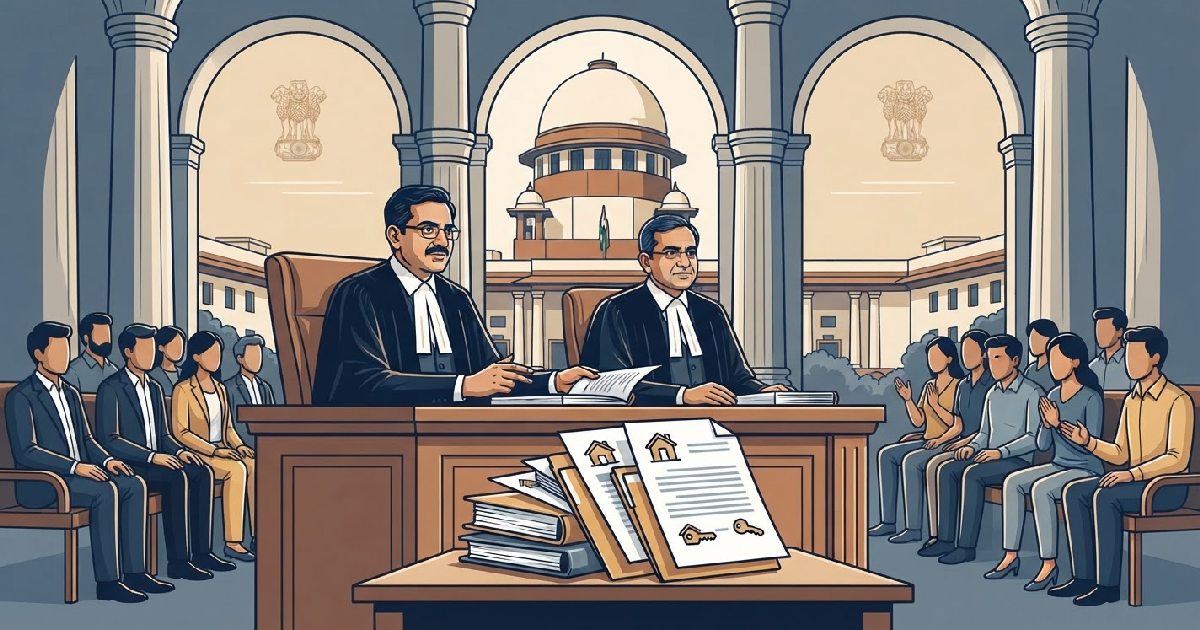
On July 27, 2026, the Supreme Court of India ruled that a Section 14 IBC moratorium does not stop consumer complaints against company promoters, directors, or associated entities.
This significant decision, handed down by a Division Bench of Justices Vikram Nath and Sandeep Mehta, offers substantial relief to homebuyers such as Tejas J. Shah & Amisha T. Shah & Ors., affirming their right to pursue legal action against individuals responsible for deficiencies in service, even when the corporate entity is undergoing insolvency proceedings.
Clarifying the Scope of IBC Moratorium Protections
The Court’s ruling stems from an appeal lodged by homebuyers of the ‘Mantri Manyata Energia’ residential project, developed by Mantri Technology Constellations Private Limited (now known as Buoyant Technology Constellations Private Limited). The National Consumer Disputes Redressal Commission (NCDRC) had previously stalled their complaint due to the developer’s insolvency. But this Supreme Court judgment effectively removes a significant barrier for consumers seeking redress.
The core of the Supreme Court’s observation centers on the precise application of Section 14 of the IBC. This provision establishes a temporary halt, or moratorium, on legal actions against a corporate debtor once it enters the Corporate Insolvency Resolution Process (CIRP).
The purpose is to preserve the company’s assets and facilitate an orderly resolution. However, the Court explicitly stated that this protection applies strictly and exclusively to the corporate debtor itself, not extending to other parties involved.
The narrow interpretation of Section 14
Justices Vikram Nath and Sandeep Mehta emphasized that the scope of the moratorium is statutory and fixed. They stated it’s not open to either the adjudicating authority or the Court to enlarge its ambit beyond what the statute contemplates. This means the moratorium cannot be expanded to include subsidiary companies, managers, directors, or personal guarantors unless the Code specifically provides for it.
This narrow interpretation is crucial for maintaining the balance between corporate recovery and individual accountability. It ensures that insolvency proceedings don’t inadvertently become a shield for individuals who may have contributed to a company’s financial distress or failed to deliver on consumer promises.
The Mantri Manyata Energia Case Explained
The dispute that led to this Supreme Court verdict originated from the ‘Mantri Manyata Energia’ residential project. Homebuyers like Tejas J. Shah and Amisha T. Shah had entered into construction and sale agreements back in 2016, with an expected possession date of December 31, 2018.
However, despite making substantial payments, they didn’t receive possession as promised. This led them to file Consumer Case No. 13 of 2023 before the NCDRC, alleging deficiency in service and unfair trade practices.
NCDRC’s erroneous adjournment
During the NCDRC proceedings, Mantri Technology Constellations Private Limited faced insolvency. The National Company Law Tribunal (NCLT), Bengaluru Bench, admitted an application under Section 9 of the IBC on August 23, 2024, initiating the CIRP and imposing a Section 14 moratorium.
Following this, the NCDRC rejected the homebuyers’ plea to continue their complaint against the non-corporate debtor respondents and adjourned the entire complaint indefinitely on January 20, 2025. The Supreme Court has now set aside that order.
| Party Type | Specific Entity (Case Example) | Status in Consumer Complaint | Affected by IBC Moratorium? |
|---|---|---|---|
| Appellants (Homebuyers) | Tejas J. Shah & Amisha T. Shah & Ors. | Complainants | No |
| Respondent No. 1 (Corporate Debtor) | Mantri Technology Constellations Pvt. Ltd. | Original Defendant | Yes |
| Other Respondents (Promoters/Directors) | Mantri Developers Pvt. Ltd., Promoters & Directors | Defendants | No (Per SC Ruling) |
| Lower Authority | National Consumer Disputes Redressal Commission (NCDRC) | Previous Adjudicator | Original order set aside by SC |
Precedent-Setting Legal Rulings
The Supreme Court didn’t arrive at this decision in a vacuum. It drew upon a series of prior judgments that have progressively shaped the understanding of the IBC moratorium’s reach. These precedents have consistently highlighted the need to differentiate between the corporate entity and the individuals or related companies associated with it.
One key case was P. Mohanraj v. Shah Brothers Ispat Pvt. Ltd. (2021). This earlier ruling established that Section 14 of the IBC applies only to the corporate debtor, not its management. It was a foundational step in clarifying that the IBC was not designed to offer a blanket shield to all parties.
Expanding accountability for promoters
Another significant decision came in *Ansal Crown Heights Flat Buyers Association v. Ansal Crown Infrabuild Pvt. Ltd.* (2024). There, the Court reaffirmed that an insolvency moratorium protecting a developer company does not offer a shield to its individual promoters or directors. The courts have consistently aimed to prevent misuse of insolvency laws to evade personal responsibilities.
The ruling in *Saranga Anilkumar Aggarwal v. Bhavesh Dhirajlal Sheth & Ors.* (2025) further strengthened this position. It held that an interim moratorium under Section 96 of the IBC, which applies to individuals, should not be expanded to stifle remedies under the Consumer Protection Act. This showed a clear judicial intent to prioritize consumer protection.
Implications for Homebuyers and Real Estate Development
This Supreme Court decision is a game-changer for countless homebuyers grappling with delayed or stalled projects across the country. It provides a clear legal pathway for consumers to hold individual promoters and directors accountable, even when the development company itself is undergoing insolvency. It’s a crucial victory for consumer rights.
The ruling sends a strong message to real estate developers and their management. They can no longer hide behind corporate insolvency to escape liability for deficiencies in service or contractual breaches. This increases the personal accountability of those at the helm of development companies.
Protecting consumer remedies
Legal experts across India are hailing the decision as a significant step towards bolstering consumer confidence in the real estate sector. The judgment ensures that corporate insolvency remains a distinct process, preventing it from granting blanket immunity to individuals and entities linked to a failing project. It upholds the robust remedies available under the Consumer Protection Act.
This directive means that consumer forums are now explicitly mandated to independently adjudicate complaints against promoters, directors, and other related parties. They must do so even when insolvency proceedings are simultaneously ongoing against the corporate debtor. This clarity should lead to faster resolution of many consumer disputes.
Ensuring developer accountability
The ruling directly impacts the financial and operational decisions of real estate developers. It highlights the fiduciary duties of promoters and directors, reminding them of their personal liabilities. For example, Section 66 of the IBC already outlines personal consequences for fraudulent or wrongful trading. This judgment reinforces that framework.
It also means that consumer claims against developers won’t simply vanish into the complex and often lengthy insolvency process. Homebuyers can continue to pursue their grievances against individuals, which could accelerate settlements and incentivize better project management from the outset. This could be particularly impactful in cases involving allegations of diverted homebuyer funds.
A shift in legal strategy
Going forward, legal strategies for both homebuyers and developers will likely adapt. Homebuyers will feel more empowered to pursue claims against individuals, knowing the IBC moratorium won’t be an automatic roadblock. Developers, on the other hand, will need to be even more diligent in their project execution and financial transparency.
This ruling reinforces the principle that those who exercise control over a company’s operations and finances bear personal responsibility for its actions, especially when it comes to consumer protection. It ensures that the spirit of consumer law is not undermined by technicalities of insolvency law.
Outlook for consumer litigation
The Supreme Court’s decision will undoubtedly streamline consumer litigation against errant developers. By setting aside the NCDRC’s previous order, the highest court has directed the NCDRC to resume and dispose of the consumer complaint against the associated company, promoters, directors, and landowners in the Mantri case. This direct instruction provides a template for similar cases.
This clear demarcation of liabilities ensures that consumers aren’t left without recourse. While the corporate debtor gets a breathing period under IBC, the individuals who steer the company remain answerable for their actions. It represents a victory for consumer advocacy groups who have long argued for such protections.
The implications extend beyond just real estate. This principle could potentially apply to other sectors where corporate insolvency might otherwise be used to shield individuals from liabilities arising from consumer complaints. It emphasizes a broader commitment to consumer rights within India’s legal framework, pushing for a stronger standard of accountability from business leaders.
What does the IBC moratorium do?
The IBC moratorium, under Section 14 of the Insolvency and Bankruptcy Code, temporarily halts legal proceedings and actions against a corporate debtor. This gives the company breathing room to restructure its finances and assets during the Corporate Insolvency Resolution Process (CIRP) without being hindered by individual creditor actions.
Why is this Supreme Court ruling important for homebuyers?
This ruling is crucial for homebuyers because it confirms they can continue to pursue consumer complaints against the promoters and directors of a development company, even if the company itself is undergoing insolvency proceedings. It prevents individuals from using the corporate moratorium as a shield against personal accountability for project delays or deficiencies.
Which parties are now open to consumer complaints despite an IBC moratorium?
Despite an IBC moratorium against a corporate debtor, consumer complaints can now explicitly proceed against its promoters, directors, associated companies, and landowners. The Supreme Court has clarified that the moratorium applies only to the corporate debtor and cannot be expanded to protect these other parties.