
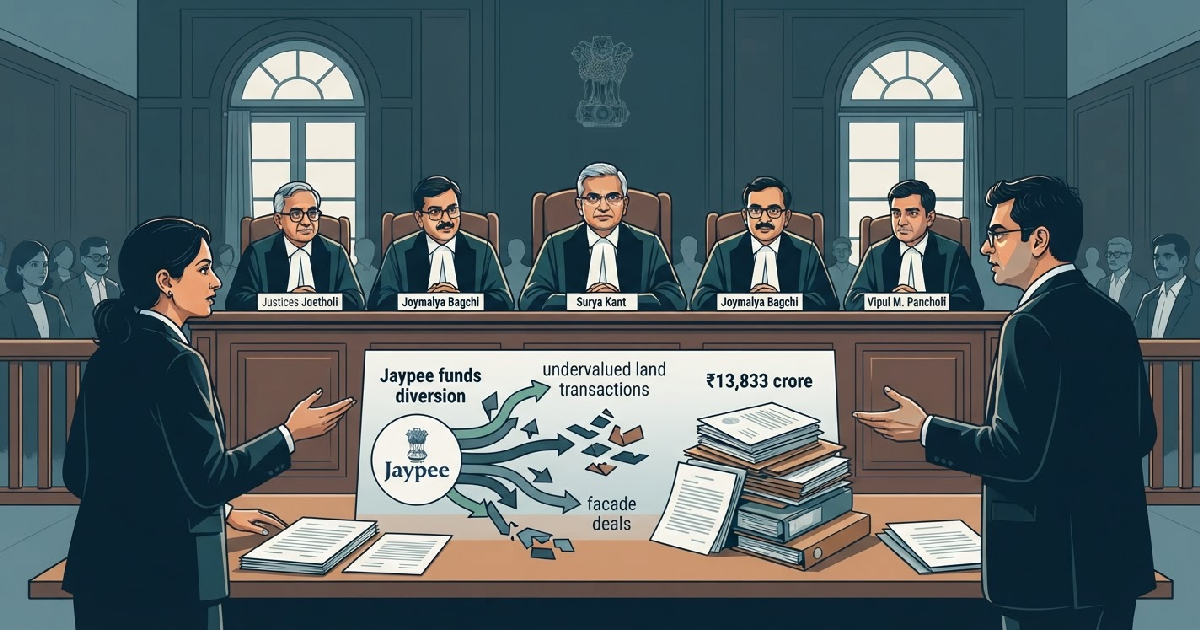
India’s Supreme Court has issued a formal notice in a significant case, probing allegations that the Jaypee Group orchestrated “facade” deals to divert a staggering ₹13,833 crore in homebuyer funds.
This action on Tuesday, May 28, 2026, stems from a writ petition filed by Vandana Sabharwal, a homebuyer represented by advocate Prashant Bhushan, who claims the real estate giant siphoned off nearly 95% of money collected from over 25,000 unsuspecting customers.
unraveling the alleged financial facade
The bench, comprising Chief Justice Surya Kant, Justice Joymalya Bagchi, and Justice Vipul M. Pancholi, has directed the Union Government, Enforcement Directorate (ED), and Reserve Bank of India (RBI) to respond. Regional authorities including UP RERA, NOIDA, and YEIDA also received notices. The next hearing is scheduled for July 15, 2026, marking a critical step in a prolonged battle for justice for thousands of families.
The petitioner’s plea details a sophisticated scheme of alleged fund diversion by the Jaypee Group. Out of an astounding ₹14,599 crore collected from homebuyers, a reported ₹13,833 crore — roughly 95% — was allegedly siphoned off through various illicit means.
These methods reportedly included transfers to associated group entities and substantially undervalued land transactions, designed to mask the true movement of funds. The Enforcement Directorate’s prosecution complaint, dated January 8, 2026, forms the backbone of these serious accusations.
the mechanisms of diversion
It highlights direct transfers totaling ₹125.25 crore to Jaypee Sewa Sansthan, ₹427.50 crore to Jaypee Healthcare Ltd., and ₹433 crore to Jaypee Sports International Ltd. These transfers raise questions about the legitimate use of funds specifically collected for housing projects.
Further allegations point to the transfer of land and development rights to five clusters of external real estate developers. These transactions were reportedly carried out at significantly undervalued rates, using what the ED described as “fictitious credit advices.” The ED found these arrangements to be a “facade” designed to facilitate the illicit movement of funds.
The scheme also reportedly involved complex double sub-lease structures, a tactic seemingly aimed at circumventing stamp duty obligations. Such convoluted dealings suggest a deliberate attempt to obscure financial trails and evade regulatory scrutiny. Homebuyers were left in the lurch, their investments vanishing into a labyrinth of corporate maneuvering.
jaypee group’s long-standing financial turmoil
The Jaypee Group, once a powerhouse in India’s infrastructure and real estate sectors, has been embroiled in financial difficulties for years. Founded by Jaiprakash Gaur, the conglomerate expanded across diverse verticals.
Its real estate arm, particularly Jaypee Infratech Limited (JIL), became the epicenter of its troubles. JIL was initially established to develop and maintain the Yamuna Expressway, alongside extensive real estate projects. However, delays and financial mismanagement plagued these ambitious ventures.
insolvency and recent corporate shifts
By 2017, JIL faced Corporate Insolvency Resolution Process (CIRP) proceedings, with Jaiprakash Associates Limited (JAL) following suit in 2024. The ongoing insolvency process saw the Adani Group acquire the beleaguered Jaypee Group for ₹14,535 crore, a significant corporate takeover in recent history.
This acquisition was meant to provide some resolution for the group’s vast liabilities, but the fate of thousands of homebuyers remains a pressing concern. The legal challenges against the group intensified with the arrest of Manoj Gaur, Executive Chairman of JAL, on November 13, 2025.
He was taken into custody by the Enforcement Directorate in connection with the alleged ₹14,599 crore fraud and remains in judicial custody, his bail plea dismissed by a Delhi court on February 16, 2026.
homebuyers’ protracted quest for restitution
For individuals like Vandana Sabharwal, the Supreme Court’s notice represents a glimmer of hope after years of frustration. Ms. Sabharwal paid for her residential unit in the ‘KASABLANCA’ project at Jaypee Wishtown in Noida over a decade ago but has yet to receive possession or a refund.
This personal plight reflects the wider agony of over 25,000 affected homebuyers. The ‘KASABLANCA’ project’s RERA registration expired in December 2021, leaving many in a regulatory limbo. The current legal action aims to pierce through the corporate veil, ensuring that those responsible are held accountable and that homebuyer interests are finally prioritized.
previous court interventions and the systemic impact
This isn’t the first time the Supreme Court has stepped in to address the Jaypee crisis. In 2017, the court intervened, directing Jaiprakash Associates Limited to deposit funds and freezing the assets of its directors to safeguard homebuyer interests.
These earlier actions highlight the persistent nature of the challenges faced by homebuyers and the continuous need for judicial oversight. The case encompasses more than just financial loss; it touches upon fundamental rights, including the right to shelter and the protection of life savings. Delays in property deals can have devastating financial and emotional consequences for families.
It calls into question regulatory accountability under the Real Estate (Regulation and Development) Act (RERA), the Prevention of Money Laundering Act (PMLA), and the Insolvency and Bankruptcy Code (IBC). These complex legal frameworks have yet to deliver effective remedies for many.
the enforcement directorate’s ongoing investigation
The Enforcement Directorate’s role has been central to uncovering the alleged financial irregularities. Their prosecution complaint, submitted earlier this year, details the intricate methods used for fund diversion.
However, the progress in recovering the diverted funds has been notably slow. After more than seven years of investigation, the ED has provisionally attached only ₹400 crore of assets. This amount represents a mere 2.9 paise for every rupee allegedly diverted, a statistic that underscores the immense challenge in tracing and recovering such large sums.
scandal reaches wider developer clusters
The ED’s investigation extends beyond the immediate Jaypee entities. On May 23, 2025, searches were conducted at five external developer clusters, indicating a potentially wider network involved in these transactions. Court fees on claimed damages in such large-scale financial disputes can also be complex, adding layers to the legal battle.
These clusters include prominent names such as Gaursons India Pvt. Ltd., Gulshan Homz Pvt. Ltd., CRC Group / CRC Greens Pvt. Ltd., Mahagun Real Estate Pvt. Ltd., and entities associated with Honey Katiyal / Sunny Katiyal / Investor’s Clinic Infratech Pvt. Ltd. The involvement of multiple developers suggests that the alleged scheme was not isolated but potentially involved collaborative efforts to facilitate the fund diversion.
This makes the recovery process even more complicated, demanding a thorough and expansive investigation to untangle all the threads.
petitioner outlines extensive demands for justice
Advocate Prashant Bhushan, arguing for Vandana Sabharwal, has laid out a comprehensive set of demands to ensure justice for the affected homebuyers. These demands go beyond individual restitution, seeking systemic changes and rigorous enforcement.
First, the petitioner seeks either possession of her flat or a full refund with interest, addressing the direct impact on her and other homebuyers. The petition extends further, calling for a court-supervised completion of the ED investigation. This oversight is crucial to ensure impartiality and accelerate progress, especially given the limited recovery of attached funds so far.
broader calls for regulatory action
The petition also urges the initiation of proceedings under the Insolvency and Bankruptcy Code against all allegedly undervalued transfers. This move aims to recover assets that may have been sold off below market value, thereby replenishing funds for distressed projects. Further, Ms. Sabharwal demands structural safeguards for homebuyers, proposing measures that would prevent such widespread fraud in the future.
A time-bound completion of the money laundering probe is also a key demand, with a focus on ensuring that the proceeds of crime are specifically utilized to complete pending housing projects. This would directly benefit the thousands still waiting for their homes.
The petition additionally asks the Reserve Bank of India to conduct an audit of all banks that provided credit facilities to Jaypee projects, seeking to understand if due diligence was adequately performed.
Finally, it calls for a prohibition on mortgaging or encumbering project lands without the explicit consent of homebuyer representatives and prior regulatory clearance, adding an extra layer of protection for future developments.
the impact on real estate confidence
This ongoing legal battle is more than just another court case; it strikes at the heart of public confidence in India’s real estate sector. When large developers are accused of diverting billions of rupees, it erodes trust and makes potential homebuyers wary of making significant investments.
The protracted delays and minimal recovery of funds in cases like Jaypee’s can deter even the most eager buyers. The Supreme Court’s decision to issue a notice, and the detailed demands made by the petitioner, signal a strong judicial intent to address these systemic issues.
a call for stricter oversight
It suggests that mere insolvency proceedings might not be enough to resolve the plight of homebuyers. This case also puts a spotlight on the effectiveness of regulatory bodies like RERA. While RERA was established to protect consumer interests, the alleged scale of the Jaypee fraud raises questions about its implementation and enforcement capabilities.
The petitioner’s call for a court-supervised probe and an RBI audit of banks reflects a growing demand for more robust and independent oversight mechanisms. Such prolonged legal battles often highlight the complexities of judicial processes, where issues like the rejection of plaint can be critical at various stages.
Ultimately, the resolution of the Jaypee Group case could set a crucial precedent for future real estate developments in India. It could lead to tighter regulations, more stringent financial audits, and faster legal remedies for homebuyers caught in similar predicaments. The outcome will be closely watched by developers, regulators, and millions of aspiring homeowners across the country.
| Financial Aspect | Amount (₹ Crore) | Percentage of Collected Funds |
|---|---|---|
| Total Homebuyer Funds Collected | 14,599 | 100% |
| Alleged Funds Diverted | 13,833 | 94.75% |
| Funds Provisionally Attached by ED | 400 | 2.74% (of total collected) |
| Unrecovered Allegedly Diverted Funds | 13,433 | 91.96% (of total collected) |
The significant disparity between the alleged diverted funds and the amount provisionally attached by the Enforcement Directorate underscores the scale of the challenge in asset recovery. The ongoing process will likely focus on tracing these substantial missing funds and exploring all avenues for restitution.
The petitioner’s demands, particularly those related to the utilization of “proceeds of crime” for project completion, suggest a shift towards ensuring that any recovered assets directly benefit the victims rather than merely entering state coffers or being tied up in further litigation. This emphasis on restorative justice for homebuyers is a critical element of the current plea before the Supreme Court.
What are the main allegations against the Jaypee Group?
The primary allegations state that the Jaypee Group, specifically Jaiprakash Associates Limited (JAL) and Jaypee Infratech Limited (JIL), diverted ₹13,833 crore out of ₹14,599 crore collected from homebuyers. This alleged diversion was carried out through “facade” deals, transfers to group entities, undervalued land transactions, and complex double sub-lease structures.
Who is Manoj Gaur and what is his role in the case?
Manoj Gaur is the Executive Chairman of Jaiprakash Associates Limited (JAL) and is specifically named in the allegations concerning the fund diversion. He was arrested by the Enforcement Directorate on November 13, 2025, in connection with the alleged ₹14,599 crore fraud and remains in judicial custody following the dismissal of his bail plea.
What action has the Supreme Court taken regarding the homebuyer’s plea?
On May 28, 2026, the Supreme Court of India issued notice on the writ petition filed by homebuyer Vandana Sabharwal. The court has directed the Union Government, Enforcement Directorate, Reserve Bank of India, and other regional authorities to respond to the allegations. The next hearing for this significant case is scheduled for July 15, 2026.