
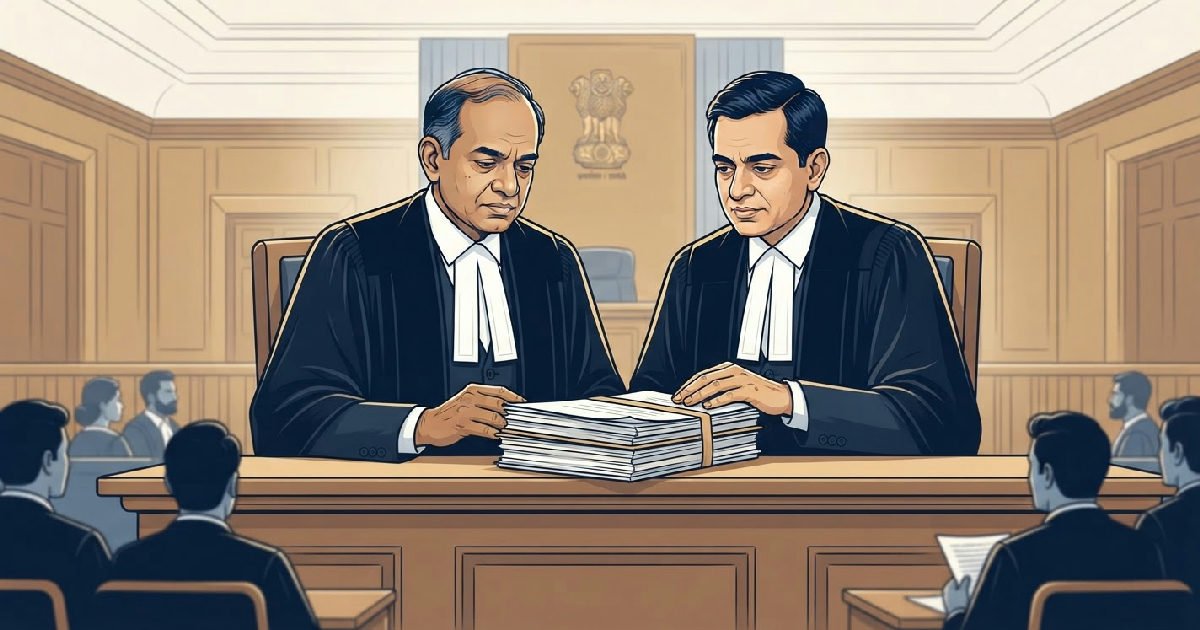
India’s Supreme Court delivered a significant ruling on October 13, 2020, asserting that judicial bodies should adopt a lenient view when defendants seek to introduce additional documents after initially filing their written statements.
This decision, emerging from the case of Sugandhi (Dead) vs. P. Rajkumar, overturned a Madras High Court judgment and re-emphasizes that substantial justice must prevail over strict procedural adherence in civil litigation.
Understanding Order VIII Rule 1A(3) CPC and Lenient View for Document Production
The bench, comprising Justice S. Abdul Nazeer and Justice Sanjiv Khanna, provided crucial guidance. Their pronouncement aims to prevent legitimate claims or defenses from being stifled by procedural hurdles, particularly concerning the critical provision of Order VIII Rule 1A(3) of the Code of Civil Procedure (CPC).
The Code of Civil Procedure, 1908, meticulously outlines the framework for civil proceedings in India. Central to this is the requirement for parties to present their evidence comprehensively and timely. Order VIII Rule 1A CPC specifically addresses the obligations of defendants regarding document production.
This rule mandates defendants to produce all documents in their possession or power along with their written statement. The intention is clear: streamline litigation by ensuring all relevant materials are before the court from the outset. But, the legal system acknowledges that circumstances can sometimes prevent such upfront compliance.
The mandate for initial filing
Order VIII Rule 1A(1) of the CPC makes it clear that defendants must list and present any documents supporting their defense when they file their written statement. Failure to do so typically means these documents won’t be admitted as evidence later. This initial requirement promotes efficiency and fairness, preventing surprises during trial.
Yet, the Supreme Court’s observation highlights that strict enforcement can sometimes lead to injustice. Real-world scenarios often involve delayed discovery of crucial evidence, or documents simply not being immediately accessible. Such situations necessitate a degree of flexibility within the procedural framework.
The ‘safety valve’ of leave
Sub-rule (3) of Order VIII Rule 1A acts as a vital “safety valve” within the procedural code. It grants defendants a second opportunity to produce documents not filed with their initial written statement, provided they secure “leave of the court.” This critical provision was incorporated by Act 22 of 2002 to discourage belated document filing while retaining judicial discretion.
Justices Nazeer and Khanna underscored that this discretion, though vital, must be exercised judiciously. The court acknowledged the maxim that “procedure is the handmaid of justice,” meaning rules should facilitate justice, not impede it. This perspective shapes how courts evaluate requests for additional documents.
It’s important to note, however, that the requirement for court leave does not apply to documents produced for cross-examination of plaintiff’s witnesses or those handed over merely to refresh a witness’s memory.
The Sugandhi vs. Rajkumar Precedent
The pivotal case that led to this Supreme Court pronouncement involved a civil appeal against a judgment from the Madras High Court. The original dispute, O.S. No. 257 of 2014, was filed by P. Rajkumar against Sugandhi (Dead) and another, seeking an injunction related to property.
After the plaintiff had concluded presenting evidence, the defendants, Sugandhi and another, sought to introduce newly traced documents. They filed an application, I.A. No. 551 of 2018, under Order VIII Rule 1A(3) CPC, explaining that these documents were only recently discovered and thus couldn’t be filed with their written statement.
Madras High Court’s earlier decision
Both the trial court and, subsequently, the Madras High Court (Madurai Bench) dismissed the defendants’ application. Their decisions effectively blocked the introduction of the additional documents, upholding a strict interpretation of the filing requirements. This refusal implied that the reasons provided for the delay were deemed insufficient.
The High Court’s stance meant the evidence would not be considered during the suit, potentially impacting the defendants’ ability to present a full defense. This kind of procedural dismissal can often lead to further legal challenges, moving up through the judicial hierarchy in search of an equitable outcome.
Supreme Court’s reasoning
The Supreme Court, however, viewed the matter differently. Justices S. Abdul Nazeer and Sanjiv Khanna observed that the defendants had indeed presented “cogent reasons” for their inability to produce the documents earlier. These reasons included the documents being “recently traced,” which the Supreme Court found to be a credible explanation for the delay.
This finding was critical. It highlighted that when a genuine and verifiable explanation for late production exists, and the documents are relevant to the case, courts should lean towards admitting them. The ruling underscores a judicial philosophy that seeks to uncover the truth in every dispute, ensuring that technicalities don’t overshadow substantive justice.
Balancing Procedure and Substantial Justice
The central tension in such procedural matters often lies between maintaining judicial efficiency and ensuring a fair hearing. The Supreme Court’s ruling carefully navigates this balance. It acknowledges the importance of timely submissions while emphasizing that these rules are ultimately subservient to the pursuit of justice.
The court noted that procedural violations should not “seriously cause prejudice to the adversary party.” If they don’t, courts must “lean towards doing substantial justice rather than relying upon procedural and technical violation.” This statement reflects a pragmatic approach, recognizing that court proceedings are a journey towards truth.
Judicial discretion and its limitations
While the ruling advocates for a lenient approach, it doesn’t endorse unfettered late submissions. The discretion conferred upon the court to grant leave must be exercised judiciously, requiring a “good cause” to be shown by the defendant. There’s no “straitjacket formula,” meaning each case requires careful consideration of its unique facts and circumstances.
This discretion isn’t absolute; it must be exercised sparingly and for an “overpowering reason,” as reinforced in other judicial interpretations. Courts consider whether the documents were previously unknown or genuinely inaccessible, rather than intentionally withheld.
This helps prevent procedural abuse, ensuring that late document submissions are not used as a tactic to unfairly disadvantage an opposing party. The ongoing need for courts to promptly resolve objections in procedural matters remains a critical aspect of efficient justice delivery.
The proposed three-pronged test
Concerns about the potential for abuse and “never-ending trials” due to overly liberal interpretations have led legal scholars to propose structured approaches. A three-pronged test has been suggested for courts to apply when considering the admissibility of documents during trial. This test aims to standardize the discretionary process.
The first prong of this test evaluates the amount and extent of delay, critically assessing the reason behind it. Key considerations include whether documents were truly unavailable or if late introduction is merely an attempt to prolong the trial. This structured evaluation helps courts make more consistent and justifiable decisions.
Here’s a breakdown of considerations in document production applications:
| Factor | Consideration for Court | Potential Outcome if Weak |
|---|---|---|
| Reason for Delay | Was a “good cause” shown (e.g., recently traced, previously unknown)? | Application likely dismissed |
| Document Relevance | Is the document genuinely material to the case and crucial for truth? | Admission denied if irrelevant |
| Prejudice to Adversary | Will late admission unfairly harm the opposing party’s case? | Could lead to rejection or costs |
| Due Diligence | Did the defendant exercise reasonable care to produce documents earlier? | Application viewed critically |
Impact on Civil Litigation in India
This ruling from the Supreme Court has far-reaching implications for civil litigation across India. It provides much-needed clarity and guidance to trial courts, urging them to prioritize the discovery of truth over rigid adherence to procedural timelines. The decision empowers courts to act as instruments of substantial justice, particularly in complex civil disputes.
For defendants, it offers a degree of reassurance that genuine oversights or delayed discoveries of evidence won’t automatically derail their case. This approach fosters a more equitable playing field, reducing the chances of a party losing a case purely on a technicality, especially when compelling new evidence emerges.
Avoiding “never-ending trials”
While promoting leniency, the judiciary is keenly aware of the need to prevent “never-ending trials.” The balance lies in allowing relevant, genuinely unavailable documents without opening the floodgates to strategic delays or the misuse of the process. Justice, after all, delayed is justice denied for all parties involved.
Some judicial interpretations, such as in Billa Jagan Mohan v. Billa Sanjeeva, have noted that clear genuineness and relevance of a document should lead to its allowance. However, this raises concerns that such an approach might inadvertently lessen the burden of showing “good cause,” potentially prolonging proceedings.
Ensuring this balance is crucial for effective judicial administration. Such judicial diligence is echoed in efforts towards clarifying case status even in long-standing legal disputes, underscoring the broader commitment to timely justice.
Distinctions for commercial suits
It’s important to note a key distinction in the application of these rules. While the CPC’s timelines for filing written statements are generally considered directory in non-commercial suits, allowing for condonation of delays, they are significantly stricter in commercial disputes. Under the Commercial Courts Act, 2015, a mandatory 90-day limit applies.
This divergence reflects the specific demands of commercial litigation, where speed and certainty are paramount. Therefore, while the spirit of leniency in producing documents may still apply in commercial cases, the threshold for demonstrating “good cause” for delay is likely to be considerably higher due to these stringent statutory deadlines.
Key takeaways for litigants and courts
The Supreme Court’s ruling in Sugandhi (Dead) vs. P. Rajkumar provides a clear mandate: courts should approach applications for late document production with an eye towards substantial justice. For litigants, this means that while due diligence in initial filing remains critical, a robust and genuine explanation for delayed document discovery can sway a court.
For trial courts, the directive encourages a flexible yet judicious application of Order VIII Rule 1A(3) CPC. The focus should be on whether admitting the document aids in discovering the truth without unduly prejudicing the opposing party or intentionally delaying proceedings. This ruling helps ensure that the legal process remains fair and adaptable to unforeseen circumstances.
What is Order VIII Rule 1A(3) of the CPC?
Order VIII Rule 1A(3) of the Civil Procedure Code (CPC) is a legal provision that permits defendants to submit documents even after their initial written statement has been filed. While the general rule is to file documents upfront, this sub-rule allows for later submission with the express permission, or “leave,” of the court, typically upon demonstration of a valid reason for the delay.
Why did the Supreme Court emphasize leniency in this ruling?
The Supreme Court emphasized taking a lenient view to prioritize substantial justice over rigid procedural technicalities. The court clarified that procedural rules are designed to facilitate justice, not to obstruct it. By allowing a lenient approach for genuine reasons of delay, the court aims to prevent legitimate defenses from being dismissed due to mere procedural oversights, thus promoting fair outcomes.
Does this ruling mean defendants can always submit documents late without consequence?
No, this ruling does not grant defendants an automatic right to submit documents late. The Supreme Court underscored that the discretion to permit late production must be exercised judiciously. Defendants are still required to provide “cogent reasons” or “good cause” for the delay, ensuring the process is not abused and that while flexibility is offered, procedural discipline remains essential for efficient litigation.