
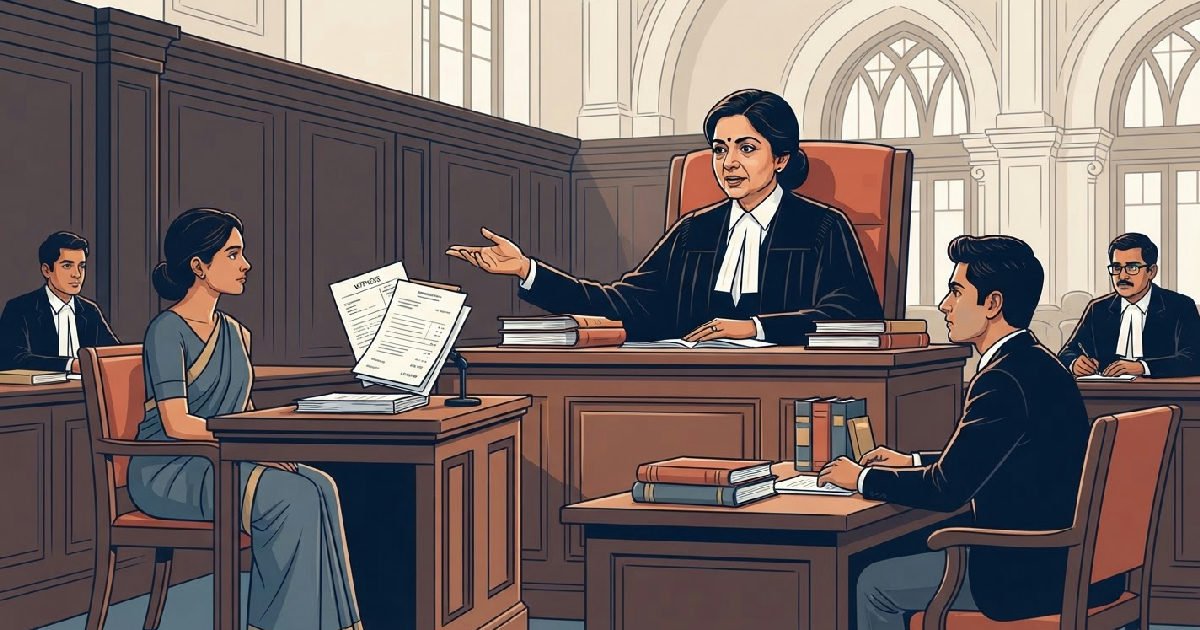
The Bombay High Court has delivered a significant procedural clarification, ruling that a defendant in a civil suit does not need to file a separate application to produce new documents when cross-examining a witness. The March 10, 2026, judgment affirms that this right is protected, provided the documents are relevant to the pleadings and are used to contradict the witness or refresh their memory.
In a decision that streamlines a contentious aspect of trial procedure, Justice Gauri Godse set aside a lower court’s order that had barred a defendant from using receipts to confront a plaintiff. The ruling reinforces the principle that procedural rules should not obstruct the truth-finding process, especially where the law provides clear exceptions for cross-examination.
Separate application needed for document production
The court’s decision revolves around a nuanced interpretation of the Code of Civil Procedure, 1908 (CPC). The general rule, found in Order VIII Rule 1A(1), requires a defendant to produce all documents they rely upon for their defense at the time of filing their written statement. Failure to do so typically prevents them from submitting those documents into evidence later without the court’s express permission.
However, the code itself carves out critical exceptions. The High Court’s ruling hinges on Order VIII Rule 1A(4), which explicitly states that the rule does not apply to documents “produced for the cross-examination of the plaintiff’s witnesses.” This sub-rule, along with a similar provision in Order XIII Rule 1(3), creates a specific allowance for introducing documents at this later stage.
This procedural safeguard is designed to work in tandem with Section 145 of the Indian Evidence Act (now Section 148 of the Bharatiya Sakshya Adhiniyam). This section allows a witness to be challenged with their own previous written statements to test their credibility.
The court noted that these provisions collectively ensure that cross-examination remains an effective tool for uncovering facts during a civil trial. The prompt resolution of procedural matters is key, much like the requirement for swift decisions in cases involving an obvious limitation bar.
Aligning with a landmark Supreme Court precedent
Justice Godse’s ruling does not exist in a vacuum. It strongly aligns with and reinforces a landmark judgment from the Supreme Court of India in December 2023. In the case of Mohammed Abdul Wahid v. Nilofer & Anr., the nation’s top court decisively settled a previously debated legal question on this very issue.
Prior to that verdict, a 2021 Bombay High Court judgment had created a confusing distinction. It held that new documents could be introduced during cross-examination to confront a witness, but not if that witness was a party to the suit (i.e., the plaintiff or defendant). This interpretation created an artificial barrier, limiting a powerful truth-testing mechanism against the primary parties in a lawsuit.
The Supreme Court bench of Justices B.R. Gavai and Sanjay Karol explicitly overturned that view. Justice Karol, authoring the opinion, stated that “witnesses and parties to a suit, for the purposes of adducing evidence, either documentary or oral are on the same footing.”
This key finding eliminated the distinction, confirming that any person on the witness stand can be confronted with relevant, previously undisclosed documents. This clarification helps prevent prolonged legal battles over procedural nuances, much like how the Madhya Pradesh High Court recently addressed a 26-year-old undecided case by clarifying res judicata.
The recent Bombay High Court order faithfully applies this Supreme Court ratio, ensuring that procedural law within Maharashtra is consistent with the national standard. It confirms that the right to confront extends equally to all witnesses, including the opposing party.
The core reasoning: truth-seeking and the element of surprise
At the heart of the court’s reasoning is the fundamental purpose of a trial: the discovery of truth. Cross-examination is one of the most vital tools available to the court and litigants to achieve this. Its effectiveness often depends on the ability to challenge a witness’s testimony with evidence they may not be expecting.
If a party were required to file an application and seek the court’s leave before every such confrontation, the strategic “element of surprise” would be lost. The opposing witness would have time to prepare explanations or tailor their testimony, potentially defeating the purpose of the cross-examination. The court’s ruling protects this crucial tactical element.
In her order, Justice Godse observed that when a document is produced to contradict a witness under these established exceptions, it “must be taken on record, and for doing so, leave of the Court is not required.”
This is a direct instruction to trial courts to permit such production without the procedural hurdle of a separate application, as long as the document is relevant to the matters in question.
Comparing document production rules in civil suits
The distinction between documents for the main defense and those for cross-examination is a critical one for litigants to understand. The following table breaks down the key differences based on the Civil Procedure Code.
| Procedural Aspect | General Rule for Defence Documents | Exception for Cross-Examination |
|---|---|---|
| Timing of Production | Must be filed along with the written statement. | Can be produced for the first time during cross-examination. |
| Requirement for Court Leave | Required for any document not filed with the written statement. | No leave of the court is required. |
| Primary Purpose | To establish the defendant’s primary case and defense. | To contradict a witness or refresh their memory. |
| Governing Principle | Ensures early disclosure and prevents trial by ambush. | Preserves the element of surprise for effective truth-testing. |
| Key CPC Provision | Order VIII Rule 1A(1) & (3) | Order VIII Rule 1A(4) & Order XIII Rule 1(3) |
The specific facts of the Jijabhau Temgire case
The High Court’s ruling came in a writ petition titled Jijabhau Dyaneshwar Temgire v. Gangaram Khandu Temgire & Ors. The case arose after a Civil Judge rejected the defendant’s attempt to produce certain receipts during the cross-examination of Plaintiff No. 1.
The defendant argued that the receipts were directly relevant to the defense they had already outlined in their written statement and were intended solely to confront the plaintiff’s testimony. The trial court, however, took a rigid view of Order VIII Rule 1A, holding that since the documents were not produced at the initial stage, they could not be introduced now.
Justice Godse found this interpretation to be flawed. The High Court held that the defendant’s intended use of the documents fell squarely within the exceptions provided by the CPC and the principles of the Evidence Act.
Consequently, the High Court allowed the writ petition, quashed the impugned order of the trial court, and directed that the defendant be permitted to produce the documents to confront the plaintiff.
Practical implications for civil litigation
This ruling provides much-needed clarity for civil litigators in Maharashtra and reinforces a national trend. It empowers lawyers to conduct more dynamic and effective cross-examinations, knowing they can use relevant documents to challenge testimony without getting bogged down in procedural applications.
However, legal experts caution that this isn’t a free pass to hide evidence. The exception is narrow; it applies only to documents used for contradiction or refreshing memory during cross-examination. It doesn’t excuse a party from their primary duty to disclose all documents they rely on to build their own case.
Other High Courts have maintained a strict stance on this, as seen in a May 4, 2026, Himachal Pradesh High Court ruling. That court refused to allow belated production of public records, such as Jamabandi and mutation records, due to a lack of due diligence.
This creates a clear distinction: documents that form the foundation of your case must be disclosed upfront. Documents used as a sword to test the other side’s testimony can be held back for the strategic moment of cross-examination.
This ensures that while the search for truth remains paramount, parties must still conduct their cases with diligence, upholding fundamental procedural requirements. This adherence extends to understanding the proper scope of execution court powers, ensuring no unintended reliefs are granted in decree cases.
A clear judicial trend toward substantive justice
The journey from the restrictive 2021 Bombay High Court view to the expansive 2023 Supreme Court judgment, and now this reaffirming 2026 High Court order, shows a clear judicial direction. Courts are increasingly prioritizing substantive justice over procedural rigidity, especially when the procedural code itself provides for flexibility.
The consistent message is that the ultimate goal of a civil trial is to adjudicate a dispute based on facts and truth. While procedural rules are essential for order and fairness, they are intended to be the handmaiden of justice, not a tool to obstruct it. This ruling ensures that in the context of cross-examination, the procedural framework serves its intended truth-seeking purpose.
What is Order VIII Rule 1A of the CPC?
Order VIII Rule 1A of the Civil Procedure Code primarily requires the defendant in a lawsuit to file all documents in their possession that they rely on for their defense. This must be done at the same time they file their written statement. However, a key exception allows for documents to be produced later specifically for cross-examining the plaintiff’s witnesses.
Can I introduce any document during cross-examination?
No, the right is not unlimited. The document must be relevant to the matters in question in the suit and cannot be completely “foreign to the pleadings.” Its purpose must be to either contradict a statement made by the witness or to refresh the witness’s memory. You cannot use this exception to introduce documents that should have formed the core of your own evidence earlier.
Does this ruling apply to confronting the plaintiff themselves?
Yes. A landmark Supreme Court ruling in December 2023 clarified that there is no difference between a regular witness and a party to the suit (like a plaintiff or defendant) when they are on the witness stand. Therefore, a defendant can use a previously undisclosed document to confront the plaintiff during their cross-examination, just as they could with any other witness.