
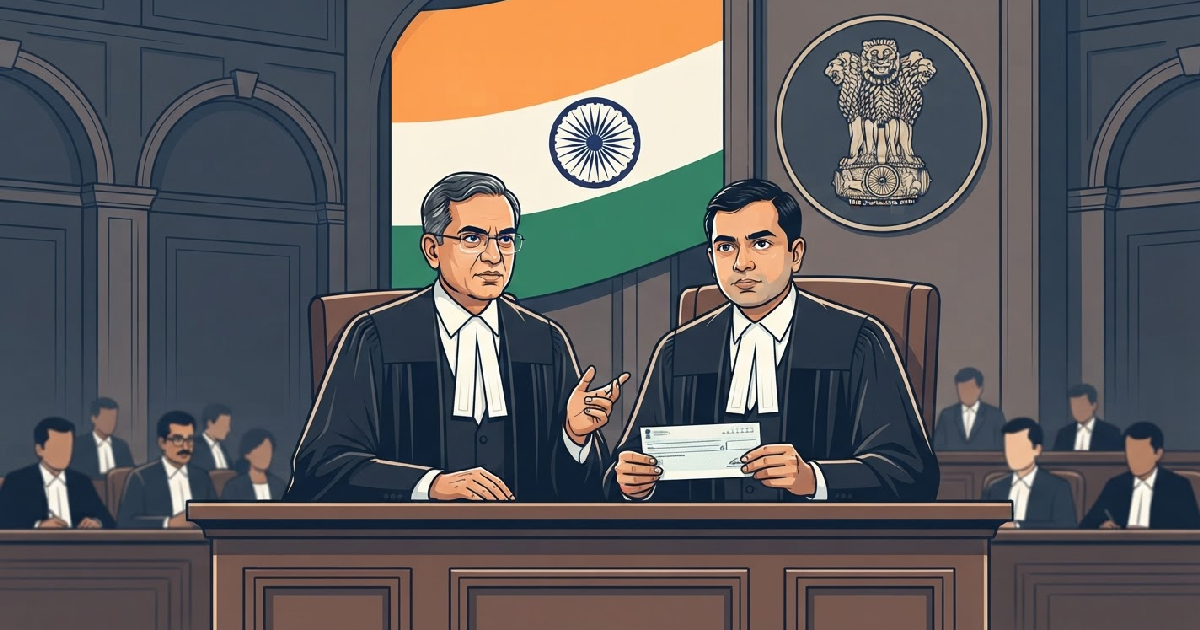
India’s Supreme Court ruled on March 15, 2024, that interim compensation cheque dishonour cases under the NI Act, 1881, require a formal plea of not guilty from the accused. This crucial ruling, delivered on March 15, 2024, by a Division Bench of Justices Abhay S.
Oka and Ujjal Bhuyan, in the case of Rakesh Ranjan Shrivastava v. The State of Jharkhand, emphasizes the discretionary nature of Section 143A of the Act.
Supreme Court restricts interim compensation in cheque dishonour cases
The apex court unequivocally stated that the word “may” in Section 143A(1) of the NI Act cannot be interpreted as “shall,” granting trial courts vital judicial discretion. This judgment prevents premature imposition of interim compensation, ensuring a more balanced and equitable process for those accused in cheque bounce matters across the country.
The Supreme Court’s decision establishes a clear timeline for when interim compensation can be mandated in cases involving dishonoured cheques. Previously, there was some ambiguity surrounding the exact stage at which such orders could be issued, leading to varied practices across lower courts.
Now, courts can only consider ordering this compensation once the accused has entered a “not guilty” plea in summary or summons cases. For other case types, the order can only be made after the formal framing of charges against the accused.
This clarification underscores that Section 143A is a tool to be used judiciously, not as an automatic penalty. Justices Oka and Bhuyan highlighted the need for trial courts to apply their minds to the specific facts of each case before issuing any such directives.
The ruling aims to balance the complainant’s need for interim relief with the accused’s right to a fair trial and defence. It ensures that an accused individual is given a proper opportunity to formally present their defence before financial obligations are imposed.
The evolution of India’s cheque dishonour law
The Negotiable Instruments Act, 1881, originally established the legal framework for various financial instruments, including cheques. Its primary goal was to foster confidence in financial transactions and ensure their smooth functioning within the Indian economy.
A significant amendment in 1988 introduced Section 138, which criminalized the dishonour of cheques due to insufficient funds. This change aimed to deter individuals from issuing cheques without sufficient backing, thereby boosting the reliability of cheque transactions.
Despite these measures, the Indian judicial system has been grappling with a massive backlog of cheque dishonour cases. As of December 2019, approximately 3.516 million cases were pending under Section 138, a number that surged to over 4.3 million by December 2024.
These cases represent a substantial portion of the court’s workload, accounting for about 13.2% of all cases and sometimes as much as 30-40% of pending cases in specific High Courts. This overwhelming caseload necessitated further legislative intervention to expedite resolutions.
In response, the Negotiable Instruments (Amendment) Act, 2018, introduced two pivotal provisions: Section 143A and Section 148. These amendments, which became effective on September 1, 2018, aimed to address the persistent delays and provide timely relief to complainants.
Section 143A specifically empowers courts to order the drawer of a dishonoured cheque to pay interim compensation. It was designed to offer some financial solace to complainants while their cases proceeded through the often-lengthy legal process.
Judicial discretion: more than a mere formality
The Supreme Court’s emphasis on judicial discretion in ordering interim compensation fundamentally shifts how Section 143A is applied. Courts must now move beyond a mechanical approach, carefully evaluating each case’s unique circumstances.
This includes a prima facie assessment of the complainant’s claims and the defence presented by the accused. Factors such as the nature of the transaction between the parties, their relationship, and the accused’s capacity to pay the compensation must also be weighed.
The ruling mandates that trial courts provide brief, clear reasons for either granting or refusing interim compensation. Orders issued without proper reasoning or those appearing to be passed mechanically are now susceptible to challenge and likely to be overturned.
While interim compensation can be up to 20% of the cheque amount, courts are not to automatically award the maximum. The quantum should reflect a careful consideration of the case’s specifics, rather than a blanket application of the highest permissible percentage.
The Court reiterated earlier precedents, such as *G.J. Raja vs. Tejraj Surana*, confirming that Section 143A applies prospectively. This means it only covers offences where the cheque dishonour occurred on or after its effective date of September 1, 2018.
This discretionary approach was foreshadowed by High Court rulings, including *M/S JSB Cargo and Freight Forwarder Pvt Ltd v State and Anr* by the Delhi High Court. That judgment correctly interpreted “may” as conferring discretion, a position now firmly upheld by the Supreme Court.
Crucial procedural milestones for compensation
The Supreme Court’s decision hinges on specific procedural triggers before an order for interim compensation can be made. This ensures due process and prevents any arbitrary imposition of financial obligations on the accused.
In cases tried under summary procedures or as summons cases, the court gains the authority to consider interim compensation only after the drawer of the cheque explicitly pleads “not guilty.” This moment is pivotal, marking the accused’s formal challenge to the accusation.
For all other types of cheque dishonour cases, the critical juncture is the framing of charges. Once charges are formally laid, the court can then exercise its discretion to order interim compensation, guided by the principles outlined in the recent ruling.
Once ordered, the interim compensation must be paid within 60 days from the date of the court’s order. The court has discretion to extend this period by an additional 30 days, provided the drawer presents sufficient cause for the delay.
An important safeguard for the accused is the provision for repayment upon acquittal. Should the drawer of the cheque ultimately be acquitted, the complainant is legally bound to repay the interim compensation.
This repayment includes interest calculated at the bank rate published by the Reserve Bank of India, prevalent at the start of the relevant financial year, within 60 days, with a possible 30-day extension for good cause.
The method of recovery for interim compensation is also clearly defined; it can be recovered as if it were a fine under Section 421 of the Code of Criminal Procedure, 1973. Additionally, any amount paid or recovered as interim compensation under Section 143A will reduce the fine imposed under Section 138 of the NI Act or compensation awarded under Section 357 of the CrPC.
This structured approach ensures transparency and fairness throughout the legal process. It clarifies the rights and obligations of both parties involved in a cheque dishonour case law.
| Provision Aspect | Detail/Requirement | Notes |
|---|---|---|
| Statutory Basis | Section 143A, Negotiable Instruments Act, 1881 | Introduced by 2018 Amendment |
| Triggering Event for Order | Accused pleads ‘not guilty’ (summary/summons cases) OR Charge framed (other cases) | Not before these stages |
| Nature of Power | Discretionary (Court ‘may’ order) | Not mandatory; requires reasoned order |
| Maximum Compensation | 20% of Cheque Amount | Not a default or automatic amount |
| Payment Deadline | 60 days from order | Extendable by up to 30 days for sufficient cause |
| Repayment on Acquittal | Yes, with RBI bank rate interest | Within 60 days, extendable by 30 days |
| Recovery Method | As fine under Section 421 CrPC | Enforceable through criminal procedure |
Ramifications for legal strategy and case management
This Supreme Court pronouncement carries substantial ramifications for both complainants and the accused in cheque dishonour litigation. It mandates a more robust and evidence-based approach from the outset of such cases.
Complainants can no longer anticipate an automatic interim compensation order early in the proceedings. They must now ensure their prima facie case is meticulously presented and strong enough to warrant such a discretionary order after the accused has formally responded to the charges.
For the accused, the ruling provides a clearer defensive pathway and safeguards against arbitrary financial demands. It creates a stronger incentive to engage with the legal process at an earlier stage, presenting a well-reasoned defence to counter any claims for interim compensation.
Trial courts, in turn, face heightened responsibility to apply Section 143A with meticulous care. Their orders must be detailed, well-reasoned, and clearly demonstrate that judicial discretion was exercised thoughtfully, rather than as a pro-forma action.
The ruling also clarifies the interplay between Section 143A and Section 148, another key provision introduced by the 2018 amendments. Section 148 allows appellate courts to direct a convicted appellant to deposit a minimum of 20% of the fine or compensation.
The Supreme Court has affirmed that any amount payable under Section 148(1) is in addition to interim compensation previously paid under Section 143A. This ensures distinct but complementary roles for these provisions in the overall framework for addressing cheque dishonour.
Legal experts suggest this ruling will encourage more circumspect use of interim compensation. It will likely foster more rigorous evidentiary standards and potentially streamline the process by focusing on the substantive merits of the case from an earlier point.
When can a court order interim compensation in a cheque dishonour case?
Based on the Supreme Court’s ruling of March 15, 2024, a court can order interim compensation only after the accused formally pleads not guilty in summary or summons cases. In other types of cases, this can occur only after charges have been formally framed.
Is the court obligated to award interim compensation under Section 143A of the NI Act?
No, the Supreme Court has clarified that Section 143A is discretionary, not mandatory. Courts must exercise careful judicial discretion, thoroughly considering the specific merits and circumstances of the case, and are not bound to automatically award interim compensation.
What happens if the accused is acquitted after paying interim compensation?
If the drawer of the cheque is ultimately acquitted, the complainant is legally required to repay the interim compensation amount. This repayment must also include interest calculated at the prevailing bank rate published by the Reserve Bank of India, and typically needs to be completed within 60 days, with a possible 30-day extension.