
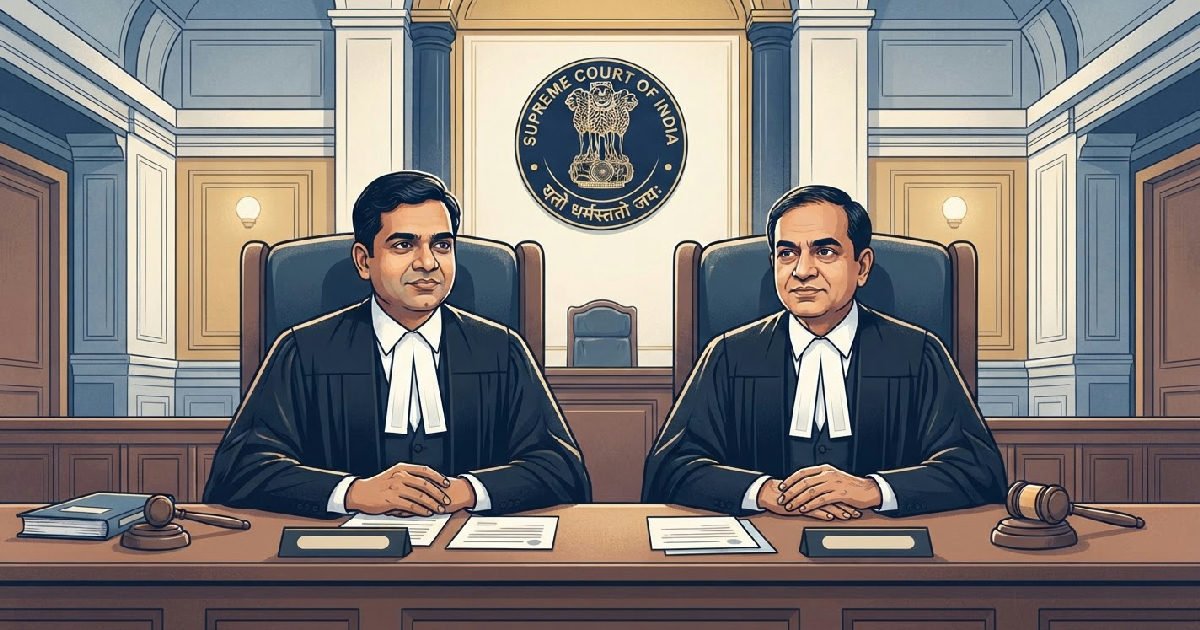
India’s Supreme Court, through a bench comprising Justices Aravind Kumar and SVN Bhatti, recently overturned an acquittal in the case of Rajesh Jain v. Ajay Singh. This pivotal decision, delivered on October 9, 2023, clarified the crucial application of Section 139 of the Negotiable Instruments Act, 1881, in cheque dishonour cases.
The apex court pinpointed a “fundamental flaw” in how both the Trial Court and the Punjab and Haryana High Court had approached the evidential burden. Their ruling reinforces the stringent legal framework governing cheque transactions, significantly impacting how these cases are adjudicated across the country.
Supreme Court’s decisive ruling on cheque dishonour cases
The landmark judgment in Rajesh Jain v. Ajay Singh specifically addressed what courts must inquire into once the presumption under Section 139 of the Negotiable Instruments Act, 1881, is activated. This presumption dictates that a cheque was issued to discharge a debt or liability, shifting the onus onto the accused.
Justices Aravind Kumar and SVN Bhatti emphasized that once the accused admits their signature on the cheque, and its execution is proven, the legal focus shifts entirely. Courts must then scrutinize the defense presented by the accused, rather than expecting the complainant to re-prove the debt.
Reversing lower court’s ‘fundamental flaw’
The Supreme Court found a critical misstep in the lower courts’ reasoning. They had mistakenly required the complainant to present additional evidence to support the loan, even after the Section 139 presumption had taken effect.
This approach, the Court stated, contradicted the very essence of the statutory presumption. The burden was on the accused to demonstrate the non-existence of the debt, not on the complainant to independently re-establish it at that stage.
Ultimately, the Supreme Court reversed the acquittal of the respondent-accused. It also imposed a substantial fine of Rs. 13,90,408, double the cheque amount. Failure to pay this fine would result in one year of simple imprisonment.
Core questions for courts to ask
The ruling outlined two key questions that courts should pose once the signature and execution of a cheque are established. These inquiries guide the judicial process when the Section 139 presumption is active.
First, has the accused presented defense evidence to conclusively establish that no debt or liability existed at the time of the cheque’s issuance? This requires active participation from the defense.
Second, if direct rebuttal evidence is lacking, has the accused proven the non-existence of debt by a preponderance of probabilities? This can be inferred from the particular circumstances of the case, demanding a coherent narrative from the defense.
The evolving legal landscape of negotiable instruments
The Negotiable Instruments Act, 1881, forms a cornerstone of India’s mercantile law. It was originally crafted to standardize practices around promissory notes, bills of exchange, and cheques.
Before 1988, dishonouring a cheque was largely a civil matter, leading to protracted legal battles. This often undermined confidence in cheques as a reliable payment method. The lengthy civil process made financial recovery difficult.
Historical context of the Negotiable Instruments Act
The 1988 amendment marked a significant shift, introducing Chapter XVII with Sections 138 to 142. These sections criminalized cheque dishonour under specific conditions. The aim was to bolster financial discipline and ensure the credibility of cheque transactions.
Section 138 outlines the conditions for prosecution, such as insufficient funds or signature mismatch. A legal notice and failure to pay within a stipulated time are also prerequisites. This legislative change provided a stronger legal recourse for payees.
Burden of proof: complainant to accused
Section 139 of the Act is central to these cases, establishing a legal presumption that a dishonoured cheque was issued against a valid debt or liability. This “reverse onus clause” places the initial burden of rebuttal firmly on the accused.
The Supreme Court has consistently reinforced this principle, stating that the complainant does not need to further prove the debt until the accused discharges their evidential burden. The standard for this discharge is a “preponderance of probabilities,” meaning the accused just needs to show their defense is more likely than not.
Once the accused successfully rebuts this presumption, the burden shifts back to the complainant. The complainant must then independently prove the existence of the debt or liability, without relying on the initial statutory presumption. This crucial aspect dictates courtroom strategy. A well-prepared criminal defense attorney understands this dynamic.
Precedent and the enduring impact of Section 139
This recent Supreme Court ruling isn’t an isolated incident; it builds upon a series of judgments that have shaped the interpretation of Section 139. These precedents collectively strengthen the enforceability of cheques.
The judiciary aims to ensure that the legislative intent behind the 1988 amendment is upheld. This consistency provides clarity for both litigants and the legal fraternity, minimizing ambiguous interpretations of the law.
Landmark rulings shaping the legal interpretation
The 2010 case of Rangappa v. Sri Mohan was foundational, establishing that Section 139’s presumption includes the existence of a legally enforceable debt. It clarified that this presumption is rebuttable, but only if the accused presents a probable defense.
Later, Krishan Rao v. Shankargounda (2018) underscored that mere denial isn’t enough to rebut the presumption. Concrete evidence is required. Bir Singh v. Mukesh Kumar (2019) further affirmed that the accused bears the initial burden to prove the cheque wasn’t for a debt.
In Rohitbhai Jivanlal Patel v. State of Gujarat (2019), the Court reiterated that admitting the signature on a cheque activates the Section 139 presumption, shifting the burden to the accused. More recently, M/s S. S. Production v. Tr. Pavithran Prasanth (2024 INSC 1059) reinforced this principle, highlighting the accused’s onus for rebuttal. This consistent judicial stance reaffirms burden of proof requirements.
Tackling the backlog: pendency of cheque bounce cases
The clarity provided by the Supreme Court is particularly relevant given the staggering number of pending cheque dishonour cases across India. These cases represent a significant portion of the country’s criminal litigation.
The sheer volume often contributes to delays, impacting the efficiency of the justice system. Addressing this backlog remains a critical challenge for judicial bodies nationwide.
Statistical overview across India
As of December 18, 2024, more than 4.3 million (43 lakh) cheque bounce cases were awaiting resolution in various Indian courts. This highlights a persistent and widespread issue within the legal system.
Rajasthan leads with over 6.4 lakh pending cases, while Delhi alone accounted for 5.55 lakh cases by October 9, 2025. This figure represents approximately 36% of the capital’s total criminal case pendency.
Cheque dishonour cases constitute a substantial 8.81% of all criminal cases in India. Between November (previous year unspecified) and April 30, 2022, the pendency increased by 737,124 cases, rising from 2.6 million to over 3.3 million. An empirical study of cases filed between 1980 and 2015 showed an average pendency of 1,326 days, exceeding three years and seven months.
| Metric | Detail |
|---|---|
| Total Pending Cases (Dec 2024) | Over 4.3 million (43 lakh) |
| Cases in Rajasthan | Exceeding 6.4 lakh |
| Cases in Delhi (Oct 2025) | 5.55 lakh (36% of Delhi’s total criminal cases) |
| Increase in Pendency (Nov-Apr 2022) | 737,124 cases |
| Share of All Criminal Cases | 8.81% |
| Average Pendency (1980-2015 study) | 1,326 days (over 3 years, 7 months) |
Judicial reforms for faster disposal
Recognizing the immense caseload, the Supreme Court has initiated measures to expedite the resolution of these cases. On March 10, 2021, the Court constituted a committee specifically to address this issue.
These reforms aim to streamline judicial processes and reduce the burden on courts. They also seek to ensure timely justice for both complainants and accused individuals, improving the overall efficiency of the legal system.
Implications for commercial transactions and legal strategy
The Supreme Court’s consistent rulings on Section 139 have far-reaching implications. They affect how commercial transactions are conducted and how legal strategies are formulated in cheque dishonour disputes.
The clarity provided helps foster greater certainty in financial dealings. This, in turn, can strengthen the trust placed in negotiable instruments as a reliable method of payment.
Reinforcing financial discipline
Legal experts believe that the Supreme Court’s firm stance on Section 139 reinforces the importance of financial discipline. It sends a clear message that cheques are serious financial commitments, not mere promises.
This judicial reinforcement helps to deter individuals from issuing cheques without sufficient funds or genuine intent to honor them. It promotes greater responsibility among those who utilize these financial instruments in their daily dealings.
Strategic shifts for litigants
For the accused, the judgment means a strong defense must go beyond simple denials. They must present concrete evidence or establish a probable case demonstrating the absence of debt. Merely raising suggestions during cross-examination won’t suffice.
For complainants, the ruling reduces the initial burden of proving financial capacity to lend. That burden only shifts if the accused successfully challenges the presumption. Understanding these nuances is crucial for success, and seeking legal steps for recovery becomes more strategic.
The Court has also clarified that a cheque dishonour complaint cannot be quashed at the pre-trial stage if the basic ingredients of Section 138 are met. The question of a legally enforceable debt is a matter to be thoroughly examined during the trial itself, ensuring a full and fair hearing.
Looking ahead: strengthening India’s payment system
The Supreme Court’s proactive approach to refining the interpretation of the Negotiable Instruments Act reflects a broader commitment. It aims to fortify India’s financial and legal infrastructure.
As the economy continues to digitize, the role of reliable payment instruments like cheques remains vital. Clear legal guidelines are essential to maintain confidence in these systems.
Ensuring fair and efficient adjudication
The directives from Justices Aravind Kumar and SVN Bhatti provide a standardized framework. This helps lower courts across the country apply Section 139 consistently and fairly.
Such judicial clarity is paramount for reducing discrepancies in judgments. It also contributes to a more efficient disposal of pending cases, ensuring justice isn’t delayed for technical reasons.
Impact on commercial confidence
Businesses and individuals rely heavily on cheques for various transactions. The strengthened legal framework instills greater trust in these instruments.
Knowing that the legal system provides robust mechanisms for recourse in cases of dishonour encourages wider adoption of formal payment methods. This fosters a more secure and predictable commercial environment.
What is Section 139 of the Negotiable Instruments Act?
Section 139 of the Negotiable Instruments Act, 1881, creates a legal presumption. It states that unless proven otherwise, a cheque that has been dishonoured was issued to discharge a legally enforceable debt or liability. This shifts the burden of proof to the accused.
How can an accused person rebut the Section 139 presumption?
An accused person can rebut this presumption by providing evidence that, on a “preponderance of probabilities,” there was no debt or liability at the time the cheque was issued. This evidence can be direct or circumstantial, but mere denial is generally not considered sufficient.
What happens if the accused successfully rebuts the presumption?
If the accused successfully rebuts the presumption under Section 139, the burden of proof shifts back to the complainant. The complainant must then independently prove the existence of the debt or liability, without relying on the initial statutory presumption from Section 139.