
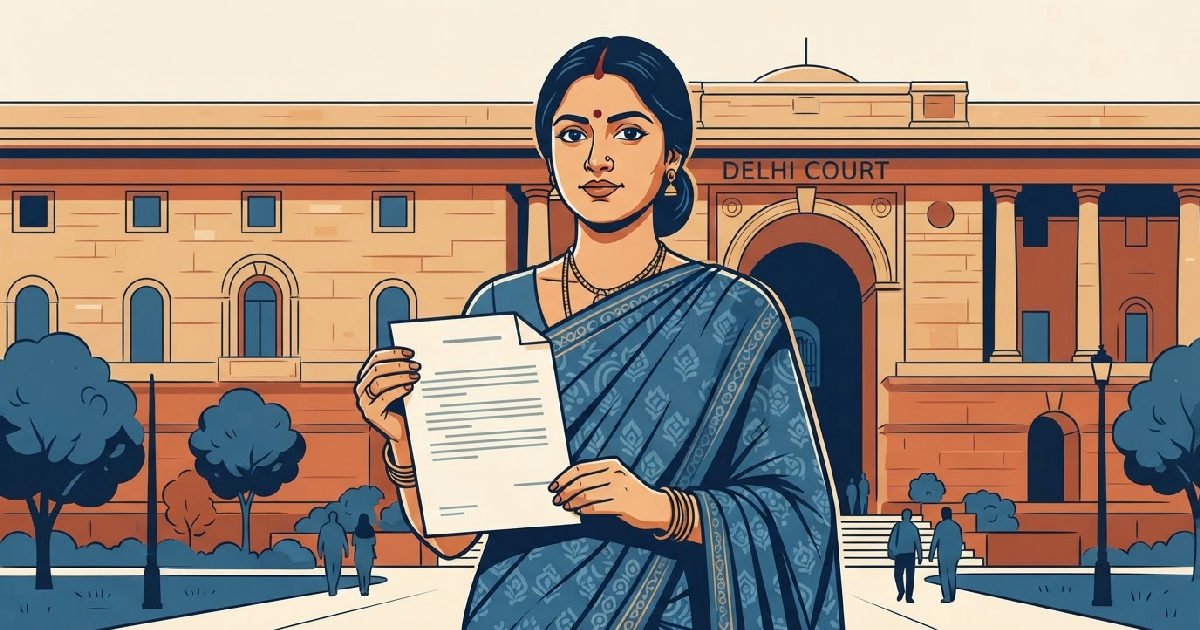
Delhi courts have consistently underscored the absolute ownership rights of a Hindu married woman over her Stridhan, a legal principle that frequently comes to the forefront during matrimonial disputes and separations. This stance by Delhi courts reinforce the wife’s complete control over her property.
The judiciary maintains that any property or wealth received by a woman before, during, or after her marriage remains her exclusive domain, with significant legal repercussions for husbands or their relatives who attempt to withhold it.
Stridhan not returned: Delhi courts define
This firm stance by the courts aims to protect a woman’s financial autonomy and provides a clear framework for redressal when these assets are not returned. The refusal to relinquish Stridhan is not merely a civil matter but can also carry criminal liability, intensifying the pressure on estranged spouses to comply with legal mandates.
Stridhan, a term rooted in Sanskrit, literally translates to “woman’s wealth.” It encompasses all movable and immovable property voluntarily bestowed upon a woman, whether before, during, or after her marriage. This includes a wide array of assets, from gold and diamond jewelry to cash gifts, wedding presents, property inherited or gifted by parents, and even assets purchased with her personal savings.
It’s crucial to distinguish Stridhan from dowry. While dowry is often demanded by the groom’s family, Stridhan is always voluntarily given and recognized legally as the woman’s absolute property. This fundamental difference underpins a woman’s inalienable right to claim her Stridhan, even if her marriage ends in separation or divorce.
Neither her husband nor his relatives can exert control over these assets; they are considered mere custodians.
Courts uphold absolute ownership rights
The Supreme Court of India has, through multiple landmark judgments, unequivocally affirmed the absolute ownership of Stridhan by a Hindu married woman. These rulings establish that a wife possesses an unfettered right to dispose of her Stridhan at will, reinforcing that her husband holds no legitimate claim or control over these assets.
This legal clarity offers a critical safeguard for women, ensuring their financial independence throughout their lives.
Key among these pronouncements was the 1985 judgment in Pratibha Rani v. Suraj Kumar, where the Supreme Court meticulously clarified the concept of Stridhan and unequivocally upheld the wife’s absolute ownership.
This was further solidified in 2016 with Krishna Bhattacharjee v. Sarathi Choudhury, where the Court decreed that a woman could claim her Stridhan even after judicial separation or divorce, asserting that refusal to return it constitutes an ongoing offence.
The Delhi High Court has similarly championed these rights, consistently upholding a woman’s entitlement to her Stridhan. These judicial decisions collectively form a robust legal shield, allowing women to reclaim their rightful property without undue legal hurdles, emphasizing that the protection of Stridhan is paramount in matrimonial disputes.
Criminal liability and continuing offence
The misappropriation or refusal to return Stridhan by a husband or his relatives can lead to severe legal consequences, extending beyond civil disputes to criminal liability.
Under Section 406 of the Indian Penal Code (which has since been re-designated as Section 316 of the Bharatiya Nyaya Sanhita, 2023), such actions are classified as a criminal breach of trust. This provision allows for penal action against those who unlawfully retain a woman’s property.
Crucially, the refusal to return Stridhan is deemed a “continuing offence.” This legal classification holds significant implications, primarily eliminating any strict limitation period for its recovery. The offence is considered to persist as long as the property remains unreturned, offering women an extended window to pursue their claims without being time-barred. This ensures that justice is not denied merely due to procedural delays.
This “continuing offence” doctrine provides considerable relief to women who might face obstacles in immediately pursuing their claims, such as emotional distress, lack of resources, or ongoing attempts at reconciliation. It underscores the judiciary’s commitment to protecting women’s property rights, ensuring that a refusal to return Stridhan is not a one-time event with a rapidly expiring claim period but a persistent legal wrong.
Delhi High Court’s firm stance on Stridhan recovery
The Delhi High Court has played a pivotal role in strengthening the legal protections surrounding Stridhan, issuing several rulings that reinforce women’s rights. These judgments have not only clarified the legal position but have also broadened the avenues through which women can seek restitution.
In the significant 2007 case of S. R. Batra v. Smt. Taruna Batra, the Delhi High Court explicitly ruled that Stridhan is a woman’s personal property. It unequivocally stated that the husband and his family cannot assert any rights over it, going so far as to order its immediate return.
This ruling set a strong precedent, empowering women to demand their assets without protracted legal battles.
Beyond traditional legal channels, the Delhi High Court has also innovated by ruling that Stridhan recovery can be treated as a consumer dispute under the Consumer Protection Act. This opens up an additional pathway for women to approach consumer courts, providing a potentially faster and more accessible forum for resolving these disputes.
This progressive interpretation reflects a dedication to finding practical solutions for women seeking their rightful property.
Evidence is crucial for recovery claims
While the legal framework strongly supports a woman’s right to Stridhan, the practical challenge often lies in proving ownership and possession. Matrimonial lawyers in Delhi consistently advise clients on the critical importance of maintaining thorough records. Vague claims or inflated lists of items without supporting documentation can significantly weaken an otherwise legitimate case.
When pursuing recovery, providing a detailed list of all items considered Stridhan is essential. Furthermore, supplying accompanying bills, receipts, or any other proof of purchase or gift strengthens the claim immensely. Identifying who currently possesses the items – whether the husband or his relatives – is also a crucial piece of information.
Inflated lists, particularly those lacking any form of receipt, can undermine the credibility of more serious, verifiable claims, creating unnecessary hurdles in the legal process.
Lawyers also caution against self-help measures, such as attempting to unilaterally “take back” items from the marital home. Such actions can escalate tensions, potentially leading to counter-allegations or even criminal complaints against the woman. Instead, all efforts for recovery should strictly adhere to legal procedures, ensuring that the process remains legitimate and enforceable by the courts.
Navigating claims in matrimonial disputes
The recovery of Stridhan rarely occurs in isolation; it is frequently intertwined with broader matrimonial disputes, such as divorce proceedings or domestic violence cases.
Women often have several avenues through which to pursue their Stridhan claims, including integrating them into a domestic violence (DV) application, filing a police complaint, or making it part of the main divorce petition. Each approach has distinct advantages and procedural requirements.
Incorporating Stridhan claims into a DV application can be effective if the withholding of property is part of a pattern of abuse or economic violence. A police complaint, particularly under Section 406 IPC (now Section 316 BNS), directly addresses the criminal breach of trust aspect.
Alternatively, including the claim within the main divorce petition allows the court to address all matrimonial property issues comprehensively as part of the dissolution of the marriage.
The choice of forum often depends on the specific circumstances of the case and the strategic advice from legal counsel regarding interim maintenance in Delhi or other related matters.
The lawyer’s role in securing assets
Given the complexities of matrimonial law and the specific nuances surrounding Stridhan recovery, the expertise of matrimonial lawyers is indispensable. Legal professionals guide women through the intricate process of identifying, documenting, and legally claiming their Stridhan. They ensure that all necessary evidence is compiled and presented effectively to the courts.
Lawyers also provide crucial strategic advice on the most appropriate legal route for recovery – whether through civil suit, criminal complaint, or as part of larger divorce proceedings.
Their role extends to negotiating with the estranged husband or his family, drafting legal notices, and representing the client in court, significantly increasing the chances of a successful recovery and ensuring that women’s financial rights are fully protected during challenging times.
| Court Case | Year | Key Ruling on Stridhan |
|---|---|---|
| Pratibha Rani v. Suraj Kumar | 1985 | Clarified and upheld absolute ownership of Stridhan by wife. |
| S. R. Batra v. Smt. Taruna Batra | 2007 | Stridhan is personal property; husband/family have no rights, ordered immediate return. |
| Krishna Bhattacharjee v. Sarathi Choudhury | 2016 | Woman can claim Stridhan even after judicial separation/divorce; refusal is continuing offence. |
What exactly constitutes Stridhan?
Stridhan includes any movable or immovable property a woman receives voluntarily before, during, or after her marriage. This can be gifts from parents, friends, or relatives, wedding presents, jewelry, cash, or assets she purchased with her own funds. It is distinct from dowry, which is demanded, as Stridhan is freely given and entirely her own.
Can I claim my Stridhan even after divorce or judicial separation?
Yes, absolutely. The Supreme Court has unequivocally affirmed that a woman retains absolute ownership of her Stridhan even after a judicial separation or divorce. The refusal to return it by her estranged husband or his family is considered a continuing offence, meaning there is no strict time limit for you to claim it back legally.
What legal steps can I take if my Stridhan is not returned?
You can pursue several legal avenues. You may file a criminal complaint under Section 406 of the Indian Penal Code (now Section 316 of the Bharatiya Nyaya Sanhita, 2023) for criminal breach of trust.
Additionally, you can include the Stridhan claim within your main divorce petition, or even approach consumer courts as per some Delhi High Court rulings if applicable. It’s advisable to consult with a matrimonial lawyer to determine the best approach for your specific situation.
Call or Whatsapp for free consultation.
Related Service: https://arpitmarwah.com/matrimonial-lawyers-in-delhi/