
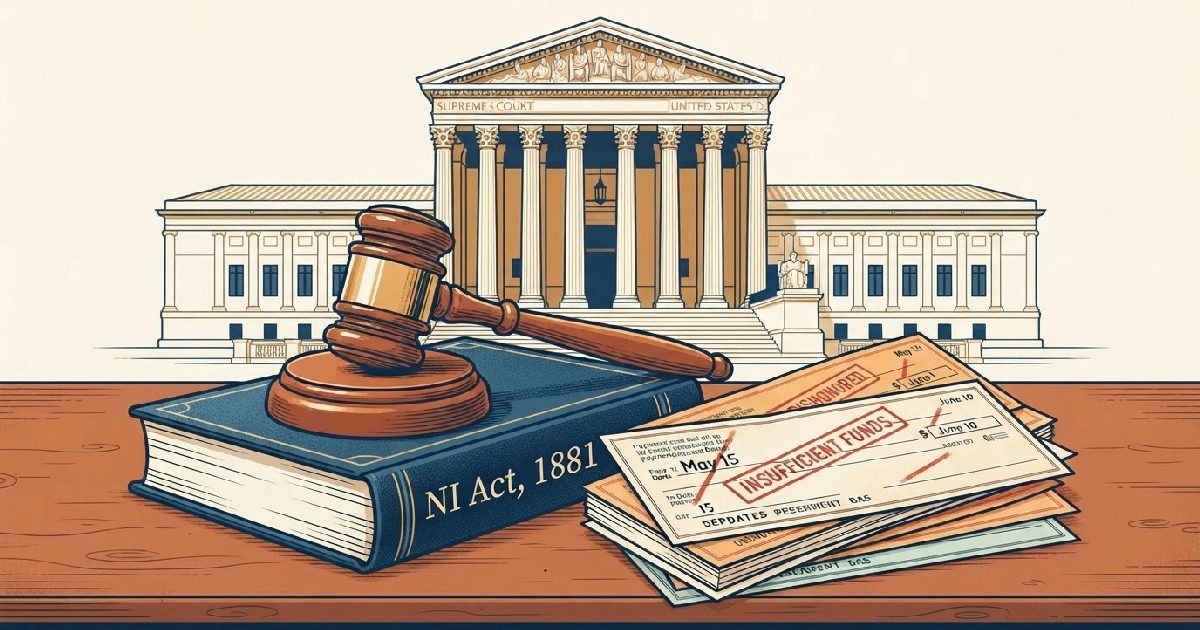
Several cheques from one debtor presented on different dates
The Supreme Court ruled on January 8, 2026, that each dishonored cheque creates a separate cause of action under Section 138 of the NI Act, 1881. This means that for multiple dishonored cheques from the same debt, separate complaints are required.
This means complainants can file separate complaints for multiple dishonored cheques, even if they stem from the same underlying debt or transaction, provided statutory requirements are met for each.
Several Cheques from the Same Business Debtor Presented on Different Dates: same causes of action?
This significant judgment overturns a previous stance taken by the Delhi High Court, which had quashed complaints on the grounds that parallel prosecutions for the same liability were impermissible. The Supreme Court’s decision provides much-needed clarity for both creditors seeking redress and debtors navigating the complexities of cheque bounce litigation across the country, particularly in Delhi.
The Supreme Court, comprising Justices Sanjay Karol and Prashant Kumar Mishra, directly addressed the question of whether multiple complaints could proceed when several cheques, albeit linked to a single transaction, were presented and subsequently dishonored on different dates. Their verdict was unequivocal: the scheme outlined in Section 138 of the NI Act does not preclude such prosecutions.
Crucially, the Court emphasized that each cheque constitutes a distinct instrument. When these instruments are drawn on different accounts, presented on separate dates, dishonored independently, and followed by individual statutory notices, they generate their own cause of action. This interpretation safeguards the rights of complainants to pursue recourse for each specific default.
Overturning the Delhi High Court’s perspective
The ruling specifically challenged judgments from the Delhi High Court that had previously impeded parallel prosecution. The High Court had reasoned that a complainant could not maintain two separate complaints for a single debt or liability simply because different sets of cheques, such as one from a firm and another personal, were dishonored.
However, the Supreme Court found that the High Court had exceeded its jurisdiction under Section 482 of the Code of Criminal Procedure (CrPC) by quashing these complaints at an early stage. Determining whether cheques were issued as alternative, substitute, or supplementary instruments involves intricate factual disputes. Such matters necessitate the presentation of evidence during a trial, not a “mini-trial” during quashing proceedings.
The statutory sequence under Section 138 NI Act
Understanding the legal framework governing cheque dishonour is paramount for both complainants and accused parties. Section 138 of the Negotiable Instruments Act outlines precise conditions that must be met for an offense to be established. Compliance with this statutory sequence is non-negotiable for successful prosecution.
The conditions include that a cheque must be drawn for a legally enforceable debt or liability and presented within its validity period, typically six months from issue or its stated validity.
If the bank returns the cheque unpaid, for reasons like insufficient funds, the payee must then issue a written demand notice to the drawer within 30 days of receiving the bank’s return memo. The offense is complete only if the drawer fails to make payment within 15 days of receiving this notice.
Conditions for an offense
For an offense under Section 138 to crystallise, several conditions must cumulatively be satisfied. The cheque itself must represent a valid financial obligation, not merely a speculative promise. The presentation window is critical; presenting a stale cheque invalidates the process.
Furthermore, the cause for dishonour must relate to the drawer’s inability or unwillingness to honour the payment, such as insufficient funds or stop payment instructions not justified by law.
Navigating the complaint process
Once the 15-day notice period expires without payment, a criminal complaint can be filed before a Judicial Magistrate. This must occur within 30 days following the end of the notice period. The meticulous adherence to these timelines and procedural steps is crucial, as any deviation can jeopardize the entire legal action. Complainants must ensure each step is documented and executed precisely.
Implications for complainants: strategies for recovery
The Supreme Court’s ruling offers significant reassurance for complainants dealing with multiple dishonored cheques from a single debtor. It legitimizes the strategy of filing separate complaints for each instance of dishonour, provided all statutory steps are completed individually.
This approach can be particularly effective when a debtor issues a series of cheques, perhaps as part of an installment plan or to cover a single large transaction over time. Each bounced cheque becomes an independent legal avenue for recovery. Complainants should ensure that legal notices are meticulously drafted, claiming the exact cheque amount, as even minor discrepancies can prove fatal to the case.
While a single notice can cover multiple cheques if carefully worded and within limitation for each, the clarity from the Supreme Court implies a stronger footing for separate complaints. This strategy allows for independent progression of each case, potentially leading to quicker resolution or distinct enforcement actions.
It also reduces the risk of an entire complaint being dismissed due to issues with one specific cheque within a bundled claim.
Challenges for debtors and defense mechanisms
For debtors, the Supreme Court’s clarification underscores the multiplied risk associated with issuing multiple cheques that subsequently bounce. Ignoring legal notices can lead to a cascade of criminal complaints, potentially resulting in numerous court appearances, arrests, and even convictions with imprisonment up to two years or fines up to twice the cheque amount for each offense.
Debtors must critically assess each legal notice and cheque dishonour. While arguments like a cheque being issued as “security” are common defenses, they require robust factual evidence to successfully rebut the statutory presumption under Section 139 of the NI Act. Simply asserting a cheque was for security, without proof, often proves insufficient in court.
Rebutting statutory presumption
Section 139 of the NI Act establishes a statutory presumption that a dishonored cheque was issued for a legally enforceable debt or liability. This presumption significantly aids the complainant. For the accused, rebutting this presumption is crucial for their defense. This typically involves presenting compelling evidence that challenges the existence of the debt, the cheque’s validity, or the proper execution of the statutory process.
The nuances of complaint consolidation
Despite the Supreme Court’s emphasis on separate causes of action, the concept of consolidating complaints for multiple dishonored cheques from the same transaction remains relevant in certain contexts. Section 219 of the CrPC generally limits joint trials to three offenses of the same kind committed within a 12-month period. However, courts have demonstrated flexibility for Section 138 cases.
Consolidation can occur if there is a single, indivisible liability and a common, consolidated legal demand notice was served for all cheques. The Supreme Court has previously affirmed that merely because multiple complaints arise from the same underlying transaction, it does not automatically constitute an abuse of process. This suggests a careful balance between distinct causes of action and procedural efficiency in judicial administration.
CrPC Section 219 and its application
Section 219 of the CrPC is designed to prevent an accused from being overwhelmed by an excessive number of charges in a single trial. However, in the realm of cheque bounce cases, courts have applied a pragmatic approach.
If a series of cheques forms part of a continuous transaction and a singular intention to defraud, a degree of latitude in clubbing cases might be considered, provided it aligns with the principles of fair trial and judicial economy.
New rules for compounding costs in Delhi
Settlement mechanisms for cheque bounce cases have seen recent refinements, particularly in Delhi. A Supreme Court ruling on September 25, 2025, effective November 1, 2025, coupled with Delhi’s Practice Direction 157 (November 6, 2025), established a clear structure for compounding costs.
These costs are levied on the accused if a settlement is reached, and they vary depending on the stage of the proceedings. The new framework encourages early resolution while penalizing delayed settlements. It’s a strategic consideration for both parties when weighing the benefits of continuing litigation versus reaching an out-of-court agreement.
| Stage of Settlement | Compounding Costs (Percentage of Cheque Amount) |
|---|---|
| Before defense evidence is led | Nil |
| After defense evidence but before judgment | 5% |
| At Sessions Court or High Court on appeal/revision | 7.5% |
| At Supreme Court | 10% |
This graduated scale incentivizes debtors to settle at the earliest possible stage to minimize additional financial burden. For complainants, it provides a clear understanding of potential recovery costs if a settlement is reached. Understanding these costs is vital for strategic decisions in cheque bounce cases, especially concerning compounding a cheque bounce case if payments falter.
Broader impact on cheque bounce litigation
The Supreme Court’s January 8, 2026, ruling is poised to have a far-reaching impact on the landscape of cheque bounce litigation in India. By firmly establishing the principle of separate causes of action for each dishonored cheque, the judgment empowers complainants with a clearer path to legal recourse, reinforcing the deterrent effect of Section 138 of the NI Act.
For legal professionals, this clarification streamlines advice to clients and procedural strategies. Lawyers specializing in cheque bounce cases in Delhi, such as Advocate Mayank Sharma, Advocate Sushil Kumar, Advocate Priya Sharma, Advocate Neha Yadav, Advocate Ramesh Chandra, and Advocate Ajay Malik, offer services including drafting legal notices, filing complaints, and court representation.
This comprehensive approach to client service ensures robust representation through all stages of litigation.
Ultimately, this ruling strengthens the enforceability of commercial instruments and promotes greater accountability in financial transactions. It sends a strong message that issuing multiple cheques without sufficient funds, even within a single transaction, carries significant and distinct legal consequences, thereby upholding the sanctity of the Negotiable Instruments Act.
Can a single transaction lead to multiple cheque bounce complaints?
Yes, the Supreme Court of India clarified on January 8, 2026, that each dishonour of a cheque creates a separate cause of action. This means even if multiple cheques arise from the same underlying transaction, separate complaints can be filed for each dishonored cheque, provided all statutory steps are independently completed.
What was the Delhi High Court’s previous position on this matter?
The Delhi High Court had previously taken a view that parallel prosecution for the same liability was impermissible. It had quashed complaints, reasoning that a complainant could not maintain two separate complaints for the same debt or liability, especially if different sets of cheques (e.g., firm and personal) were dishonored. The Supreme Court’s recent ruling directly overturned this interpretation.
How does the statutory presumption under Section 139 of the NI Act affect these cases?
Section 139 of the NI Act creates a statutory presumption that a dishonored cheque was issued for a legally enforceable debt or liability. This presumption places the burden on the accused to present evidence proving otherwise. The Supreme Court emphasized that this presumption must be given due weight, and courts should be cautious when quashing proceedings prematurely, highlighting the importance of factual evidence during trial.
Multiple cheques of the same customer have bounced on different dates? Call or Whatsapp for consultation.
Related: https://arpitmarwah.com/cheque-bounce-lawyers-in-delhi/