
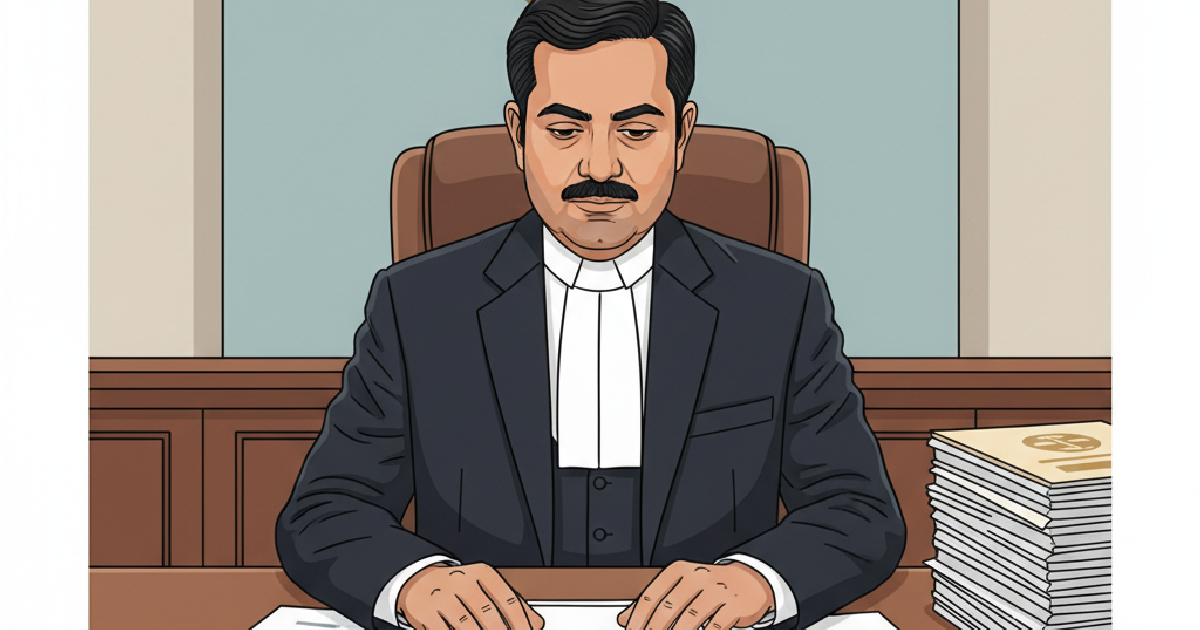
Justice Harpreet Singh Brar of the High Court of Punjab and Haryana at Chandigarh has quashed a criminal complaint and summoning order under Section 138 of the Negotiable Instruments Act, 1881, involving a joint account holder who had not signed the dishonoured cheque.
The decision, delivered on January 16, 2025, in the case of Charanjeet Singh vs. Kulwant Singh (CRM-M-54012-2023), clarifies that criminal liability for cheque bounce cases is restricted solely to the person who draws and signs the instrument.
High court clarifies negotiable instruments act
The ruling by Justice Harpreet Singh Brar underscores a critical aspect of India’s Negotiable Instruments Act: only the actual drawer of a cheque can face prosecution for its dishonour. This distinction is particularly significant in cases involving joint bank accounts, where culpability might otherwise be broadly assigned.
The High Court’s decision impacts how complaints under Section 138 of the NI Act are pursued and offers clarity for individuals holding joint accounts but not directly involved in issuing a specific cheque.
The court examined two connected petitions, CRM-M-54012-2023 and CRM-M-10122-2024, both stemming from an identical factual background. For operational purposes, the facts from CRM-M-54012-2023, involving petitioner Charanjeet Singh and respondent Kulwant Singh, were primarily considered.
This case initially arose from a complaint filed by Kulwant Singh against Jasbir Kaur and another, which included Charanjeet Singh. The complaint alleged dishonour of a cheque for Rs. 7,50,000.
The core of the dispute: an unsigned cheque
The genesis of this legal battle dates back to May 2018, when Charanjeet Singh reportedly sought a friendly loan of Rs. 7,50,000 from Kulwant Singh to expand his business. The repayment was promised for April 2019.
However, after delays, a cheque bearing number 047132, dated June 12, 2019, for the stated amount was issued. This cheque, when presented for encashment, was returned on June 13, 2019, with the remark “funds insufficient.”
Following the dishonour, a legal notice was purportedly served on Charanjeet Singh on July 5, 2019. But, it was later discovered that this initial notice was mistakenly addressed to one Rishi Jain, not the intended recipient.
A corrigendum-cum-rejoinder was subsequently issued on July 24, 2019, aiming to rectify this error. This chain of events formed the basis for Kulwant Singh’s complaint, leading to Charanjeet Singh’s summoning by the Judicial Magistrate 1st Class, Samrala.
Arguments for quashing the proceedings
During the High Court proceedings, counsel for Charanjeet Singh, Mr. Bikramjit Singh Baath, argued that the cheque in question was issued by Jasbir Kaur, Charanjeet Singh’s wife, under her signature alone. The petitioner was only summoned because he jointly held the account from which the cheque was drawn.
The defence contended that since Charanjeet Singh was not the drawer of the cheque, the complaint under Section 138 of the NI Act was not maintainable against him. This stance aligns with established legal principles that emphasize the drawer’s direct responsibility.
Another crucial point raised was the invalidity of the legal notice. The initial notice, inadvertently sent to Rishi Jain, and the subsequent corrigendum, issued on July 24, 2019, fell outside the stipulated 15-day period from the bank’s memo date of June 13, 2019. This procedural lapse, the defence argued, rendered the entire proceedings defective.
They referenced several Supreme Court judgments, including Alka Khandu Avhad vs. Amar Syamprasad Misra and another and Mrs. Aparna A. Shah vs. M/s Sheth Developers Private Limited and another, to bolster their position on the requirement of actual signature and the strict adherence to notice periods.
Respondent’s counterarguments and court’s examination
Counsel for the respondent, Ms. Sushma Sharma, representing Kulwant Singh, maintained that the Judicial Magistrate had correctly applied judicial mind in summoning the petitioner. She asserted that the joint nature of the bank account from which the cheque was drawn implicated Charanjeet Singh.
Despite these arguments, Justice Harpreet Singh Brar meticulously reviewed the case record. The core finding was unequivocal: the disputed cheque was indeed from a jointly held account, but only Jasbir Kaur had signed it, not Charanjeet Singh.
The legal precedents that shaped the decision
Justice Brar’s ruling leaned heavily on the precedents set by the Supreme Court concerning Section 138 of the NI Act. A pivotal reference was made to the two-judge bench decision in Mrs. Aparna A. Shah vs. M/s Sheth Developers Private Limited and another. The Supreme Court confirmed that only the “drawer” of a cheque can be held liable for penal action under the NI Act, emphasizing strict interpretation of penal statutes.
The Supreme Court clarified that for an offence under Section 138, the cheque must be drawn by a person on an account maintained by them. This requires the person to have physically signed the cheque.
Furthermore, the high court reiterated that in cases of cheques issued from joint accounts, a joint account holder cannot be prosecuted unless every joint account holder has signed the cheque. This provides a crucial safeguard against unwarranted prosecution for individuals who are merely co-owners of an account.
The critical aspect of proper legal notice
Beyond the drawer liability, Justice Brar also scrutinised the validity of the legal notice. Section 138(b) of the NI Act mandates that the payee must demand payment in writing from the drawer within thirty days of receiving notification from the bank about the cheque’s dishonour.
The judge highlighted that serving a proper notice is a fundamental prerequisite for initiating a complaint under Section 138. Its purpose is to offer the debtor an opportunity to settle the amount before criminal proceedings begin.
The initial notice in this case was erroneously sent to Rishi Jain. While a corrigendum was later issued to Charanjeet Singh on July 24, 2019, the core issue persisted: the original error was significant and the correction fell outside the statutory 30-day window. The memo regarding the dishonoured cheque was issued on June 13, 2019, meaning any valid notice or correction had to be dispatched by July 13, 2019.
The court deemed this infirmity to be more than a mere technicality; it impacted the very foundation of the case. “It is trite law that serving a notice is a sine qua non for instituting a complaint under Section 138 NI Act,” the court stated, adding that the defective notice vitiated the entire proceedings, rendering them incurably illegal.
Implications for criminal law and banking practices
This ruling has significant implications for both criminal law practitioners and individuals who manage joint bank accounts. It reinforces the principle that criminal liability under the NI Act is not automatic simply by virtue of being a joint account holder. Personal involvement through signing the cheque is paramount.
Moreover, the emphasis on the strict compliance with the notice period and the accuracy of the notice recipient serves as a stern reminder for complainants and their legal representatives. Procedural exactitude remains critical in cheque dishonour cases, preventing legal recourse from becoming an “arm-twisting tactic” as the Supreme Court previously noted.
The decision shields individuals from facing untenable criminal charges based on technicalities or association rather than direct culpability. It reaffirms that courts cannot hear premature cheque bounce complaints or those with procedural defects.
| Aspect of Law | High Court Ruling (Charanjeet Singh Case) | Supreme Court Precedent |
|---|---|---|
| Liability for joint account holders | Only signatory liable | Only signatory liable (Mrs. Aparna A. Shah) |
| Requirement of legal notice | Mandatory, must be accurate and timely | Mandatory, to allow opportunity to settle |
| Correction of defective legal notice | Corrigendum invalid if outside 30-day period | Strict adherence to notice period implied |
| Application of Section 482 Cr.P.C. | Used to quash proceedings due to legal infirmities | Inherent powers used sparingly in exceptional circumstances |
The quashing order and its wider ramifications
Ultimately, Justice Harpreet Singh Brar allowed both petitions (CRM-M-54012-2023 and CRM-M-10122-2024). This resulted in the quashing of Complaint No. 169 of 2019, the summoning order dated September 19, 2022, and all subsequent proceedings against the petitioners.
The decision from the High Court of Punjab and Haryana at Chandigarh serves as a crucial reminder for all parties involved in cheque dishonour litigation under the Negotiable Instruments Act. Legal proceedings must strictly adhere to statutory requirements, particularly concerning the identification of the drawer and the timely, accurate issuance of legal notices.
It acts as a shield for individuals who might otherwise be erroneously implicated in financial disputes merely due to their association with a cheque or a joint account, without having directly authorised or signed the instrument. This legal clarity is vital for maintaining fairness and due process within the criminal justice system.
Frequently Asked Questions
Who is considered the “drawer” of a cheque?
The drawer of a cheque is the person who signs the cheque and issues the instruction to their bank to pay a specified amount to the payee. Under the NI Act, only this individual can be held liable for cheque dishonour.
Can I be prosecuted for a bounced cheque from a joint account if I didn’t sign it?
No, according to the High Court’s ruling and Supreme Court precedents, a joint account holder cannot be prosecuted under Section 138 of the NI Act unless they have personally signed the cheque.
What does “sine qua non” mean in legal terms?
In legal context, “sine qua non” means an essential condition or an indispensable prerequisite. In cheque bounce cases, a valid legal notice is considered a “sine qua non” for initiating a complaint.