
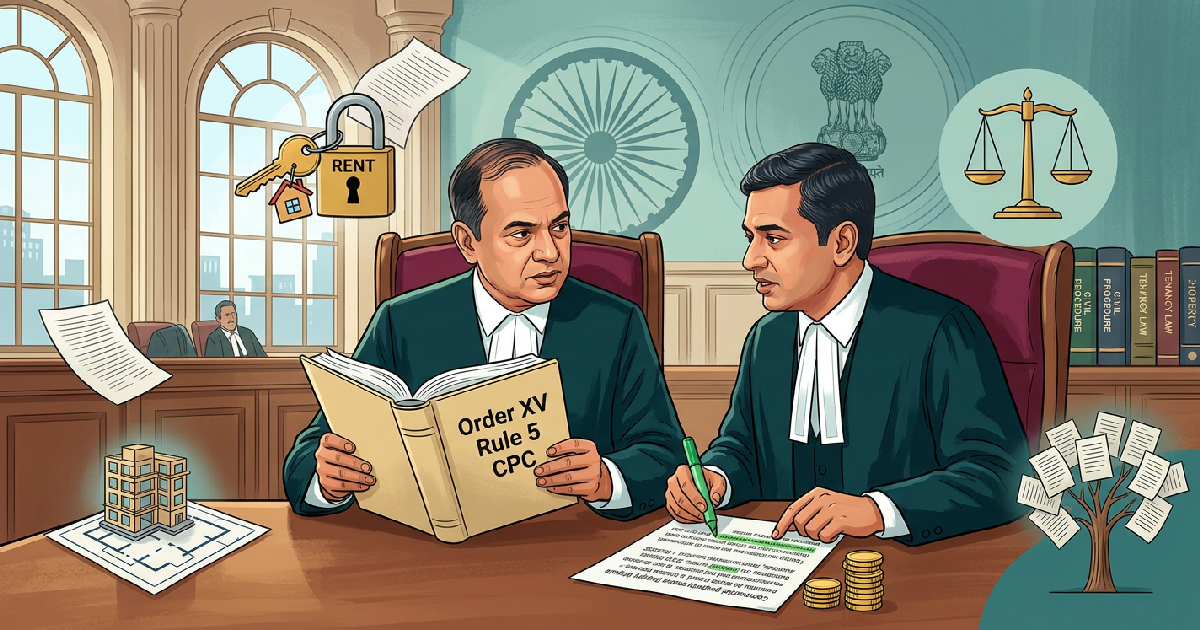
The Supreme Court of India ruled on May 15, 2026, that a tenant’s defense in an eviction suit cannot be struck off under Order XV Rule 5 of the Code of Civil Procedure (CPC) without a specific finding that the rent default was wilful. A Bench comprising Justice S.V.N. Bhatti and Justice Prasanna B. Varale delivered the judgment in the case of Dharmendra Kalra & Ors. v. Kulvinder Singh Bhatia. The court emphasized that the power to strike off a defense is discretionary and must not be exercised mechanically or prematurely against a tenant.
The dispute originated in Kanpur over a commercial property at Kaushalpuri where the respondent, Kulvinder Singh Bhatia, operated the “Gyan Vaisnav Hotel.” Landlords Dharmendra Kalra and others had revised the monthly rent to Rs. 25,000 in September 2020. They later alleged that the tenant failed to pay from November 2020, leading to a suit before the Small Causes Court in Kanpur. On August 5, 2023, the Trial Court struck off the tenant’s defense, a decision the Supreme Court has now set aside.
In its ruling, the Bench clarified that the Trial Court must determine the “first date of hearing” and ensure proper service of notice before invoking such a “drastic” penalty. The justices noted that the rules of procedure are the “handmaid of justice and not its mistress.” Striking off a defense is a serious matter that should only be reserved for “grossly recalcitrant tenants” who exhibit deliberate or contumacious conduct.
Judicial discretion and the wilful default test
The Supreme Court highlighted that the word “may” in Order XV Rule 5 CPC indicates that the power is not mandatory. Courts must evaluate whether a tenant’s default was wilful or bona fide before stripping them of their right to contest the suit. If there is evidence of substantial compliance or a lack of deliberate non-performance, the court should lean toward allowing the defense to stand.
The Bench criticized the mechanical application of procedural rules. It observed that the trial court must look for clear cases of volitional non-performance. Similar procedural themes have appeared in other high-stakes legal areas, such as when the Supreme Court provided guidelines for summary judgments in commercial suits to ensure merit-based outcomes. In the current case, the court found the original orders failed to address these behavioral nuances.
This ruling reinforces that while property owners deserve timely compensation, the law protects tenants from sudden dismissal over minor procedural slips. However, the court did clarify that even if a tenant denies the landlord-tenant relationship, they maintain a statutory obligation to deposit rent or damages during the litigation. This aligns with other strict statutory interpretations, such as how directors remain liable for cheque bounces even during corporate insolvency proceedings.
Defining the first date of hearing
A central requirement of the Supreme Court’s ruling is the accurate determination of the “first date of hearing.” The Court defined this not as a formal date for filing a written statement or a mere appearance, but as the day the court proposes to apply its mind to the controversy and frame issues. Without this clear date, the foundation for striking off a defense becomes uncertain.
The Bench remanded the matter back to the Trial Court in Kanpur for fresh consideration. The lower court must now determine the correct first date of hearing and assess if Kulvinder Singh Bhatia’s failure to pay the revised rent was intentional. The Supreme Court noted that previous interventions, which lowered the required deposit to Rs. 1,500, had complicated the procedural history and required a fresh look at the tenant’s intent.
| Legal Metric | Supreme Court Interpretation | Tenant Obligation |
|---|---|---|
| Standard of Default | Must be “wilful, deliberate, or contumacious.” | Must prove default was “bona fide” to save defense. |
| First Date of Hearing | Date court frames issues and applies its mind. | Calculation of rent deposit timelines begins here. |
| Interest on Arrears | Statutory rate of 9% per annum. | Payable on all admitted rent due to the court. |
| Nature of Power | Discretionary (indicated by the word “may”). | Protects against mechanical strike-offs of defense. |
Legal precedents and procedural safeguards
The Bench cited several landmark rulings to support its decision, including Bimal Chand Jain v. Sri Gopal Agarwal (1981) and Asha Rani Gupta v. Vineet Kumar (2022). These cases collectively establish that striking off a defense should be the exception, reserved for cases of gross non-compliance. The primary objective is to balance the landlord’s right to rent with the tenant’s right to a fair hearing.
This scrutiny of procedural barriers is a common theme in Indian civil law. For example, the J&K High Court has ruled on Order VII Rule 11 that a plaint cannot be rejected when property status remains a triable issue. By remanding the Dharmendra Kalra case, the Supreme Court ensured that the Kanpur court provides a reasoned order regarding the “volitional” nature of the rent default.
Frequently Asked Questions
What is the core of the Supreme Court’s ruling on Order XV Rule 5?
The Court ruled that a tenant’s defense cannot be struck off mechanically for non-payment of rent. Trial courts must first determine if the default was “wilful or contumacious” rather than accidental or bona fide before taking such a serious procedural step.
What does “first date of hearing” mean under this ruling?
The Supreme Court defined the “first date of hearing” as the specific day when the court intends to apply its mind to the legal controversy and frame the issues of the case, rather than just a formal date for filing papers or making an appearance.
Is the power to strike off a defense mandatory for trial courts?
No, the Court clarified that the use of the word “may” in Order XV Rule 5 CPC makes the power discretionary. It is intended only for “grossly recalcitrant tenants” and should be exercised with circumspection to ensure justice is served.