
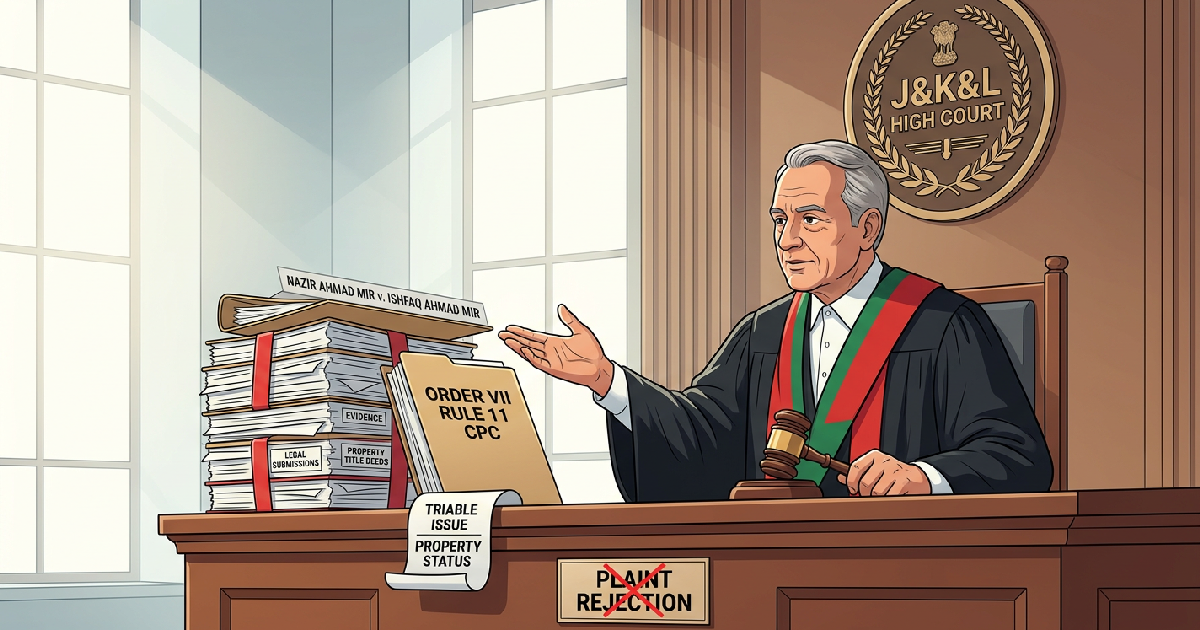
The High Court of Jammu & Kashmir and Ladakh at Srinagar ruled on April 30, 2026, that a plaint cannot be rejected under Order VII Rule 11 of the Code of Civil Procedure (CPC) if the status of a suit property involves a “triable issue.” Justice Sanjay Dhar, presiding over the case of Nazir Ahmad Mir & Ors. v. Ishfaq Ahmad Mir & Ors., set aside a trial court’s order that had previously dismissed a suit seeking ownership by adverse possession. The court held that disputes regarding whether a property is a joint holding or has been privately partitioned necessitate the admission of evidence, making a threshold dismissal improper.
The ruling overturns a July 31, 2024, decision where a trial court rejected the plaint based on an application from the defendants. The defendants argued that no cause of action existed because the plaintiffs admitted co-ownership in a joint holding established by a 1971 award. They further contended that adverse possession against co-owners requires specific pleading of “ouster,” which they claimed was not precisely dated in the original filing. But the High Court found these factual disputes were exactly why the case must proceed to trial.
Justice Sanjay Dhar observed that the 1971 arbitral award did not explicitly rule out the possibility of a private partition occurring without the assistance of revenue authorities. Because the property’s status is contested, the High Court quashed the trial court’s order and remanded the case for issue-framing. The parties are now required to prove their respective claims of private partition and possession through evidence. This focus on factual clarity matches requirements in other regions, such as how the Andhra Pradesh High Court clarifies rules for explaining procedural delays in commercial filings.
Strict interpretation of Order VII Rule 11 CPC
The High Court emphasized that the power to reject a plaint is a narrow exception reserved for “hopeless suits” that clearly lack legal merit. According to the judgment, such a rejection must be based solely on the averments made in the plaint and the specific documents relied upon by the plaintiff. Courts must remain hesitant to exercise this power unless the factual foundation of the case squarely meets the statutory requirements for dismissal.
This judicial caution ensures that a “triable issue”—a matter of fact that requires evidence to resolve—is not dismissed prematurely. The Supreme Court of India has expressed similar concurrence, setting aside rejections in family partition disputes where allegations of coercion or fabrication raised serious triable questions. These high-level protections ensure that a real cause of action is not ignored due to technicalities, similar to how the Supreme Court issues guidelines for summary judgments to ensure commercial disputes are handled with procedural precision.
Judicial precedents on partial rejection of plaints
A significant aspect of the ruling is the reinforcement of the principle that a suit cannot be rejected partially. If any part of the plaint requires the examination of evidence, the entire suit must move forward. The High Court cited several Supreme Court precedents to support this mandate, including Sejal Glass Ltd. v. Navin Merchants (2018 11 SCC 780) and Madhav Prasad Aggarwal v. Axis Bank Ltd. (2019 7 SCC 158).
The court also invoked Kum. Geetha v. Nanjundaswamy (2024 14 SCC 390) to emphasize that possession holders are entitled to seek injunctions against unlawful ouster. These precedents collectively demonstrate that even if a claim appears difficult to prove, the plaintiff has a right to a trial if the facts are in dispute. The case has been returned to the lower court with a mandate for issue-framing and a full trial to determine the property’s status.
| Case Citation / Authority | Legal Principle Established | Key Focus Area |
|---|---|---|
| Nazir Ahmad Mir v. Ishfaq Ahmad Mir (2026) | Remand for issue-framing and trial | Triable issues in property status |
| Sejal Glass Ltd. v. Navin Merchants (2018) | No partial rejection of plaints | Order VII Rule 11 CPC |
| Kum. Geetha v. Nanjundaswamy (2024) | Injunctions against unlawful ouster | Rights of possession holders |
Frequently Asked Questions
What constitutes a triable issue in a property suit?
A triable issue is a factual dispute that cannot be resolved solely based on the initial court papers. In this case, the High Court identified the dispute over whether the land was a joint holding or privately partitioned as a triable issue that requires the admission of evidence and witness testimony.
Can a judge reject a plaint based on the defendant’s evidence?
No. The High Court clarified that a rejection under Order VII Rule 11 CPC must be based solely on the averments (statements) in the plaint and the documents relied upon by the plaintiff. The court should not consider the defendant’s arguments or external evidence at this initial stage.
What happens if a trial court’s rejection is overturned on appeal?
When the High Court quashes a trial court’s order of rejection, the case is typically remanded. This means the case is sent back to the lower court with instructions to frame the legal issues, admit evidence, and proceed with a full trial to determine the merits of the claims.