
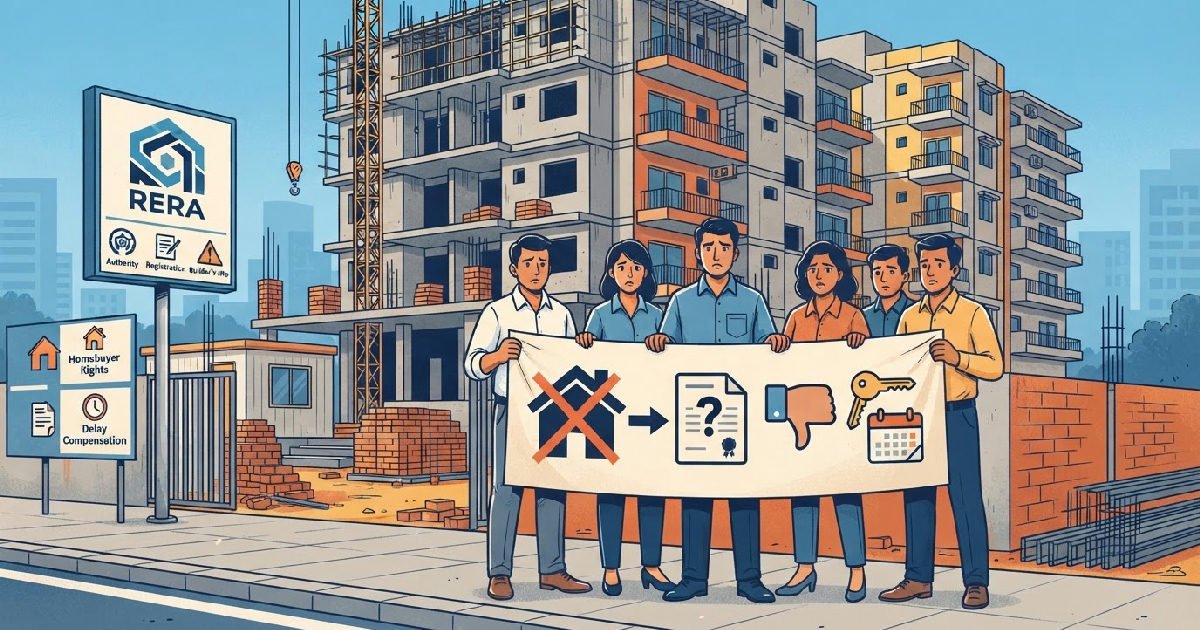
Homebuyers across Delhi NCR frequently encounter a significant hurdle: builders offering possession of flats without the mandatory Occupancy Certificate (OC). This practice, though common, is illegal and has severe legal and financial implications for property owners. RERA warns builders that this is an illegal practice.
Despite builders’ assurances that the OC is forthcoming, Indian courts and the Real Estate (Regulation and Development) Act, 2016 (RERA), consistently rule that such offers do not constitute lawful possession, safeguarding buyers’ rights to compensation and recourse.
Occupancy certificate delayed after the builder promised possession: RERA warns builders
The core issue revolves around developers pressuring buyers to accept “fit-out” or “soft” possession for interior work. This happens even when the promised agreement date has passed. But, critically, such offers do not waive a homebuyer’s statutory right to claim interest or a full refund for the delay, as recent judicial pronouncements have firmly established.
An Occupancy Certificate, or OC, stands as a pivotal document in the real estate landscape, particularly in regions like Delhi NCR. Issued by local municipal authorities or the relevant planning department, it’s official confirmation that a building adheres to approved plans and all safety standards. Without it, a property remains technically incomplete and unfit for legal occupation.
This critical certificate confirms the integration of essential civic infrastructure, including reliable water supply, electricity connections, and proper sanitation systems. So, an OC isn’t just a piece of paper; it’s the definitive proof that a home is ready and legal for habitation. It enables permanent utility connections, facilitates home loans, and is indispensable for property registration and any future resale transactions.
RERA Mandate for Builders
Under the stringent provisions of RERA, specifically Section 11(4)(b), developers are legally obligated to obtain the Occupancy Certificate before they hand over possession to homebuyers. Offering possession without a valid OC isn’t just a contractual breach; it’s a direct violation of the law. This carries significant penalties for non-compliant builders.
This legal requirement ensures that buyers receive a fully compliant and habitable property, protecting them from potential hazards and future regulatory complications. It’s a crucial safeguard against unscrupulous practices in the residential sector. Should you still take possession if an OC hasn’t been issued? Legal precedent strongly advises against it.
Risks of Uncertified Occupation
Occupying a property without an OC exposes homeowners to substantial risks and inconveniences. Utility providers can refuse permanent connections for water, electricity, and gas, leaving residents reliant on temporary, often costlier, solutions. Moreover, the lack of an OC complicates loan approvals and property registration processes, hindering future financial transactions.
Perhaps most importantly, without an OC, a property is legally considered an incomplete structure. This makes any resale problematic and potentially voids insurance policies. Local authorities also retain the power to issue demolition orders or levy heavy fines, underlining the importance of this certification for long-term peace of mind and property value.
“Soft Possession” Offers: A Legal Minefield for Delhi NCR Homebuyers
Developers in Delhi NCR often try to mitigate possession delays by offering what they term “fit-out” or “soft” possession. This allows homebuyers access to their units for interior decoration or inspection purposes. However, legal experts and regulatory bodies unequivocally state that this arrangement does not equate to lawful or complete possession.
Homebuyers who accept keys for fit-outs might feel like they’re making progress, but this doesn’t waive their rights. The builder remains fully liable for procuring the official OC and compensating for any delays, as mandated by RERA. It’s a distinction that often catches unsuspecting buyers off guard, highlighting the need for vigilance.
Court Rulings Reject Unlawful Possession
Courts and regulatory authorities have consistently dismissed builder attempts to compel buyers into taking possession without a valid Occupancy Certificate. This firm stance protects buyers from the significant risks associated with occupying an uncertified property. Legal precedent makes it clear: a builder cannot sidestep their statutory obligations.
The Supreme Court, in the 2026 case of Parsvnath Developers Ltd. v. Mohit Khirbat, emphatically reaffirmed this principle. The Court declared that “possession without an Occupancy Certificate cannot be forced upon the respondents. Obtaining such certificate is a statutory pre-condition integral to lawful delivery of possession.” This ruling underscores the mandatory nature of the OC.
No Waiver of Rights Through Fit-Outs
Even if a homebuyer accepts keys for interior fit-outs, their statutory rights to claim compensation for delayed possession under RERA remain fully intact. Builders often imply that accepting “soft possession” means waiving these rights, but this is a false premise. The law clearly states otherwise.
The Punjab and Haryana High Court, in an October 2026 ruling, affirmed that taking possession or executing a conveyance deed does not extinguish a homebuyer’s right to claim RERA Section 18(1) compensation. Justice Jagmohan Bansal highlighted that the promoter’s liability is mandatory, overriding any conflicting contractual terms. This offers significant reassurance to buyers caught in such dilemmas.
RERA’s Shield: Homebuyer Rights Amidst Delays
The Real Estate (Regulation and Development) Act, 2016 (RERA), serves as a crucial legal framework protecting homebuyers, especially when builders fail to deliver possession as promised. Section 18 of RERA specifically addresses delays, providing clear avenues for redressal and compensation. It empowers buyers to take decisive action against non-compliant developers.
This section ensures that homebuyers are not left in limbo due to builder negligence or unforeseen project setbacks. It mandates transparency and accountability, shifting the burden of delay onto the developer. Understanding these provisions is vital for any buyer facing a stalled project in Delhi NCR.
Options for Delayed Project Buyers
Under RERA, homebuyers faced with project delays have two primary recourses. They can choose to withdraw from the project entirely, demanding a full refund of all amounts paid. This refund must include prescribed interest and any applicable compensation, offering a complete exit strategy from a problematic investment.
Alternatively, buyers can opt to continue with the project and claim interest for every month of delay until actual, lawful possession is delivered. This option allows buyers to secure their property while being compensated for the financial inconvenience caused by the builder’s delay. Both choices aim to mitigate financial losses for the buyer.
Calculating Compensation for Delay
Compensation for delayed possession under RERA is typically calculated as interest on the amount already paid by the homebuyer. The specific interest rate is determined by the respective state’s RERA authority. This rate is often linked to the State Bank of India’s highest marginal cost of lending rate (MCLR), plus an additional 2%.
For instance, if the prevailing MCLR is 9.10%, the compensation rate could be 11.10%. This standardized calculation method ensures fairness and predictability for both parties involved. It provides a clear financial consequence for developers who fail to meet their promised timelines.
Navigating the RERA Complaint Process
Filing a complaint with the RERA authority is a straightforward yet crucial step for homebuyers seeking redressal for delayed possession or other grievances. The process is designed to be accessible, often allowing buyers to submit their complaints online through the state’s RERA website. This digital approach streamlines what could otherwise be a cumbersome legal procedure.
Buyers need to gather essential documentation before initiating the complaint. This includes the project number, a copy of the agreement for sale, all payment receipts, and detailed specifics of the delay. Clearly articulating the relief sought, whether it’s a refund or delay compensation, is also vital for a successful outcome.
The Adjudicating Officer’s Role
Once a complaint is filed, the Adjudicating Officer (AO) of the State RERA authority takes charge. This officer is specifically designated to hear and rule on claims for compensation related to delayed possession, as outlined in Section 18(1)(a) of RERA. Their role is critical in ensuring a fair and timely resolution for homebuyers.
The AO examines the evidence presented by both the homebuyer and the developer, ultimately issuing a binding order. RERA aims for these cases to be resolved typically within 60 days, offering a much faster resolution than traditional court proceedings. This expedited process is a significant benefit for aggrieved buyers.
Enforcing RERA Orders Against Developers
Should a builder fail to comply with a RERA order, homebuyers are not without further recourse. The Act provides for execution of orders under Section 40. This allows buyers to pursue enforcement through the RERA authority itself, rather than needing to file a new lawsuit.
Enforcement measures can be quite severe for non-compliant developers. These include seizing the builder’s bank accounts, attaching other assets, or even auctioning off properties to recover the awarded compensation. This robust enforcement mechanism underscores RERA’s power to hold developers accountable. For specifics on how to file a RERA complaint in Delhi NCR, resources are readily available.
Judicial Reinforcement: Recent Rulings Bolster Buyer Stance
Recent judicial pronouncements have significantly strengthened the position of homebuyers grappling with delayed Occupancy Certificates in Delhi NCR. These rulings consistently uphold the sanctity of the OC as a prerequisite for lawful possession, delivering a clear message to developers. They reinforce RERA’s intent to protect consumers from builder malpractices.
The legal landscape is evolving, with courts increasingly siding with buyers. This provides a firmer foundation for those seeking recourse against developers. It’s a positive trend for residential property owners.
Key Supreme Court Judgments
The Supreme Court of India has issued landmark judgments that shape the interpretation and enforcement of RERA provisions. In Pioneer Urban Land & Infrastructure Ltd. v. Govindan Raghavan (2019), the Court ruled decisively that a buyer cannot be forced to wait indefinitely for possession. Nor can they be compelled to accept belated possession, clearly siding with consumer interests.
Building on this, the Supreme Court’s 2026 judgment in Parsvnath Developers Ltd. v. Mohit Khirbat reiterated that developers cannot force homebuyers to take possession without a mandatory OC. This ruling firmly established the OC as a statutory pre-condition for lawful delivery of possession. It cements the legal principle that OC is non-negotiable.
Consumer Commissions Weigh In
Beyond the Supreme Court, other judicial bodies have also contributed to the pro-homebuyer legal environment. In October 2025, the National Consumer Disputes Redressal Commission (NCDRC) stated that developers handing over flats without an OC entitle buyers to a full refund with interest. Crucially, the NCDRC also ruled that maintenance cannot be charged from buyers in the absence of an OC, a common point of contention.
Further reinforcing this, the Chandigarh State Consumer Disputes Redressal Commission ruled in January 2026 against merely handing over “fit-out possession.” It directed Omaxe New Chandigarh Developers Pvt Ltd to pay delay compensation at 9% interest, plus ₹75,000 for mental harassment and ₹35,000 for litigation costs. This highlights the financial and emotional toll on buyers.
Builder Accountability: Penalties for Non-Compliance
Developers who fail to obtain the Occupancy Certificate before offering possession face severe penalties under RERA, designed to deter such illegal practices. These measures ensure that builders prioritize compliance and deliver on their commitments. The law provides a robust framework for builder accountability.
RERA’s penalties serve as a powerful deterrent, compelling developers to adhere to timelines and statutory requirements. This protects the financial interests and peace of mind of homebuyers in the residential sector.
RERA Fines and Imprisonment
Non-compliance with RERA can lead to substantial financial penalties for developers. These fines can amount to up to 10% of the estimated project cost, a significant sum intended to reflect the seriousness of the breach. Such a penalty aims to disincentivize delays and unlawful possession offers.
In more egregious cases, RERA even provides for imprisonment of up to three years for developers who repeatedly or severely violate its provisions. This criminal component underscores the gravity of RERA’s enforcement. It ensures that developers cannot simply absorb fines as a cost of doing business.
Municipal Powers and Service Disconnections
Beyond RERA, municipal authorities also wield significant power over properties occupied without a valid Occupancy Certificate. They possess the authority to disconnect essential services like water and electricity. This makes continued occupation without an OC practically unfeasible and legally tenuous for residents.
This power acts as an additional layer of enforcement, compelling builders to expedite the OC acquisition process. It creates direct consequences that affect the daily lives of residents, thereby pressuring developers to fulfill their legal obligations. Homebuyers should also be aware of situations where a sale deed is delayed even after possession.
Verifying Occupancy Certificate Status in Delhi NCR
For homebuyers in Delhi NCR, verifying the status of their Occupancy Certificate is a critical step in safeguarding their investment. It prevents them from being misled by developers and ensures they enter a legally compliant property. Thankfully, several avenues exist to check this vital document.
Proactive verification empowers buyers, allowing them to make informed decisions and assert their rights under RERA. It’s an essential due diligence measure in the complex real estate market.
Checking Through RERA and Municipal Portals
The most reliable way to check the OC status is through the respective state RERA portal where the project is registered. Builders are mandated to upload all completion and occupancy documents onto these platforms, providing transparency for buyers. These portals serve as central repositories of crucial project information.
Additionally, municipal corporation websites, such as those for the Delhi Development Authority (DDA) and Municipal Corporation of Delhi (MCD), often integrate with RERA. These platforms allow for direct checks on OC applications and their current status. This dual verification approach provides greater assurance.
Direct Builder Inquiry and Verification
Homebuyers should also proactively engage with their builders regarding the OC status. It’s advisable to request the acknowledgement number or inward number of the OC application submitted to the municipal authority. This specific reference allows buyers to independently track its progress with the issuing body.
Crucially, buyers should never solely rely on a paper copy of an OC provided by the builder. Always verify its authenticity and status directly with the issuing authority to prevent potential fraud or misrepresentation. This step is vital for complete peace of mind.
| RERA Provision | Description | Homebuyer Remedy |
|---|---|---|
| Section 11(4)(b) | Builder must obtain OC before possession. | Right to refuse possession without OC. |
| Section 18 | Compensation for delayed possession. | Withdrawal with full refund + interest, OR continue with monthly interest. |
| Section 40 | Execution of RERA orders. | Enforcement action against builder for non-compliance (e.g., asset seizure). |
| Defect Liability | Builder must rectify defects within 30 days. | Compensation if builder fails to rectify. |
What is an Occupancy Certificate and why is it important for my home?
An Occupancy Certificate (OC) is a legal document confirming that a building meets all local regulations, safety standards, and has essential utilities like water and electricity. It’s crucial because it makes your property legally habitable, allows for permanent utility connections, and is required for property registration, home loans, and future resale.
Can a builder force me to take possession of my flat without an Occupancy Certificate?
No, a builder cannot legally compel you to take possession of your flat without a valid Occupancy Certificate. RERA mandates that developers must secure an OC before offering possession. Judicial rulings consistently uphold this, stating that possession without an OC is not lawful.
What are my options if my builder has delayed obtaining the Occupancy Certificate?
Under RERA Section 18, you have two main options: you can withdraw from the project and demand a full refund with interest and compensation, or you can choose to continue with the project and claim monthly interest for every period of delay until you receive lawful possession with the OC.
OC is still pending and the possession date is long gone? Call or Whatsapp for consultation.