
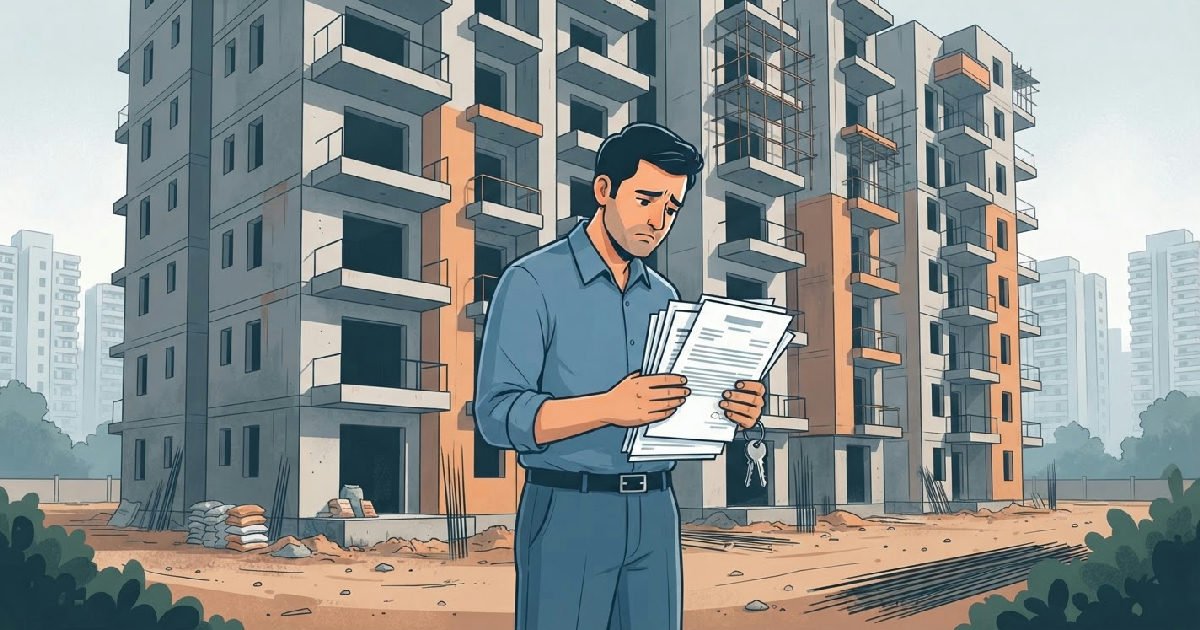
Possession given but sale deed delayed
The sale deed validity is questioned when builders in Delhi NCR fail to execute it, leaving homebuyers in physical possession of flats facing legal uncertainty. This administrative lapse plunges property owners into legal uncertainty, hindering their ability to assert full rights over their investments and raising questions about sale deed validity.
While residents manage daily life within their new homes, often paying maintenance charges, the absence of a registered conveyance deed means they lack official legal title. This discrepancy leaves buyers vulnerable and unable to sell, mortgage, or legally transfer the property. It’s a nuanced problem, but one with clear legal pathways for resolution.
The Critical Distinction: Possession Versus Legal Title
The core of the issue lies in understanding the fundamental difference between physical possession and legal ownership. Many buyers, upon receiving keys and moving in, assume their property journey is complete. But the reality is far more complex.
Possession simply signifies physical control over a property; it means you hold the keys and can occupy the space. A possession letter, a common document in this scenario, formally confirms this physical handover. Often, this is the point where maintenance charge liabilities begin, and for those with construction-linked home loans, it triggers the start of full Equated Monthly Installment (EMI) payments.
Understanding Possession and Occupancy Certificates
True ownership, or title, is a legal right established through a registered sale deed. This document, also known as a conveyance deed, is executed and registered at the sub-registrar’s office, typically after paying stamp duty. It creates a public, legally recognised record of ownership transfer.
Without a registered sale deed, a buyer does not hold full legal title, regardless of how long they’ve lived in the property or how many maintenance bills they’ve settled. This distinction becomes critical when considering future transactions or facing disputes with the developer.
The Imperative Role of the Occupancy Certificate
Before any sale deed can be legally executed, several conditions must be met. Among the most crucial is the Occupancy Certificate (OC), a vital legal document issued by the local municipal authority, such as the Municipal Corporation of Delhi (MCD) or Delhi Development Authority (DDA) in Delhi.
This certificate confirms that the building adheres to approved plans, meets safety and habitability standards, and is fit for occupation.
The OC is essential for lawful possession and securing utility connections like water, electricity, and sewage. Banks frequently require it for home loan processing and full disbursement, underscoring its financial significance. Without an OC, a property is considered illegally occupied, exposing the buyer to potential legal complications, penalties, or even demolition orders.
It’s worth noting that the OC is issued *after* the Completion Certificate (CC), which merely confirms the physical construction is finished. The OC goes further, ensuring compliance and habitability, protecting both buyer and future stakeholders from unauthorized construction disputes.
Why Builders Stall: Common Causes for Conveyance Delays
The reasons behind a builder’s reluctance or inability to register a sale deed, even after handing over possession, are varied. These delays often leave buyers in a limbo, despite having fulfilled their own payment obligations.
One primary cause for delay is the builder’s failure to secure the necessary Occupancy Certificates or Completion Certificates from local authorities. Without these critical approvals, the legal formalities for property transfer cannot proceed. Builders may also have outstanding dues, penalties, or internal disputes among developers that halt the process.
Financial and Regulatory Hurdles
Delays in clearing land titles can also be a significant impediment to deed execution. Sometimes, builders resort to delaying tactics as a pressure point, attempting to extract additional charges from buyers who are eager to finalise their ownership. These reasons highlight a systemic issue within the real estate sector.
| Cause of Delay | Frequency | Impact on Buyer |
|---|---|---|
| Non-receipt of OC/CC | High | Legal uncertainty, utility issues |
| Land Title Disputes | Medium | Ownership challenges, sale restrictions |
| Financial Irregularities | Medium | Project stagnation, legal battles |
| Buyer Payment Defaults | Low | Builder refusal to register |
Buyers must also ensure they have met their own prerequisites before conveyance. This includes fulfilling all payment terms as per the agreement, paying stamp duty and registration charges to the Collector of Stamps, and clearing any service charges or other dues. If the buyer has failed in these aspects, the delay might stem from their end rather than the builder’s inaction.
The Peril of Waiving Deed Dates
A common pitfall for homebuyers is signing a possession letter that includes clauses waiving the deed execution date. While such a letter confirms physical handover, it does not transfer legal ownership. Critically, waiving the deed date can allow the builder to indefinitely postpone the formal transfer of ownership.
Many buyers mistakenly believe that having keys and paying maintenance equates to full legal ownership, but this is far from the truth. This misunderstanding can lead to significant legal vulnerabilities and considerable difficulties later on, particularly when trying to sell, mortgage, or secure a home loan against the property.
Understanding the implications of such clauses is paramount, as detailed in our guide on a possession letter without a conveyance deed.
Navigating Legal Recourse: Pathways for Aggrieved Buyers
For buyers in Delhi NCR who have received possession but face persistent delays in sale deed execution, especially after fulfilling all payment obligations, several legal remedies are available. These options provide distinct avenues to compel builders to complete the transfer of ownership.
Choosing the right forum depends on the specifics of the case, including the project’s RERA registration status and the monetary value of the claim. Many buyers opt for the route that offers the quickest and most effective resolution for their particular circumstances.
RERA: A Powerful Avenue for Resolution
The Real Estate (Regulation and Development) Act, 2016 (RERA), stands out as one of the most effective platforms for homebuyers seeking redress. Any aggrieved person, including an allottee or even subsequent purchasers, can file a complaint. Complaints are lodged before the appropriate State RERA Authority or an Adjudicating Officer appointed under RERA, with most states now offering convenient online submission systems.
Under RERA, authorities can direct the builder to execute the sale deed, providing a direct solution to the problem. Buyers can also claim compensation or interest for the delay. If a buyer chooses to withdraw from the project due to the delay, they are entitled to a full refund of the amount paid, along with interest.
RERA’s Scope and Remedies
For buyers who opt not to withdraw and await possession, the builder must pay monthly interest for every month of delay until possession is officially delivered.
This interest rate is typically pegged at the State Bank of India’s (SBI) Marginal Cost of Funds-based Lending Rate (MCLR) plus 2%, calculated on the total amount paid by the buyer. Compensation can extend beyond interest to cover mental harassment and financial losses.
RERA also imposes significant penalties for non-compliance. If a developer fails to adhere to a RERA order, penalties can reach up to 5% of the estimated project cost, providing a strong incentive for builders to comply. This robust framework makes RERA a formidable tool for homebuyers.
Recent RERA Interpretations
An important point to note is that a RERA complaint cannot always be filed if the Occupancy Certificate has already been granted. However, a recent ruling by the Haryana Real Estate Regulatory Authority (HRERA) on September 10, 2026, clarified this.
It stated that a fully paid buyer should not be left without a remedy to transfer property simply because the promoter failed to execute the conveyance deed, even if the OC was obtained earlier, as was the case on February 24, 2020, in that specific instance.
This ruling reinforces the principle that builders cannot evade their obligations to transfer ownership even after project completion. The remedies offered by RERA, including potential RERA refund interest, provide substantial leverage for buyers.
Consumer Courts: Addressing Service Deficiencies
Another viable option for aggrieved buyers is to file a complaint in Consumer Courts under the Consumer Protection Act, 2019. This route allows buyers to allege
Q1: What is the difference between physical possession and legal title?
A1: Physical possession means you have the keys and can occupy the property. Legal title, however, refers to full ownership established through a registered sale deed. Without a sale deed, you do not have legal ownership, even if you are living in the property and paying maintenance.
Q2: Why is the Occupancy Certificate (OC) so important for a sale deed?
A2: The Occupancy Certificate is crucial because it confirms that the building has been constructed according to approved plans and meets all safety and habitability standards. Without an OC, the local municipal authority will not allow the execution of the sale deed, making the property legally unoccupiable and preventing formal ownership transfer.
Q3: Can I sell my property if I only have possession but no registered sale deed?
A3: No, you generally cannot legally sell, mortgage, or fully transfer a property without a registered sale deed. While you might be able to find a buyer willing to proceed with an unregistered transfer (which is risky), it does not grant clear legal title and can lead to significant complications and disputes in the future.
Keys in hand, sale deed still not done? Call or Whatsapp for consultation.