
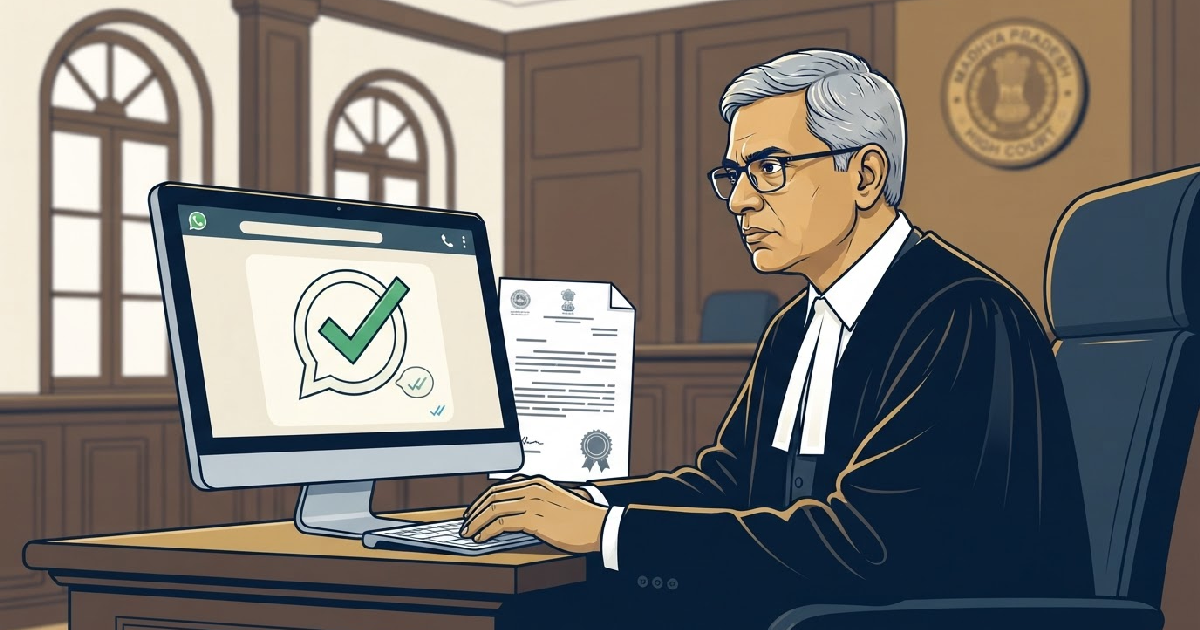
Madhya Pradesh High Court ruled Family Courts must verify digital notice verification for WhatsApp/email service before issuing ex-parte maintenance orders.
On July 24 or 25, 2026, Justice Jai Kumar Pillai of the Indore bench set aside an ex-parte order that directed Wasim Khan to pay ₹10,000 monthly maintenance to his wife, Anam Khan.
Digital notice verification strengthens natural justice
This decision, arising from the case of WK v AK (Cr.R. NO. 4141/2024), underscores the judiciary’s commitment to upholding fundamental principles of natural justice amidst the increasing reliance on electronic communication in legal proceedings.
Justice Pillai’s ruling emphasizes that simply sending a notice via WhatsApp or email isn’t enough; courts must confirm its successful delivery and acknowledgment. This verification is crucial to ensure that the absent party truly had an opportunity to appear and present their case.
The High Court found that the Family Court had failed to establish whether the electronic notices were genuinely served. This oversight directly undermined the right to be heard, a cornerstone of fair legal process.
The Case of WK v AK
The legal dispute originated from the marriage of Wasim Khan and Anam Khan on June 14, 2021. Anam Khan had filed an application under Section 125 of the Code of Criminal Procedure (CrPC), seeking maintenance from her husband.
Initially, traditional notices were issued to Wasim Khan but were returned unserved because he wasn’t home. The Family Court then permitted service through WhatsApp, email, and Registered AD (acknowledgment due) mode, but later proceeded ex-parte without verifying the electronic service reports.
Core of the High Court’s Ruling
Justice Pillai described the Family Court’s action as a “grave irregularity,” stating that the failure to ascertain digital service status “strikes at the root of the principles of natural justice.” This procedural flaw rendered the impugned ex-parte order patently illegal.
The High Court intervened using its revisional jurisdiction, remanding the matter back to the Family Court for a fresh hearing. Both parties are now expected to appear before the Family Court on August 17, likely in 2026, to ensure a fair opportunity for both sides.
A Closer Look at the Legal Framework for Electronic Service
India’s judiciary has progressively embraced digital communication for legal processes, particularly in recent years. Amendments to the Code of Civil Procedure (CPC) in 2002 first allowed electronic means for serving summons.
The Supreme Court of India notably expanded this during the COVID-19 pandemic, permitting service of notices and pleadings via email and instant messaging platforms like WhatsApp, often considering read receipts as prima facie proof.
Evolution of Digital Communication in Courts
Various High Courts have affirmed the validity of digital service in different contexts. The Bombay High Court, in cases like Kross Television India Pvt. Ltd. v. Vikhayat Chitra Production and SBI Cards & Payment Services Ltd. v. Rohidas Jadhav, recognized WhatsApp and email service as valid, particularly with delivery confirmation.
Similarly, the Delhi High Court allowed service of summons via WhatsApp, text message, and email when traditional methods failed. Even the Kerala High Court allows direct postal, electronic summons for matters abroad, showing a clear trend towards modernization.
The “Blue Tick” Dilemma and Proof of Service
Despite judicial acceptance, concerns about the reliability of electronic service persist. Critics often point to the “blue tick fallacy” for WhatsApp, arguing that read receipts aren’t statutory proof under the CPC.
The Information Technology Act, 2000, particularly Sections 4 and 5, provides legal recognition for electronic records, while Section 63 of the Bharatiya Sakshya Adhiniyam, 2023 (formerly Section 65B of the Indian Evidence Act), governs the admissibility of electronic evidence. This requires a certificate to authenticate proper device functioning.
Impact on Family Court Proceedings
The Madhya Pradesh High Court’s ruling significantly impacts how Family Courts handle cases involving electronic service. It creates a higher bar for confirming notice, directly affecting countless maintenance, divorce, and child custody disputes.
This mandate ensures that parties, especially those who may not be digitally savvy or actively using specific platforms, are not unfairly disadvantaged by an ex-parte order issued in their absence.
Implications for Ex-Parte Orders
An ex-parte order is issued when one party fails to appear in court after receiving proper notice. While these orders prevent endless delays, they are exceptions to the fundamental principle of natural justice, which demands that both sides be heard.
Courts must be absolutely satisfied that summons were genuinely served and the defendant had a real chance to respond before proceeding without them. This ruling reinforces that crucial safeguard.
Protecting the Right to Be Heard
The principle of audi alteram partem, meaning “hear the other side,” is a core tenet of Indian law, enshrined in Articles 14 and 21 of the Constitution. It guarantees a fair hearing, including the opportunity to present one’s case and evidence.
Failing to verify electronic notice for an ex-parte order directly violates this right. The High Court’s decision ensures that procedural efficiency doesn’t come at the expense of fundamental fairness.
Judicial Precedent and Broader Implications
Justice Jai Kumar Pillai has been at the forefront of several notable rulings from the Madhya Pradesh High Court’s Indore bench. His decisions often focus on reinforcing procedural integrity and constitutional rights.
This consistent judicial stance helps shape clearer guidelines for lower courts, ensuring they adhere to due process even as legal mechanisms evolve.
Justice Jai Kumar Pillai’s Recent Rulings
Just weeks before this maintenance order ruling, on May 27, 2026, Justice Pillai stated that requests for round-the-clock security for interfaith couples must show “clear proof of threat.” He denied such requests based on general fears alone.
Earlier, on July 21, 2026, he quashed a Collector’s directive to recall a Closure Report, asserting that the Collector holds no authority over the investigative process under the CrPC. This reinforces the separation of powers within the criminal justice system.
Challenges in Digital Justice Delivery
While technology offers efficiency, it also presents challenges. The “digital divide” is a significant concern, potentially excluding individuals without internet access or smartphones from judicial processes. This could contravene Article 14, guaranteeing equality before the law.
Ensuring consistent implementation and preventing manipulation of digital evidence remain key hurdles for the Indian legal system. There’s an ongoing need for clear, universal rules to manage these complexities.
Financial Stakes and Legal Battles
Maintenance cases under Section 125 CrPC aim to prevent destitution by providing financial support to dependent spouses, children, and parents. The stakes are often high for both parties involved.
In this particular case, Anam Khan had initially claimed ₹2 lakh per month in maintenance, a figure significantly higher than the ₹10,000 ultimately ordered by the Family Court before the ex-parte ruling was set aside.
Maintenance Claims and Disputes
The wide discrepancy between the claimed and ordered maintenance amounts highlights the contentious nature of these proceedings. Such financial disputes frequently involve detailed examination of income, needs, and lifestyle.
The legal battle between Wasim Khan and Anam Khan also included allegations of dowry demand, with the wife reportedly claiming ₹50 lakhs and a Swift Dzire car. These allegations add another layer of complexity to their matrimonial dispute.
The Road Ahead for the Khans
With the matter remanded back to the Family Court in Indore, both Wasim Khan and Anam Khan will now have the opportunity to present their respective arguments fully. The court will need to ensure proper service of notice before any further proceedings occur.
This renewed hearing aims to resolve the maintenance issue based on a complete assessment of facts from both sides, aligning with the principles of fairness articulated by the High Court.
The Future of Digital Evidence and Service in India
The Madhya Pradesh High Court’s decision is a critical step in refining how India’s legal system integrates technology without compromising foundational legal principles. It underscores the ongoing balance between modernization and justice.
The judiciary’s increasing reliance on digital tools is expected to continue, with projects like the Supreme Court’s e-Committee driving further digitization of court records and e-filing capabilities.
Technological Advancements and Judicial Adaptation
The eCourts project, spearheaded by the Supreme Court’s e-Committee, aims to transform the Indian judicial system through technology. This includes digitizing records, enabling e-filing, and facilitating virtual hearings.
Such initiatives promise greater efficiency and accessibility, but also necessitate continuous adaptation of legal rules and procedures to address new challenges. The National Service and Tracking of Electronic Processes (NSTEP) system, for instance, equips process servers with GPS-enabled devices to track service, including electronic deliveries.
Addressing the Digital Divide
One of the most persistent challenges remains the digital divide. Ensuring that technological advancements do not disenfranchise citizens without access to digital infrastructure is paramount. Any legal reform must consider equitable access to justice.
Legal experts advocate for a “hybrid service model,” where electronic service complements traditional physical service, offering comprehensive notification. The Supreme Court has also emphasized adherence to established procedures for clarity, such as its ban on WhatsApp for certain CrPC notices, recognizing the need for proper acknowledgment.
Comparative Aspects of Electronic Notice Verification
The Madhya Pradesh High Court’s stance on verifying electronic service aligns with an evolving judicial approach to digital communication. Courts across India have dealt with similar issues, leading to varied interpretations and guidelines.
This table illustrates how different courts and legal frameworks approach the verification of electronic notices and the implications for legal proceedings.
| Aspect of Service | Traditional Method | Electronic (WhatsApp/Email) | Implication of MP High Court Ruling |
|---|---|---|---|
| Proof of Delivery | Registered AD, Process Server Report | Read Receipts (blue ticks), Delivery Reports | Mandatory verification of electronic reports to ensure actual service. |
| Legal Recognition | Well-established via CPC | IT Act, 2000; SC guidelines (COVID-19) | Reinforces actual service over mere sending, especially for ex-parte orders. |
| Risk of Ex-Parte Order | Lower if proper service record exists | Higher if electronic service is unverified | Significantly reduces risk of invalid ex-parte orders based on unconfirmed digital notice. |
| Natural Justice Impact | Ensured with confirmed physical service | Potentially violated without verification | Upholds audi alteram partem by preventing unjust ex-parte rulings. |
The broader judicial landscape also includes rulings like the Delhi High Court’s stance against piecemeal plaint rejection, reinforcing comprehensive procedural adherence. Similarly, the Andhra Pradesh High Court has detailed strict criteria for plaint rejection, indicating a wider trend of courts scrutinizing procedural aspects.
What does an ex-parte maintenance order mean?
An ex-parte maintenance order is a court directive for financial support issued by a Family Court when one party, typically the respondent, has failed to appear in court. This happens even after they were supposedly served notice about the proceedings, but without their physical presence or representation.
Why did the Madhya Pradesh High Court set aside the ex-parte order?
The High Court set aside the order because the Family Court failed to verify if the digital notices sent via WhatsApp and email were actually served to the husband. Justice Jai Kumar Pillai ruled that this lack of verification violated the fundamental principles of natural justice, specifically the right to be heard.
What is the significance of this ruling for digital notice service in India?
This ruling is highly significant as it clarifies that merely sending a notice through electronic means isn’t enough; courts must confirm actual delivery and acknowledgment. It reinforces the need for procedural fairness in an increasingly digital legal system, safeguarding against ex-parte decisions based on unverified electronic communication.