
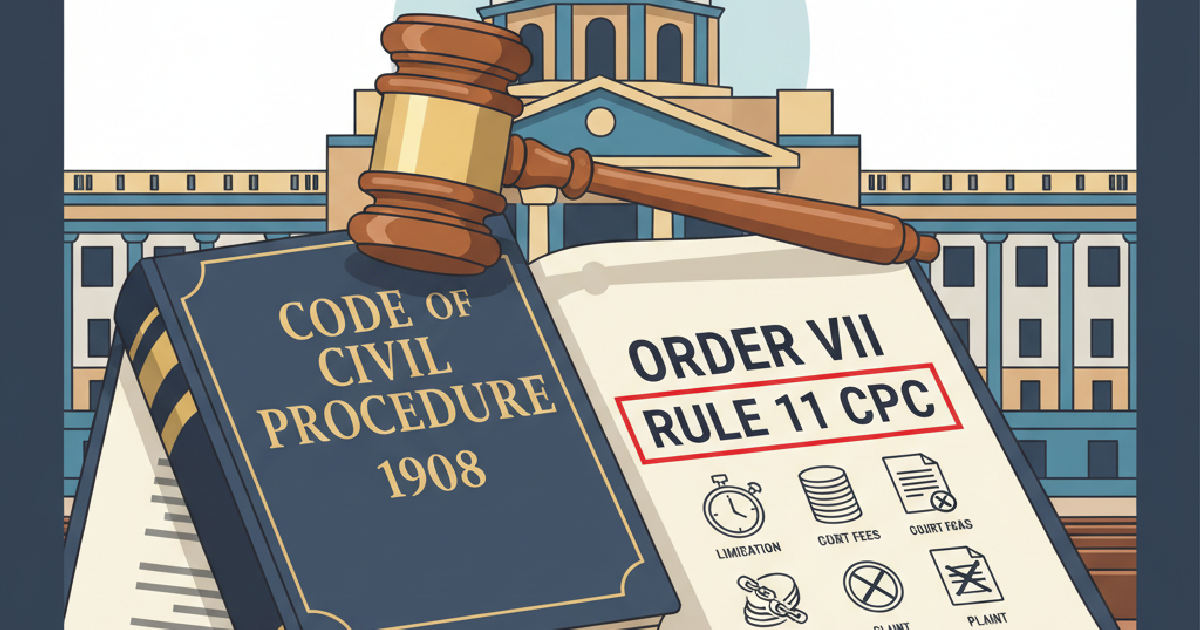
The Andhra Pradesh High Court has reiterated that rejecting a civil plaint under Order VII Rule 11 of the Code of Civil Procedure (CPC) is permissible only when the specific grounds outlined in the rule are strictly applicable to the pleadings presented.
This crucial clarification, reported by LiveLaw on January 20, 2022, emphasizes a foundational principle of Indian civil jurisprudence. It aims to prevent the premature dismissal of potentially valid legal claims.
Understanding Order VII Rule 11 of the Civil Procedure Code
Order VII Rule 11 of the Code of Civil Procedure, 1908 (CPC) empowers civil courts across India to reject a plaint at the very initial stage of a lawsuit. This legal provision serves as a critical gatekeeper, ensuring that only cases with a valid legal foundation proceed to trial.
Its primary objective is to weed out frivolous, vexatious, or legally defective litigation. By doing so, it saves valuable judicial time and resources, preventing parties from engaging in protracted legal battles over claims that inherently lack merit or are procedurally unsound.
Key defects leading to plaint rejection
The rejection of a plaint under Order VII Rule 11 CPC isn’t a discretionary power exercised loosely by the courts. Instead, it’s a stringent measure applicable only when specific conditions, explicitly listed in the rule, are met. These conditions address fundamental flaws in the plaintiff’s initial submission.
The rule details six primary grounds upon which a plaint shall be rejected. These clauses act as a checklist for courts when scrutinizing a plaint at the preliminary stage, ensuring procedural adherence and substantive legal basis.
Clause (a): Failure to disclose a cause of action
One of the most fundamental requirements for any civil suit is the disclosure of a ’cause of action.’ This means the plaint must clearly state the facts that, if proven true, would entitle the plaintiff to the relief sought from the court. If the plaint, even if taken at face value, does not show any legal injury or right to sue, it falls under this clause.
Essentially, the court asks: even if everything the plaintiff says is true, do they have a legal reason to be here? Without a cause of action, the suit is inherently flawed, lacking the very foundation upon which a court can act.
Clauses (b) and (c): Under-valuation and insufficient stamp paper
Clauses (b) and (c) address pecuniary and fiscal aspects of the plaint. If the relief claimed in the suit is undervalued, the court will require the plaintiff to correct the valuation within a stipulated time. Similarly, if the plaint is filed on insufficiently stamped paper, the court mandates the supply of requisite stamp paper.
Failure by the plaintiff to comply with these directions within the time fixed by the court leads to the rejection of the plaint. These provisions ensure proper adherence to court fee regulations, which are crucial for the fiscal administration of justice.
Clause (d): Barred by law
A significant ground for rejection is when the suit appears, from the statements made in the plaint itself, to be barred by any law. This includes situations where the suit is clearly barred by the law of limitation, principles of res judicata, or specific statutory prohibitions. For instance, if a suit is filed long after the legally prescribed period for such a claim has expired, and this is evident from the plaint, it can be rejected.
However, the key here is that the bar must be *apparent* from the plaint’s averments alone. If it involves disputed questions of fact regarding, for example, the commencement of the limitation period, the court cannot reject the plaint at this preliminary stage. This principle was recently emphasized by the Andhra Pradesh High Court.
Clauses (e) and (f): Procedural defects
The final two clauses, (e) and (f), deal with other procedural defects. Clause (e) pertains to cases where the plaint is not filed in duplicate, and clause (f) covers instances where the plaintiff fails to comply with the provisions of Rule 9 of Order VII, which relates to the production of documents.
These clauses underscore the importance of proper procedural compliance in civil litigation. While seemingly minor, such defects can hinder the efficient processing of a case, necessitating their correction or leading to rejection if unaddressed.
Andhra Pradesh High Court's consistent emphasis on strict applicability
The Andhra Pradesh High Court has consistently maintained a strict interpretation of Order VII Rule 11 CPC. Its January 18, 2022, ruling, reported by LiveLaw, clearly stated that a plaint cannot be rejected under an application filed by the defendant unless any of the specific clauses under Order VII Rule 11 are *strictly applicable* to the pleadings within the plaint. This ruling, delivered by Justice R. Raghunandan Rao, reinforces the idea that the power to reject a plaint is an extraordinary one.
It’s not a tool for adjudicating disputed facts or for resolving complex legal questions prematurely. Instead, it’s reserved for clear-cut instances where the plaint itself, on its face, demonstrates a fatal legal or procedural flaw. This approach safeguards genuine litigants from having their claims dismissed summarily.
Considering only plaint averments at this stage
A crucial principle reiterated by the Andhra Pradesh High Court is that at the stage of considering an Order VII Rule 11 application, the court must look *only* at the averments made in the plaint and the documents filed alongside it. The court cannot delve into the defense presented by the defendant or consider any extraneous material.
The plaint must be read as a whole to determine if it discloses a cause of action or if any of the other grounds for rejection are clearly applicable. This strict limitation ensures that the preliminary scrutiny doesn’t turn into a mini-trial, which would defeat the purpose of the rule.
Disputed questions of fact cannot trigger rejection
The High Court has also made it clear that if the application of Order VII Rule 11 involves disputed questions of fact or mixed questions of law and fact, the rejection of the plaint at the threshold is impermissible. Such issues require evidence and a proper trial for adjudication. For instance, questions regarding the actual date a cause of action arose, or whether a party had knowledge of certain facts, are often contentious. These require a thorough examination of evidence and cannot be decided merely by reading the plaint.
This stance protects plaintiffs from hasty dismissals, ensuring that complex factual matrices are properly explored. It aligns with the broader principle of preventing new defenses that contradict original pleadings in civil trials. Such issues need a full hearing, not a preliminary dismissal.
Recent rulings shaping plaint rejection criteria
The Andhra Pradesh High Court has consistently built upon its jurisprudence regarding Order VII Rule 11 CPC through several subsequent rulings. These decisions provide further clarity on how this vital procedural tool should be applied, reinforcing the need for strict adherence to its statutory conditions.
The judiciary aims to strike a balance: enabling the swift disposal of baseless litigation while ensuring legitimate claims are not stifled prematurely. These clarifications are significant for both legal practitioners and prospective litigants.
| Date of Ruling | Key Principle Clarified | Implication for Plaint Rejection |
|---|---|---|
| January 18, 2022 | Strict applicability of Order VII Rule 11 clauses | Rejection only if clauses are strictly met by plaint averments |
| October 9, 2025 | Power confined to plaint, no factual disputes at preliminary stage | Courts cannot resolve facts; directed court-fee refunds for set-aside rejections |
| March 3, 2026 | Clear bar by limitation from plaint itself for Rule 11(d) | If limitation involves factual dispute, trial is required |
| May 24, 2026 | Deemed notice not sufficient for specific performance suit rejection | Actual knowledge pleaded overrides constructive notice under Transfer of Property Act |
Limitation period and the role of actual knowledge
A particularly nuanced area in Order VII Rule 11(d) CPC concerns the limitation period. The Andhra Pradesh High Court clarified on March 3, 2026, that a plaint can only be rejected if it’s *clearly barred by limitation from the statements made in the plaint itself*. If the defendants dispute the date the cause of action first arose, it becomes a mixed question of law and fact, necessitating a trial.
Furthermore, on May 24, 2026, the High Court ruled that a plaint in a suit for specific performance cannot be rejected merely based on deemed notice from registered documents under Section 3 of the Transfer of Property Act, 1882. This holds true especially when the plaint pleads a specific date of actual knowledge. Questions of deemed notice or willful abstention are considered mixed questions of fact and law, demanding adjudication during a full trial rather than a preliminary dismissal.
This ruling significantly impacts how property deal cases involving specific performance are handled at the outset.
Court fee refunds and procedural fairness
The High Court has also addressed the financial implications for litigants when a plaint rejection order is later overturned. On October 9, 2025, it directed a refund of court fees on appeal under Section 64 of the A.P. Court-Fees and Suits Valuation Act, 1956, when a rejection order is set aside and the plaint is ordered to be received and registered. This is a crucial aspect of procedural fairness.
It ensures that plaintiffs are not unduly penalized when an initial rejection, deemed incorrect on appeal, delays their access to justice. This move signals a commitment to reducing financial burdens on litigants when errors occur at the preliminary stage of litigation. It also aligns with the broader principles of access to justice that govern civil procedure, complementing efforts to simplify processes like easing NRI divorce proceedings through modern means.
Implications for litigants and legal practice
These consistent rulings from the Andhra Pradesh High Court carry significant implications for civil litigants and legal practitioners throughout India. For plaintiffs, it means their initial pleadings must be meticulously drafted, clearly outlining the cause of action and ensuring all procedural requirements, including proper valuation and stamp duty, are met. It places a premium on thorough preparation from the very outset of a suit.
For defendants, the rulings clarify that applications for rejection under Order VII Rule 11 CPC must be based strictly on the content of the plaint itself. They cannot introduce external evidence or seek to convert a preliminary procedural check into a factual dispute. This prevents strategic, but ultimately unfounded, attempts to derail valid suits at an early stage.
Enhancing judicial efficiency and reducing frivolous litigation
The High Court’s emphasis on strict applicability, coupled with its nuanced interpretations concerning limitation and actual knowledge, contributes to a more efficient judicial system. By setting clear boundaries for plaint rejection, courts can more effectively filter out genuinely unmeritorious cases. At the same time, they protect those with legitimate grievances from premature dismissal.
This approach helps to strike a crucial balance. It allows courts to manage their caseload effectively by preventing frivolous suits from consuming valuable time and resources. Yet, it does so without infringing upon a litigant’s fundamental right to have their case heard and decided on its merits after a full trial.
Broader impact on civil jurisprudence
The Andhra Pradesh High Court’s directives resonate beyond its immediate jurisdiction, influencing civil jurisprudence across India. The consistent interpretation of Order VII Rule 11 CPC as a power to be used sparingly and strictly reinforces the foundational principle that a plaintiff should generally have their day in court. It emphasizes that procedural bars should not be lightly applied to extinguish substantive rights.
These rulings serve as a guide for lower courts, urging them to exercise caution and precision when considering applications for plaint rejection. They underscore the importance of reading the plaint holistically and refraining from deciding contested factual issues at a preliminary stage. This promotes greater predictability in legal outcomes and bolsters public confidence in the judicial process.
Frequently Asked Questions
What is the primary purpose of Order VII Rule 11 CPC?
The primary purpose of Order VII Rule 11 CPC is to enable courts to reject a civil plaint at an early stage if it suffers from fundamental legal or procedural defects. This helps in filtering out unmeritorious or clearly flawed cases, saving judicial time and resources by preventing unnecessary trials.
Can a defendant introduce new evidence to support a plaint rejection application?
No, when considering an application for rejection under Order VII Rule 11 CPC, courts are generally restricted to examining only the averments made in the plaint and the documents filed along with it. A defendant cannot introduce external evidence or delve into their defense to seek rejection at this preliminary stage.
What happens if a court erroneously rejects a plaint under Order VII Rule 11 CPC?
If a court erroneously rejects a plaint under Order VII Rule 11 CPC, and that order is subsequently set aside on appeal, the High Court has directed that court fees paid on the appeal should be refunded. The plaint is then ordered to be received and registered, allowing the suit to proceed as originally intended, ensuring procedural fairness for the litigant.