
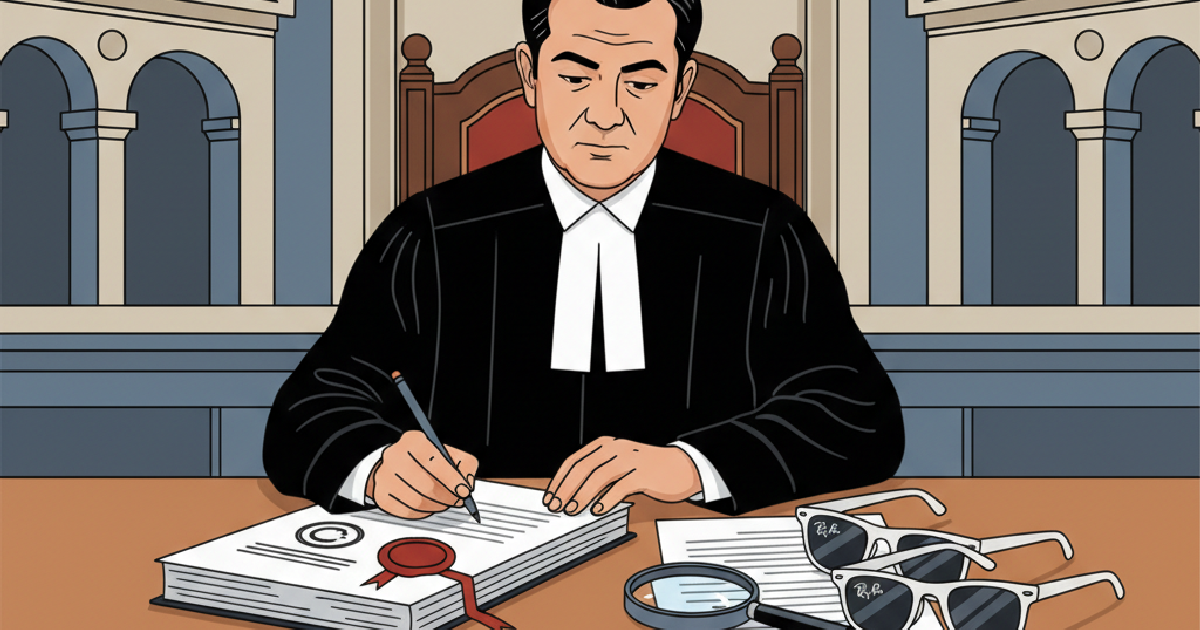
In a significant decision handed down on June 09, 2026, the Commercial Court at Saket, New Delhi, declared that a Local Commissioner’s report can indeed serve as the foundational evidence for a decree in trademark and copyright infringement suits. This ruling is a crucial development for businesses battling counterfeiting in India.
The judgment, delivered in the case of M/s Luxottica Group S.P.A. v. Muneet Kumar & Ors. (Case No. CS (COMM) No. 345/2019), saw the globally renowned RAY-BAN brand successfully enforce its intellectual property rights. It specifically targeted traders found dealing in counterfeit eyewear. The case reinforces the power of interim measures in intellectual property enforcement.
Delhi Commercial Court bolsters trademark enforcement
The Commercial Court at Saket, New Delhi, found Luxottica Group S.P.A., the proprietor of the RAY-BAN brand, had established its rights. This was based on extensive registrations, longstanding use, and a substantial reputation for its trademark. Defendants in the case were notably absent from proceedings.
They failed to effectively contest the suit or present any evidence in their defence. This lack of opposition left the court to rely heavily on the evidence submitted by the plaintiff. It streamlined the path to a decisive judgment.
Role of the Local Commissioner’s report
Central to the court’s decision was the report filed by a Local Commissioner. This official had been appointed early in the litigation process. The Commissioner’s role involved visiting the defendants’ premises.
During the visit, a substantial quantity of infringing products was seized. This tangible evidence formed the bedrock of the plaintiff’s case. It provided undeniable proof of the counterfeit activities.
Legal precedent and evidentiary weight
The court explicitly stated that a Local Commissioner’s report constitutes substantive evidence. This stands true under Order XXVI Rule 10(2) of the Code of Civil Procedure (CPC). Crucially, the court reiterated that examining the Local Commissioner is not mandatory.
This applies when the report remains unchallenged by the opposing party. In reaching this conclusion, the Delhi Commercial Court drew upon established precedents. These included Levi Strauss & Co. v. Rajesh Agarwal, alongside other relevant Delhi High Court rulings.
Commercial Courts Act: Speeding up justice
The establishment of Commercial Courts, like the one in Saket, falls under the Commercial Courts Act, 2015. This legislation was enacted to accelerate the resolution of high-value commercial disputes. India aimed to improve its global ranking in the Ease of Doing Business index through this initiative.
Delhi operates a two-tier system for these commercial cases. District-level Commercial Courts handle disputes with a “specified value” exceeding ₹3 lakh but below the Delhi High Court’s original side pecuniary jurisdiction. These courts are located across various complexes in the city.
The Commercial Division of the Delhi High Court handles higher-value disputes. Its “specified value” threshold is above ₹3 crore. This division has original civil jurisdiction for complex commercial matters. It includes intellectual property (IP) disputes and arbitration-related petitions throughout Delhi.
Powers and functions of Local Commissioners
A Local Commissioner serves as an “extended arm of the court.” They are neutral fact-finders, aiding in evidence gathering outside the courtroom. Sections 75-78 and Order XXVI of the Code of Civil Procedure (CPC), 1908, outline their legal framework and powers.
Courts often appoint LCs in trademark infringement suits at the outset. This helps to prevent “fly-by-night operators” from concealing or destroying counterfeit inventory. It’s a proactive measure to secure evidence.
Their powers are comprehensive. LCs can enter and inspect a defendant’s premises, which might include shops, godowns, or factories. They are authorized to seize infringing goods, often placing them in “Superdari.”
This means safe custody, frequently with sealing and strict instructions against movement or sale. LCs also document findings through photographs, inventory creation, and signing ledger books. This prevents potential tampering. Police assistance is typically directed by courts to ensure their safety during raids.
| Aspect | Description | Legal Basis / Context |
|---|---|---|
| Role of Local Commissioner | Court-appointed officer for fact-finding and evidence collection. | Sections 75-78 & Order XXVI of CPC, 1908 |
| Evidentiary Value of Report | Constitutes substantive evidence in court record. | Order XXVI Rule 10(2) of CPC |
| Mandatory Examination | Not mandatory if the report remains unchallenged by defendants. | Delhi High Court precedents (e.g., Levi Strauss & Co. v. Rajesh Agarwal) |
| Typical Powers | Entry, inspection, seizure (Superdari), documentation (photos, inventory). | Court’s discretionary orders for LC appointment |
| Purpose in IP Cases | Prevent destruction of counterfeit stock, gather prima facie evidence. | Critical for early stage trademark enforcement |
Jurisdiction over online intellectual property infringement
The Commercial Court also upheld its territorial jurisdiction in the Luxottica case. It noted that Luxottica Group S.P.A.’s products were readily available through interactive websites. These online marketplaces were accessible within the court’s geographical jurisdiction.
And the infringing products themselves had been sold within that same territorial reach. This finding further solidifies the basis for courts to exercise jurisdiction over intellectual property disputes that involve online activities. This is particularly relevant in the era of e-commerce and digital marketplaces.
It means that companies can pursue legal action against online infringers in local courts where their products are sold. This is true even if the counterfeiters operate from a different physical location. The digital reach of a business increasingly defines a court’s authority.
Relief granted and its implications for brand protection
Following its findings, the court granted significant relief to Luxottica Group S.P.A. This included a permanent injunction. It specifically restrains the defendants from manufacturing, marketing, selling, or dealing in any goods bearing the infringing RAY-BAN mark.
This injunction also covers any mark deceptively similar to it. Additionally, the court ordered the delivery-up of all seized infringing goods. This ensures they are removed from circulation. The plaintiff was also awarded ₹1.5 lakh as notional damages and ₹1 lakh towards costs.
This judgment provides a robust framework for brand owners. It allows them to combat counterfeiting more effectively. The explicit affirmation of the Local Commissioner’s report as substantive evidence is a powerful tool.
It means that once physical evidence of infringement is secured, the path to a decree is significantly clearer. This is especially true when defendants choose not to defend themselves. Such rulings streamline the legal process for victims of intellectual property theft. It makes enforcement more predictable.
Challenges and criminal penalties for trademark infringement
Trademark protection and enforcement in India are primarily governed by the Trade Marks Act, 1999. Under Section 29 of this Act, infringement occurs when an identical or deceptively similar mark is used. This applies to the same or related goods/services without proper permission.
It also covers situations where the reputation of a well-known trademark is unfairly exploited. Sections 134 and 135 of the Act outline the available civil remedies. These include injunctions, damages, or an account of profits.
Delivery-up, which involves the seizure and destruction of infringing goods and marks, is another key remedy. Moreover, the Trade Marks Act, 1999, also includes criminal penalties. Sections 103 to 105 cover acts such as the falsification of trademarks.
These offences can lead to imprisonment for up to three years. Fines can also reach up to ₹2 lakh. For brand owners, understanding the dual nature of civil and criminal remedies is crucial for a comprehensive enforcement strategy.
And for commercial entities dealing with litigation, staying updated on procedural nuances, like those concerning Local Commissioners, is essential. For instance, the Supreme Court recently issued a ruling on written statements filed in commercial suits during extended limitation periods.
Frequently Asked Questions
What is a Local Commissioner’s report in a trademark infringement case?
A Local Commissioner’s report is a document prepared by an officer appointed by the court. This report details the findings from an on-site investigation. In trademark infringement cases, it typically includes observations, an inventory of seized counterfeit goods, and photographic evidence collected from the defendant’s premises.
Why is the Delhi Commercial Court’s ruling on these reports important for businesses?
This ruling is crucial for brand owners as it explicitly validates that a Local Commissioner’s report can be the primary basis for a court decree in trademark infringement suits, particularly if unchallenged by the defendants. It strengthens a brand’s ability to secure immediate injunctions and damages against counterfeiters, relying on tangible and legally obtained evidence.
Can Indian courts take action against online sellers of counterfeit products?
Yes, the Delhi Commercial Court affirmed its territorial jurisdiction in this case because the plaintiff’s products were available through interactive websites and online marketplaces accessible within its jurisdiction, and the infringing goods were sold within that area. This means courts can increasingly assert authority over online sellers whose illicit activities affect consumers or businesses locally, broadening the scope of intellectual property protection.