
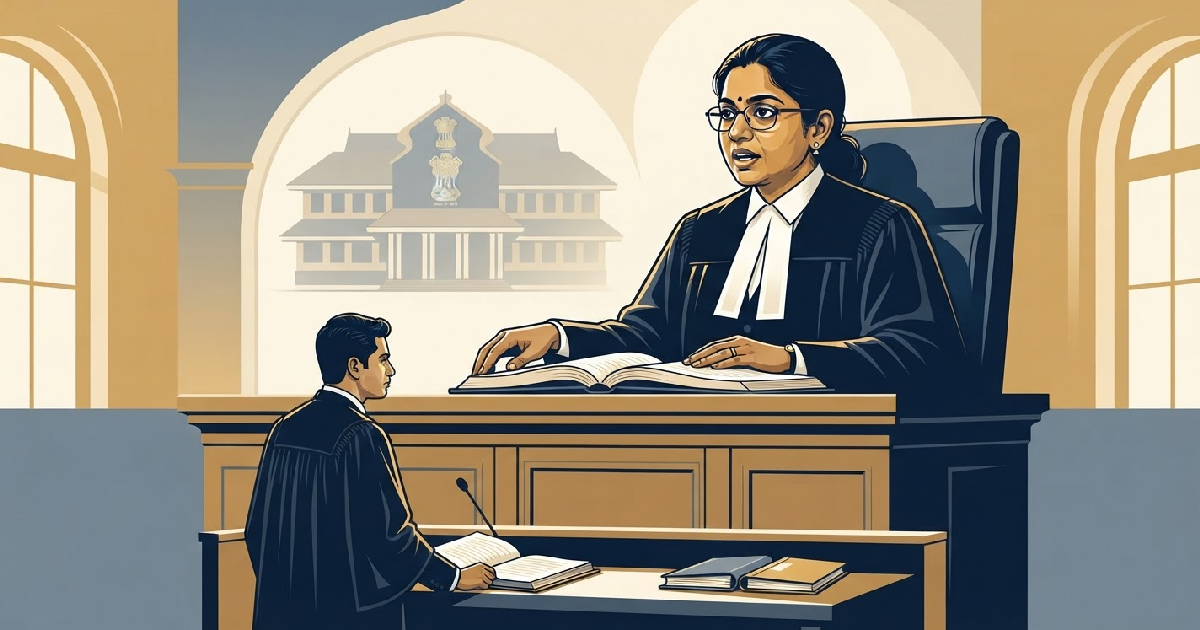
The Kerala High Court ruled that a director cannot be held liable under Section 138 of the Negotiable Instruments Act if the company itself is acquitted of the offense.
This crucial decision, delivered by Justice Sophy Thomas on November 14, 2023, in the case of Afsal Hussain v KS Muhammed Ismail & Anr., reinforces the principle that an individual’s criminal liability stems from the primary offense committed by the corporate entity.
Understanding India’s Cheque Dishonour Laws
The verdict provides a shield for directors who might otherwise face prosecution even after their companies are cleared of wrongdoing in cheque bounce incidents, particularly under Section 141 of the NI Act. It impacts how corporate criminal liability is assessed in India and brings further clarity to a complex area of law.
India’s legal framework for negotiable instruments, primarily the Negotiable Instruments Act, 1881, governs various financial instruments, including cheques. The introduction of Section 138 into the Act in 1988 was a pivotal moment, transforming cheque dishonour from a purely civil matter into a quasi-criminal offense. This was aimed at boosting public confidence in cheque transactions and ensuring financial discipline.
Before the 1988 amendment, individuals who issued cheques that bounced faced only civil penalties, which often proved inadequate to deter fraudulent practices or ensure timely payments. The subsequent amendments, including those in 2002, 2015, and 2018, have further strengthened the Act. These changes have broadened its scope and provided more robust mechanisms for redressal, such as interim compensation.
Evolution of the Negotiable Instruments Act
The Negotiable Instruments Act, 1881, was originally designed to streamline commercial transactions involving promissory notes and bills of exchange. Section 138, inserted in 1988, dramatically changed its application to cheques. It made the act of a cheque bouncing due to insufficient funds a punishable offense.
This legislative move was a direct response to the growing issue of unpaid cheques in commercial dealings. The intent was to provide a swift and effective legal remedy for payees, reducing delays associated with civil litigation. It introduced a layer of criminal deterrence to financial mismanagement.
The evolution of cheque dishonour laws continues to be debated and refined by judicial interpretations. Courts often grapple with balancing the need to punish offenders and prevent misuse of the law against individuals. This ongoing process shapes the contours of financial accountability in India.
Conditions for Section 138 Offences
For an offense under Section 138 to be proven, several strict conditions must be met. First, the cheque must have been issued to discharge a legally enforceable debt or other liability. This ensures that the law isn’t invoked for casual or non-binding agreements.
Second, the bank must return the cheque unpaid, typically due to insufficient funds in the drawer’s account. The payee then must issue a formal legal notice to the drawer within 30 days of receiving the “return memo” from the bank. This notice demands payment of the cheque amount.
Finally, if the drawer fails to make the payment within 15 days of receiving this notice, a complaint can then be filed in a court of law. All these steps are crucial and must be meticulously followed for a successful prosecution under the Act.
The Principle of Vicarious Liability for Directors
Vicarious liability is a legal concept where one person is held responsible for the acts of another. In the context of corporate law, Section 141 of the Negotiable Instruments Act extends this liability to individuals within a company when the company commits an offense. This section aims to prevent individuals from escaping responsibility by hiding behind the corporate veil.
However, this liability isn’t automatically assigned to every director. Courts have repeatedly emphasized that merely holding a directorship isn’t enough to attract criminal responsibility. Specific involvement in the company’s affairs at the time of the offense is a prerequisite.
Section 141 of the NI Act
Section 141 of the NI Act stipulates that if a company commits an offense under Section 138, every person who, at the time the offense was committed, was in charge of and responsible to the company for the conduct of its business, shall also be deemed guilty. This means they can be prosecuted and punished alongside the company.
The phrase “in charge of and responsible for the conduct of the business” is central to interpreting this section. It requires a tangible link between the director’s role and the company’s day-to-day operations, especially concerning financial decisions. This provision ensures accountability for those truly managing the corporate entity.
Supreme Court’s Stance on Director Accountability
The Supreme Court of India has consistently provided crucial interpretations of Section 141, refining its application. In S.M.S. Pharmaceuticals Ltd. v. Neeta Bhalla (2005), the Court ruled that a complaint must contain specific averments detailing the director’s role and responsibility. General statements are insufficient to trigger liability.
Later, the landmark three-judge bench decision in Aneeta Hada v. Godfather Travels & Tours Pvt. Ltd. (2012) established a fundamental principle: the company itself must be an accused party for any director or officer to be prosecuted under Section 141. Without impleading the company, the prosecution against individuals isn’t maintainable. This decision significantly clarified the gravitas of a complaint under the Negotiable Instruments Act.
These rulings highlight the Supreme Court’s cautious approach to extending criminal liability to corporate functionaries. They underscore the need for concrete evidence linking individuals to the offense, rather than relying solely on their position within the company. This protects directors from arbitrary or baseless prosecutions.
The Afsal Hussain Verdict: A Closer Look
The recent Kerala High Court judgment centers on the case of Afsal Hussain, the Managing Director of Omnitech Information Systems Pvt. Ltd. The specific facts of his case provided a clear context for Justice Sophy Thomas’s ruling, ultimately influencing the outcome for many other corporate directors facing similar charges.
The verdict is particularly significant because it addresses a common legal challenge: what happens when different courts deliver conflicting judgments on various accused parties within the same case? It highlights the hierarchical nature of India’s judicial system and the ultimate authority of higher courts.
Case Background and Initial Rulings
The case stemmed from a complaint filed by K.S. Muhammed Ismail, who alleged he was induced to invest ₹10 lakh in Omnitech Information Systems Pvt. Ltd. The company subsequently issued a cheque for this amount in February 2000, which was dishonoured due to insufficient funds. Ismail then initiated proceedings under the NI Act.
The Judicial First Class Magistrate Court-I, Kanjirappally (C.C. No. 695 of 2000), initially convicted all accused parties: the company, Afsal Hussain as its Managing Director, and other directors. However, the subsequent appeal to the Additional Sessions Judge, Kottayam (Crl. Appeal No. 226 of 2005), resulted in a partial acquittal.
The appellate court acquitted the company and the other directors, but it upheld Afsal Hussain’s conviction, reducing his penalty to imprisonment “till the rising of the Court” and a fine of ₹10 lakh.
Justice Sophy Thomas’s Rationale
Afsal Hussain then filed a revision petition before the Kerala High Court. Justice Sophy Thomas, presiding over the single bench, meticulously reviewed the case. She noted a critical point: the bounced cheque was issued by the company, not by Afsal Hussain in his personal capacity.
The core of her rationale lay in the principle that if the primary accused, the company, is acquitted of the offense under Section 138, then the basis for holding its directors vicariously liable under Section 141 ceases to exist.
“When the company is found not guilty of the offence alleged, the managing director cannot be held vicariously liable for the offence,” Justice Thomas stated, setting aside the appellate court’s order and acquitting Afsal Hussain.
Impact and Legal Implications of the Ruling
This ruling from the Kerala High Court carries substantial weight for corporate governance and criminal law in India. It doesn’t just resolve a specific case; it sets a precedent that will guide lower courts in handling similar cheque dishonour disputes involving companies and their management. The decision helps clarify the boundaries of individual accountability within a corporate structure.
It emphasizes that directors are not mere extensions of a company and that their liability is not automatically intertwined with every corporate action. Rather, it must be established on solid legal grounds, particularly when the corporate entity itself is absolved of blame. This offers a degree of protection against overzealous prosecutions.
Reinforcing Corporate Liability Principles
The Kerala High Court’s judgment reinforces the well-established principle that vicarious criminal liability requires a primary offender. If the company, which is the principal accused in a Section 138 case, is acquitted, then the foundation for prosecuting its directors for the same offense collapses.
This aligns with previous Supreme Court pronouncements, particularly the Aneeta Hada case, which underscored the necessity of the company being an accused party.
This means the court recognized that a director’s liability under Section 141 is derivative, flowing from the company’s alleged offense. If there’s no corporate offense to derive from, there can be no vicarious liability for the director. It streamlines the judicial process by preventing individual prosecutions where the corporate body has already been exonerated.
Shielding Directors from Undue Prosecution
This decision offers much-needed clarity and protection for directors, especially managing directors, who are often the first to be implicated in cheque dishonour cases. It ensures that directors aren’t unfairly burdened with criminal proceedings when the corporate entity they represent has been found not guilty. This helps in fostering a more predictable legal environment for corporate leadership.
The ruling discourages the practice of prosecuting directors as a default, regardless of the company’s standing in the case. It mandates a more nuanced approach, requiring courts to consider the company’s culpability before extending liability to its directors. This approach is more equitable and prevents legal overreach.
Navigating Corporate Cheque Dishonour Cases
The ruling in Afsal Hussain v KS Muhammed Ismail & Anr. builds upon a growing body of jurisprudence that seeks to delineate the precise scope of director liability in corporate criminal matters. It adds a critical layer of understanding to Section 138 and Section 141 of the Negotiable Instruments Act.
This refined legal position underscores the importance of a company’s legal standing in such cases. It makes the acquittal of the corporate entity a decisive factor in determining the fate of its directors. This means legal strategy for both prosecution and defense in cheque dishonour cases must now account for this precedent.
Key Differentiators in Director Liability
Recent judicial pronouncements have drawn clear lines between various types of directors and their potential liability. Executive directors, especially managing directors, who are actively involved in day-to-day operations and financial decision-making, bear a higher degree of responsibility. Conversely, non-executive or independent directors often face less scrutiny.
On February 15, 2026, the Kerala High Court itself, in a separate case, affirmed that a managing director actively in charge of a company’s affairs can indeed be held liable. However, this was distinct from the Afsal Hussain scenario where the company was acquitted.
Furthermore, the Supreme Court, in K.S. Mehta v. M/s Morgan Securities and Credits Pvt. Ltd. (2025), quashed director liability in a similar cheque case, reiterating that non-executive directors are not automatically liable without specific allegations of their direct involvement.
The table below summarizes key scenarios and the typical liability outcomes based on recent rulings:
| Scenario | Company Status | Director Liability | Key Precedent |
|---|---|---|---|
| Company convicted, director actively involved | Convicted | Vicariously liable (if involvement proven) | V.J. Joseph (2026 Kerala HC) |
| Company acquitted, director accused | Acquitted | Not vicariously liable | Afsal Hussain (2023 Kerala HC) |
| Non-executive director, no direct involvement | Irrelevant (focused on individual) | Generally not liable without specific role | K.S. Mehta (2025 Supreme Court) |
The Role of Specific Evidence
The consistent message from Indian courts is the critical need for specific averments in complaints. Simply listing a person as a director isn’t sufficient to attract criminal liability under Section 141 of the NI Act. Prosecutors must present concrete evidence demonstrating an individual director’s role and responsibility in the issuance of the dishonoured cheque or the financial decisions leading to it.
This judicial emphasis on specific evidence reflects a broader legal principle: criminal liability is personal and cannot be imputed without a direct link to the alleged offense. It ensures that the burden of proof rests squarely on the prosecution to establish an individual’s culpability, rather than relying on their corporate title. This standard protects innocent directors from unwarranted legal battles.
What This Means for Businesses and Legal Practice
The Kerala High Court’s ruling provides crucial guidance for companies, their boards of directors, and legal professionals. For businesses, it reinforces the importance of robust internal controls and clear delineation of financial responsibilities. It also underscores the necessity for companies to vigorously defend themselves in cheque dishonour cases, as their acquittal directly benefits their directors.
From a legal practice perspective, lawyers representing directors in Section 138 cases now have a stronger argument if the primary accused company has been acquitted. It may lead to more strategic decisions on how to approach initial complaints and appeals. This ruling promotes a more equitable application of the Negotiable Instruments Act, aligning individual liability with corporate culpability.
Ensuring Due Diligence in Corporate Governance
Corporate boards and senior management now have an even greater impetus to ensure rigorous due diligence in all financial transactions. Establishing clear protocols for cheque issuance, signatory authority, and funds management is paramount. Detailed records of board meetings and resolutions can serve as vital evidence in defending directors against claims of vicarious liability.
The decision also highlights the need for transparent communication between a company’s management and its legal counsel. Proactive legal advice on compliance with the NI Act and potential liabilities can significantly mitigate risks for individual directors. It encourages a culture of accountability at the corporate level, which ultimately benefits all stakeholders.
Future Legal Challenges and Clarifications
While the Afsal Hussain ruling offers significant clarity, the dynamic nature of corporate law means further interpretations and challenges are inevitable. Courts will likely continue to grapple with nuanced situations, such as cases where a company faces liquidation or dissolution during ongoing proceedings. The precise extent of “acquittal” and its implications in various scenarios might also require further judicial elucidation.
Legislative amendments could also be considered to further streamline the application of Sections 138 and 141, potentially introducing clearer guidelines for director liability. But for now, this Kerala High Court decision stands as a strong benchmark. It ensures that justice is served to directors only when their company has been proven guilty of an offense.
Can a director be held liable if the company is acquitted of cheque dishonour?
No, according to the Kerala High Court’s ruling on November 14, 2023, in the case of Afsal Hussain v KS Muhammed Ismail & Anr. If the company, as the primary accused, is acquitted of an offense under Section 138 of the Negotiable Instruments Act, its directors cannot be held vicariously liable for that same offense.
What is “vicarious liability” under the Negotiable Instruments Act?
Vicarious liability refers to the legal responsibility of an individual for the actions of another. Under Section 141 of the Negotiable Instruments Act, directors or other officers of a company can be held responsible for a cheque dishonour offense committed by the company, provided they were in charge of and responsible for the company’s business at the time of the offense.
How does Section 141 of the NI Act affect directors?
Section 141 of the Negotiable Instruments Act extends criminal liability to individuals within a company if the company commits a cheque dishonour offense. However, courts, including the Supreme Court, have clarified that this liability is not automatic and requires proof that the director was actively involved in or responsible for the company’s affairs related to the dishonoured cheque.