
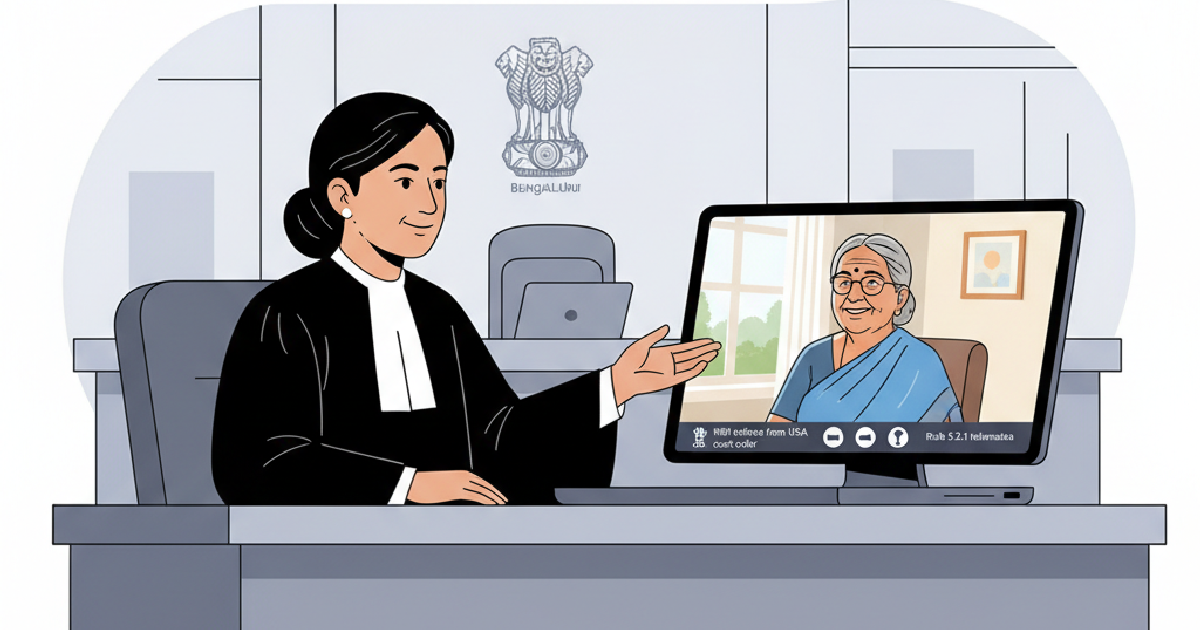
Justice Tara Vitasta Ganju allowed 71-year-old Mrs. Rekha Gupta to record evidence via video conference from the US. Justice Tara Vitasta Ganju of the High Court of Karnataka at Bengaluru has issued an order allowing Mrs. Rekha Gupta, a 71-year-old senior citizen currently residing in the United States, to record her evidence via video conference from her home without the presence of an Indian Embassy official.
The ruling, delivered on July 3, 2026, in Writ Petition No. 12610 of 2026, relaxes strict procedural requirements under Rule 5.3.1 of the Video Conferencing Rules for Courts to prevent “undue hardship” to the petitioner, who serves as the sole executrix and beneficiary of her late husband’s Will.
The petitioner’s plea for remote testimony
Mrs. Rekha Gupta, aged 71, filed Writ Petition No. 12610 of 2026 before the High Court of Karnataka, seeking to relax specific rules governing video conferencing for court proceedings. Her primary request was to allow her to record her examination-in-chief in a probate matter from a secure, pre-verified location in the United States. She is currently a green card holder, which restricts her travel back to India.
The petitioner is the widow of the late Mr. Girish Kumar Gupta, who passed away on September 20, 2024. He had executed a Will on May 6, 2024, bequeathing all his movable and immovable properties to his wife, Mrs. Rekha Gupta, also naming her as the sole executrix.
Probate proceedings and previous applications
Following her husband’s death, Mrs. Gupta filed a petition under Section 276 of the Indian Succession Act, 1925, seeking probate of the Will. This petition was registered as P & SC No. 11/2025 before the VI Additional District and Sessions Judge, Bengaluru Rural. During these proceedings, she filed two crucial applications.
On December 19, 2025, she submitted an application, I.A. No. 4, under Section 75 and Order XXVI Rule 5 of the Code of Civil Procedure, 1908, read with the Video Conferencing Rules. This application sought the appointment of a Court Commissioner to record her evidence via video conference from the USA.
Before that, she had also filed I.A. No. 3 under Section 151 of the Code of Civil Procedure, read with the Video Conferencing Rules, specifically seeking permission to depose evidence through video conferencing. These applications remained undecided, leading to significant delays.
The trial court’s order sheet showed repeated adjournments for her evidence over the past year. This delay was causing substantial prejudice, preventing the senior citizen from accessing the assets bequeathed to her by her late husband. Her counsel highlighted the non-adversarial nature of probate proceedings to argue for relaxation of the rules.
Challenges of overseas testimony for NRIs
The traditional legal framework often presents hurdles for individuals residing abroad who need to give evidence in Indian courts. Specifically, the Rules for Video Conferencing for Courts, outlined in Notification HCC No. 18/2020 dated June 9, 2020, contain provisions that can cause significant logistical challenges for non-resident Indians (NRIs).
Rule 5.3.1 states that when a required person is located overseas, the remote point coordinator “shall be an official of an Indian Consulate / the relevant Indian Embassy / the relevant High Commission of India.” This typically means the witness must travel to an Indian diplomatic mission for their testimony, incurring cost and time.
Rule 5.1 reinforces this by stipulating the need for a coordinator at the remote point when a witness is to be examined. For a senior citizen like Mrs. Gupta, who had relocated to the USA to be with her son and is a green card holder, these mandates presented considerable “undue hardship,” impacting her ability to participate in the legal process from afar. This case highlights how such stipulations can disproportionately affect elderly litigants or those with travel restrictions.
The High Court’s power to relax rules
A critical aspect of this case is Rule 18 of the Video Conferencing Rules, titled “Power to Relax.” This rule empowers the High Court to “dispense with or relax the requirements of that Rule to such extent and subject to such conditions, as may be stipulated to deal with the case in a just and equitable manner.” This provision gives courts the flexibility to adapt procedural norms to individual circumstances.
This power was also affirmed in a prior ruling by a Co-ordinate Bench of the Karnataka High Court in Richa Mishra v. State of Karnataka & Anr. The earlier judgment, cited by Mrs. Gupta’s counsel, clarified that the High Court holds the sole authority to grant waivers for mandatory rules requiring overseas testimony to be routed through an Indian Embassy or Consulate. Indian courts have increasingly used video conferencing to facilitate participation from abroad.
In the present case, Justice Tara Vitasta Ganju considered these precedents and the specific hardships faced by Mrs. Gupta. The court recognized that requiring a 71-year-old green card holder to travel to an Indian Embassy for testimony would impede justice, especially when the proceedings were uncontested and had faced significant delays.
The High Court’s ruling on Mrs. Gupta’s petition
On July 3, 2026, Hon’ble Ms. Justice Tara Vitasta Ganju presided over Writ Petition No. 12610 of 2026. The counsel for Mrs. Rekha Gupta first successfully moved an interlocutory application (I.A. No. 1/2026) to amend the petition, incorporating additional averments and prayers related to recent rulings on video conferencing. This amendment was deemed necessary for proper adjudication of the case.
The High Court then addressed Mrs. Gupta’s two primary requests. First, it directed the VI Additional District and Sessions Judge, Bengaluru Rural, to expeditiously dispose of I.A. No. 4, the application seeking to appoint a Court Commissioner for video conferencing. This was a direct response to the year-long delay in the trial court proceedings regarding the petitioner’s evidence.
Secondly, and most significantly, Justice Ganju exercised the High Court’s power under Rule 18 of the Video Conferencing Rules to relax Rule 5.3.1. This decision allows Mrs. Gupta to record her evidence from her residence in the United States, thereby waiving the requirement for an Indian Embassy official or High Commission coordinator at the remote point, as ordinarily mandated by Rules 5.1 and 5.3.1. This relaxation was granted considering the uncontested nature of the probate proceedings; public notices in ‘Kannada Prabha’ and ‘Indian Express’ had yielded no objectors to the Will.
Safeguards imposed by the court
While relaxing the stringent rules, the High Court imposed specific safeguards to ensure the integrity and fairness of the video conferencing proceedings. These conditions are vital in balancing convenience with judicial oversight.
| Condition Clause | Requirement | Rationale |
|---|---|---|
| (i) | Petitioner must file an undertaking not to disconnect or permit obstruction. | Ensures an uninterrupted and reliable testimony; prevents deliberate disruption. |
| (ii) | Any disconnection attributable to the petitioner will result in discarded evidence. | Places responsibility for technical reliability squarely on the petitioner; deters malpractice. |
| (iii) | Trial Court can impose additional safeguards. | Provides flexibility for the lower court to address unforeseen issues and maintain fairness. |
These stipulations demonstrate the court’s intent to leverage technology for accessibility while also guarding against potential misuse or technical glitches. For example, serving legal notices to NRIs has also seen adaptations to ensure effective communication across borders.
Implications for digital justice and senior citizens
This ruling by Justice Tara Vitasta Ganju marks another step forward in the Indian judiciary’s embrace of technology, particularly post-pandemic. The COVID-19 era significantly accelerated the adoption of video conferencing in courts, transforming it from a peripheral tool to an essential component of justice delivery. This judgment reinforces the principle that technological solutions should ease access to justice, not create new barriers, especially for vulnerable populations such as senior citizens and NRIs.
The High Court’s clear directive to the lower court to expedite the probate proceedings within three months underscores a growing judicial emphasis on timely justice. Long delays disproportionately affect litigants, particularly those like Mrs. Gupta who are elderly and are seeking resolution over inherited property. This decision could set a strong precedent for other similar cases involving senior citizens residing abroad.
Impact on NRI litigation
For NRIs embroiled in legal battles back home, this decision offers a glimmer of hope. The relaxation of Rule 5.3.1 directly addresses one of the most significant practical obstacles: the requirement to visit an Indian diplomatic mission for testimony. By allowing remote testimony from a secure, pre-verified location, the court acknowledges the realities of international living and the restrictions faced by green card holders or expatriates. Many NRIs face civil disputes in India, making such rulings highly pertinent.
However, it’s crucial to note that this is not a blanket waiver. The High Court stressed that the relaxation was granted primarily due to the “undue hardship” faced by Mrs. Gupta and the uncontested nature of the probate proceedings. In more complex or fiercely contested cases, courts may still insist on closer adherence to the original rules to maintain strict evidentiary standards.
The safeguards imposed for the video conference—an undertaking against disconnection and the risk of discarded evidence—also highlight that while convenience is being prioritized, accountability for the technical conduct of proceedings remains with the litigant. This balance between accessibility and judicial integrity will likely shape future rulings on remote testimonies.
Broader context of India’s legal technology evolution
The Indian judiciary has been steadily integrating technology into its operations, a trend significantly bolstered by the impetus of the COVID-19 pandemic. Early uses of video conferencing in Indian courts date back to the early 2000s, primarily for specific instances like witness testimonies in civil and criminal trials, and within tribunals such as the Income Tax Appellate Tribunal.
A landmark moment came with the Supreme Court of India’s ruling in State of Maharashtra v. Dr. Praful B. Desai (2003), which clarified that the legal requirement for a witness’s presence did not necessarily mean physical presence. This opened the door for wider acceptance of virtual appearances.
Post-2020, with directives from the Supreme Court for courts to transition to virtual hearings, technology is now considered indispensable. Rules like Notification HCC No. 18/2020 governing video conferencing were designed to standardize these virtual processes. This ongoing evolution reflects a commitment to modernizing the justice system and enhancing its efficiency.
The supervisory role of High Courts
Article 227 of the Constitution of India grants High Courts the power of superintendence over all subordinate courts and tribunals within their jurisdiction. This supervisory power was central to Justice Ganju’s decision. It allows High Courts to intervene not as an appellate body to correct minor errors, but to ensure that lower courts act within their jurisdiction, adhere to fair procedures, and prevent abuses of process.
In Mrs. Gupta’s case, the High Court’s exercise of this power served two purposes: directing the swift disposal of a pending application and relaxing procedural rules to prevent undue hardship and ensure the ends of justice. This is a classic example of Article 227 being invoked to address a genuine procedural impasse causing prejudice to a litigant.
Frequently Asked Questions
Can all NRIs record evidence from home instead of an Embassy?
No, the standard rule (5.3.1) still requires an Embassy official as a coordinator for overseas testimony. However, the High Court of Karnataka has the power to relax this rule under Rule 18 if the litigant can prove “undue hardship,” such as old age, travel restrictions, or health issues. Each case is decided on its specific merits by the High Court.
What happens if a video conference call drops during testimony?
Under the conditions set by the High Court in the Rekha Gupta case, if a disconnection is attributable to the petitioner, the entire evidence tendered during that session will be discarded. Litigants must provide an undertaking that they will ensure a stable connection and not allow any obstructions during the proceedings.
Is this relaxation applicable to contested property disputes?
While the rules allow for relaxation in various civil matters, courts are generally more comfortable granting these waivers in non-adversarial or uncontested cases like probate. In highly contested trials where cross-examination is rigorous, the court may still insist on the presence of an official coordinator to prevent witness coaching or technical manipulation.