
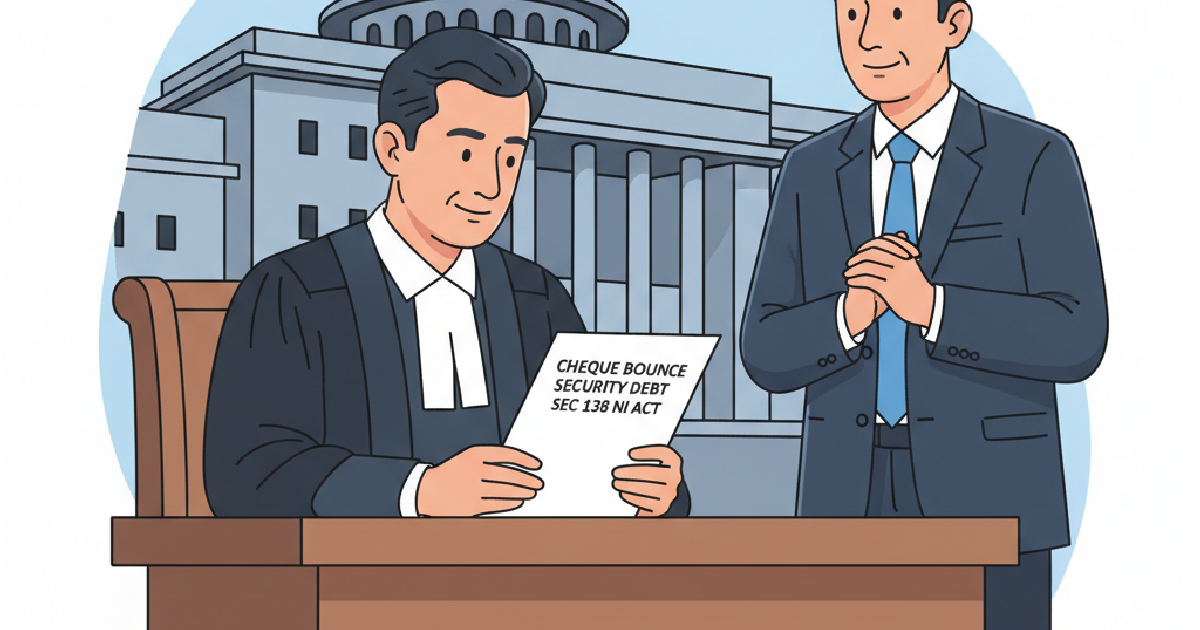
Justice Sanjay Parihar of the High Court of Jammu & Kashmir and Ladakh has ruled that factual disputes regarding whether a cheque was issued as a security instrument or to discharge a debt cannot be resolved during quashing proceedings under Section 482 of the Code of Criminal Procedure (CrPC).
In a significant judgment delivered on February 20, 2026, Justice Sanjay Parihar dismissed a petition filed by Deepak Bawa Sharma, who sought to quash a criminal complaint initiated by Asif Iqbal involving a dishonoured cheque amounting to ₹35 lakh.
Limited scope of inherent powers under CrPC
The High Court underscored the critical distinction between the inherent powers vested in High Courts and the role of a trial court in appreciating evidence. Justice Parihar emphasized that the inherent powers under Section 482 CrPC are to be exercised sparingly. This jurisdiction is typically reserved for exceptional circumstances, aimed at preventing abuse of legal processes or securing the ends of justice.
It’s not meant for a “mini-trial” or a deep dive into disputed facts, especially when those facts form the very crux of the criminal complaint. Such issues are inherently matters of evidence that must be thoroughly examined during a full trial.
The case details: Deepak Bawa Sharma versus Asif Iqbal
The case, officially titled Deepak Bawa Sharma Vs Asif Iqbal, arose from a real estate transaction gone awry. Asif Iqbal, the complainant, had booked a villa from Deepak Bawa Sharma, the accused.
The agreed consideration for this property exceeded ₹35 lakh. Sharma reportedly issued a cheque for ₹35 lakh to Iqbal, intended to discharge a liability connected to this transaction. This cheque was subsequently dishonoured, leading to the criminal complaint.
Petitioner’s arguments regarding the cheque
Deepak Bawa Sharma, through his legal representation, contended that the cheque was not issued to settle any legally enforceable debt. Instead, he argued that it served purely as a security instrument. Sharma further claimed that the complainant, Asif Iqbal, had misused this security cheque.
However, the High Court found these contentions to be matters requiring substantiated evidence. They could not be conclusively determined at the preliminary stage of a quashing petition.
Presumption versus proof: Section 138 and 139 of NI Act
Central to cheque dishonour cases are Sections 138 and 139 of the Negotiable Instruments Act, 1881. Section 138 outlines the conditions under which the dishonour of a cheque becomes a criminal offense, while Section 139 establishes a significant legal presumption.
Section 139 presumes that the holder of a cheque received it for the discharge of a debt or liability. This presumption is rebuttable, meaning the accused can present evidence to prove otherwise, but this generally happens during the trial itself, not during quashing proceedings.
Key legal provisions in cheque dishonour cases
The legal framework surrounding cheque dishonour cases is robust, aiming to instill confidence in financial transactions. The primary legal instruments are Section 482 CrPC and the relevant sections of the Negotiable Instruments Act.
| Statute/Section | Purpose | Applicability |
|---|---|---|
| Section 482 CrPC | Inherent powers of High Court to prevent abuse of process or secure justice. | Exercised sparingly in exceptional cases; not for factual disputes. |
| Section 138 NI Act | Defines the offense of cheque dishonour. | Requires cheque issued for debt/liability, dishonoured, and non-payment post-notice. |
| Section 139 NI Act | Presumption that cheque is for legally enforceable debt/liability. | Rebuttable during trial; shifts burden of proof to the accused. |
Court’s reasoning and adherence to precedents
Justice Sanjay Parihar reaffirmed that the High Court cannot engage in an appreciation of disputed questions of fact. He stated that it cannot conduct a “mini-trial” under the façade of inherent jurisdiction. This position aligns with established Supreme Court precedents, which consistently advise High Courts against delving into factual matrixes that are best resolved through a full evidentiary hearing.
The bench observed that even if Sharma’s defence—that the cheque was merely security or that the liability had been discharged—were to be considered, these are arguments that need to be proven before the trial court. They necessitate leading appropriate evidence and cannot be determined in a petition seeking to quash the proceedings outright. Previous rulings have established that even security cheques can lead to liability under Section 138 if conditions for presentation are met, as seen in cases like Sripati Singh v. State of Jharkhand (2021).
Implications for Section 138 NI Act cases
This ruling reinforces the procedural integrity of cheque dishonour cases. It means that individuals facing complaints under Section 138 of the Negotiable Instruments Act will find it challenging to get their cases dismissed at an early stage solely by claiming the cheque was for security.
The decision emphasizes that the factual matrix surrounding the issuance of a cheque—whether for security or as payment for a debt—is an evidentiary matter for trial. This approach aims to prevent accused parties from prematurely ending legitimate complaints based on unproven assertions. The Supreme Court has also clarified that Indian courts can hear foreign cheque complaints, as Justice Navin Chawla confirmed in a related decision.
The path forward for litigants
For both complainants and accused parties in future similar cases (Citation: 2026 LiveLaw (JKL) 56), the path is now clearer. Complainants alleging cheque dishonour can expect their cases to proceed to trial unless there’s an undeniable legal infirmity in the complaint itself. Accused individuals, like Deepak Bawa Sharma, will need to prepare their defenses more rigorously for the trial stage, focusing on presenting concrete evidence to rebut the statutory presumption under Section 139 of the NI Act.
The outcome ensures that the merits of these disputes are properly adjudicated, aligning with the legislative intent behind the Negotiable Instruments Act to foster faith in cheque transactions. This also acts as a safeguard against frivolous claims of cheques being merely security instruments. It’s a stance reiterated by the Supreme Court in December 2025, emphasizing that High Courts shouldn’t become pre-trial forums for disputed facts. The Supreme Court has also ruled that courts cannot hear premature cheque bounce complaints, further streamlining the judicial process.
The ruling’s broader impact on criminal proceedings
The judgment from the Jammu & Kashmir and Ladakh High Court serves as a reminder of the judicious application of Section 482 CrPC. It prevents High Courts from acting as a substitute for trial courts, particularly in matters where factual determination is paramount. This preserves the sanctity of the trial process, where evidence is properly tested through examination and cross-examination.
This approach also helps in managing the judicial workload, ensuring that High Courts focus on correcting grave errors or clear abuses of process, rather than re-evaluating factual disputes that lower courts are equipped to handle. It ensures that the principle of dominus litis, where the plaintiff is master of the suit, is respected.
Frequently Asked Questions
What does Section 482 CrPC mean in the context of cheque cases?
Section 482 of the Code of Criminal Procedure grants High Courts inherent powers to quash criminal proceedings. In cheque cases, it means the court can dismiss a complaint if the allegations don’t reveal an offense or if the process is being abused. However, these powers are limited and generally can’t be used for resolving complex factual disputes like whether a cheque was for security or a debt.
What is a “security cheque” and how does it differ from a cheque for debt?
A “security cheque” is typically given as collateral for a loan or obligation, not for immediate encashment against a current debt. A cheque for debt, conversely, is issued to immediately settle an existing financial obligation. The distinction is crucial because while a security cheque can still lead to liability under Section 138 NI Act if the underlying debt becomes due, proving its nature often requires a full trial.
Why did the High Court dismiss Deepak Bawa Sharma’s plea?
The High Court dismissed Deepak Bawa Sharma’s plea because his contention that the cheque was merely for security and misused by Asif Iqbal involved disputed questions of fact. The court ruled that such matters are best decided during a full trial where evidence can be presented and examined, rather than through a quashing petition under Section 482 CrPC, which has a limited scope for factual inquiry.