
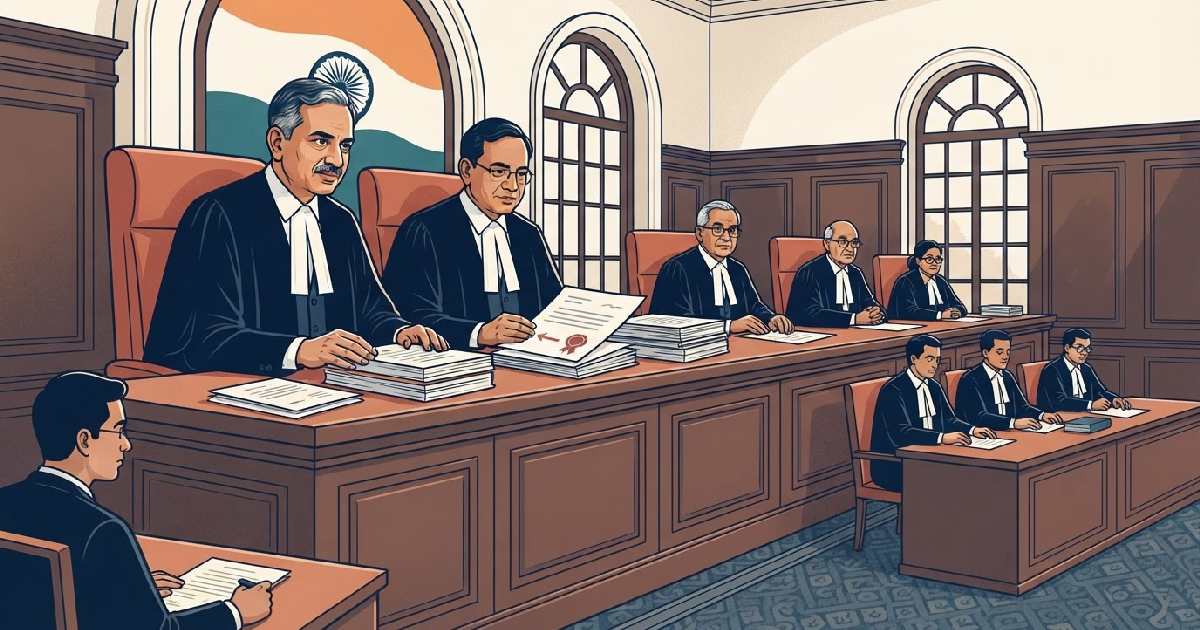
On Friday, August 7, 2026, Indias Supreme Court ruled that marking a document as an exhibit does not automatically prove its contents, clarifying evidence law.
A bench comprising Justice Sanjay Karol and Justice Nongmeikapam Kotiswar Singh emphasized that exhibiting documents, , still need to be proven in accordance with legal procedures. This decision came in the case of S. Sangeetha & Ors. v. Tmt. P. Ponni, upholding a Madras High Court judgment related to a probate proceeding.
supreme court clarifies evidence standards in civil disputes
The ruling underscores a critical distinction in judicial proceedings between identifying a document for the court record and establishing its authenticity and truthfulness. It means parties can’t assume a document’s assertions are fact simply because it carries an exhibit number. They must still present evidence to substantiate its claims.
The highest court’s pronouncement originated from an appeal challenging a Madras High Court decision. That case involved a probate proceeding where the appellant-defendants, S. Sangeetha and others, sought to exclude certain documents. These documents were exhibited by the respondent-plaintiff, Tmt. P. Ponni, within her proof affidavit. The core of the dispute centered on whether these documents, once exhibited, automatically stood proven.
Justice Karol, authoring the judgment, stated that objections to a document’s admissibility shouldn’t usually be decided at the initial stage if it seems relevant. However, he stressed that allowing a document to be marked as an exhibit doesn’t validate its contents. Its authenticity and truthfulness must still be established through proper legal channels.
clarifying exhibiting docuements status versus actual proof
The Supreme Court clearly differentiated between the procedural act of marking a document as an exhibit and the substantive requirement of proving its contents. Marking identifies the document for the court’s record, assigning it an exhibit number like “Exhibit P-1” for the plaintiff or “Exhibit D-1” for the defendant. This is a crucial administrative step that helps in referencing evidence during a trial.
But that identification doesn’t equate to proof. For a document to be considered reliable evidence, its contents must be verified. This involves presenting witnesses or other corroborating evidence to confirm its authenticity, its execution, and the truth of the statements it contains.
the role of order xiii rule 3 cpc in document management (Exhibiting Documents)
The case also delved into the application of Order XIII Rule 3 of the Code of Civil Procedure (CPC), 1908. This rule gives courts the power to reject any document at any stage of a suit if it deems it irrelevant or otherwise inadmissible. The court must record its reasons for such rejection.
In this instance, the Madras High Court had rightly rejected photocopied documents where no original was presented, and no explanation was offered for its absence. But it allowed the exhibition of other documents related to family disputes, litigation, and property transactions.
The Supreme Court backed this decision, stating that documents fundamental to the case’s adjudication shouldn’t be discarded prematurely, even if their contents require later proof.
This nuanced approach allows for a comprehensive trial where all potentially relevant documents are considered, while still maintaining high standards for evidentiary proof. Litigants and their counsel must understand this distinction to avoid relying solely on the exhibition of a document. It’s a key procedural aspect that can influence the outcome of a case, impacting how arguments are constructed and evidence is presented.
historical precedents in indian evidence law
This isn’t a new concept in Indian jurisprudence; rather, it’s a consistent reiteration of a fundamental principle. The Supreme Court and various High Courts have, for decades, underscored the necessity of proving the contents of exhibited documents.
The legal framework for evidence in India is primarily governed by the Indian Evidence Act, 1872, now largely subsumed by the Bharatiya Sakshya Adhiniyam (BSA), 2023. These statutes lay down precise rules on how documents are to be presented and proved in court. The recent ruling reaffirms the judiciary’s unwavering commitment to these established norms.
evolution of evidentiary standards
The principle that merely marking a document isn’t proof has evolved through numerous judgments. This continuity ensures predictability and fairness in the legal system. It prevents parties from using documents to assert facts without proper corroboration.
The standard demands that the party relying on a document bears the burden of proof. They must satisfy the court that the document is genuine, correctly executed, and that its contents are true. This can involve calling witnesses, such as the person who wrote or signed the document, or expert testimony.
key landmark decisions shaping this principle
Several landmark cases have cemented this legal position over the years. In Sait Tarajee Khimchand v. Yelamarti Satyam (AIR 1971 SC 1865), the Supreme Court clearly stated that marking an exhibit does not eliminate the need for proving the document. Similarly, Narbada Devi Gupta v.
Birendra Kumar Jaiswal (2003) 8 SCC 745, highlighted that the mere production and marking of a document as an exhibit doesn’t constitute due proof of its contents; its execution must be proven by admissible evidence.
More recently, LIC of India v. Ram Pal Singh Bisen (2010) 4 SCC 491, reiterated that admitting a document into evidence doesn’t automatically prove its contents. These precedents illustrate a long-standing judicial consensus, ensuring that evidentiary standards remain robust. Such clarity helps all parties involved in civil litigation understand their obligations.
implications for civil litigation and legal practice
This reiteration from the Supreme Court has significant implications for civil litigation across India. It serves as a reminder to lawyers and litigants alike about the meticulousness required in handling documentary evidence. It prevents over-reliance on procedural admissions and mandates substantive proof.
The ruling encourages a more rigorous approach to evidence presentation. Lawyers can’t assume that once a document is exhibited, their job is done. They must actively prepare to demonstrate the veracity of every crucial document. This impacts trial strategies, particularly in cases with complex documentary evidence.
what litigants need to know
For individuals and entities involved in court cases, understanding this distinction is crucial. Simply submitting a document and having it marked as an exhibit isn’t enough. If the document’s contents are critical to your claim or defense, you must ensure you have the means to prove those contents through testimony or other corroborating evidence.
This includes ensuring that originals of important documents are available. If only photocopies exist, litigants must provide a satisfactory explanation for the absence of the original. The court will not accept secondary evidence without proper justification, as seen in the Madras High Court’s eschewal of xerox copies in the underlying case.
impact on legal practitioners and case strategy
Legal practitioners must factor this principle into every stage of their case preparation. From the initial filing to the final arguments, attention to evidentiary detail is paramount. This may involve a more thorough discovery process, identifying and securing witnesses who can attest to document authenticity, and anticipating challenges to their evidence.
The ruling also reinforces the court’s discretion under Order XIII Rule 3 CPC to reject inadmissible documents. While a document might be provisionally exhibited, its ultimate probative value rests on successful proof. This means counsel must be prepared to argue for both the admissibility and the evidential weight of their documents.
the Bharatiya Sakshya Adhiniyam, 2023 and modern evidence
The recent ruling also comes in the context of India’s evolving legal landscape, particularly with the introduction of the Bharatiya Sakshya Adhiniyam (BSA), 2023. The BSA replaced the archaic Indian Evidence Act, 1872, on July 1, 2024. While modernizing several aspects, it retains the foundational principles of evidence, including the rigorous requirements for proving documentary evidence.
The BSA aims to streamline legal processes and adapt to contemporary challenges, including the rise of electronic evidence. However, its core philosophy remains consistent with the judiciary’s long-standing insistence on verifiable facts. This latest Supreme Court ruling reaffirms that even with new laws, the burden of proof for document contents remains a stringent requirement.
modernizing evidence law, upholding core principles
The transition to the BSA has brought about significant changes, particularly in how electronic records are treated as evidence. But the fundamental distinction between a document’s mere presence in court records and its proven truthfulness continues. Courts are increasingly scrutinizing the authenticity of all forms of evidence. This ensures that justice is based on solid, verifiable facts, not simply on procedural submissions.
The Supreme Court’s decision serves as a timely reminder that technological advancements in evidence presentation don’t diminish the need for substantive proof. Whether a document is physical or digital, its contents must stand up to legal scrutiny.
critical data points in document handling
Understanding the stages and requirements for documents in court is vital for any legal proceeding. The following table outlines key differences in how documents are handled:
| Aspect of Document Handling | Marking as Exhibit | Proving Contents |
|---|---|---|
| Purpose | Identification for court record | Establishing authenticity and truthfulness |
| Stage in Trial | Often at initial evidence stage | Throughout cross-examination and argument |
| Requirement | Prima facie relevance and admissibility | Compliance with Indian Evidence Act/BSA provisions |
| Burden of Proof | On party objecting to admissibility (initially) | On party relying on the document’s contents |
| Legal Effect | Document is part of court record | Contents accepted as fact by the court |
forward outlook for evidentiary practice
The Supreme Court’s reiteration in S. Sangeetha & Ors. v. Tmt. P. Ponni reinforces the judiciary’s consistent stance on evidentiary integrity. It suggests that while courts are willing to admit potentially relevant documents for consideration, they will not compromise on the ultimate requirement for their contents to be properly proven. This stance aligns with the broader objective of ensuring fair trials and robust judicial outcomes.
The ruling effectively serves as a guidepost for lower courts and legal practitioners, emphasizing diligence in collecting, presenting, and proving documentary evidence. It signals that courts will not tolerate shortcuts in establishing facts. This is particularly relevant in complex civil disputes, such as property matters and probate cases, where documentary evidence often forms the backbone of a party’s claims.
Moreover, the vacating of the stay on the testamentary proceedings in T.O.S. No. 12 of 2021 means that case will now move forward. It will proceed with the clear directive that the contents of the exhibited documents must be proven legally. This ongoing scrutiny of evidence ensures that legal decisions are grounded in verifiable facts.
The decision also reminds practitioners about the judicial oversight on the quality of evidence. Even when documents are marked as exhibits, their probative value is always subject to the court’s final determination. This reinforces a system where the truth, established through proper legal process, remains paramount. For those navigating civil disputes, this ruling highlights the indispensable role of meticulous preparation and presentation of evidence.
What does it mean for a document to be marked as an exhibit?
Marking a document as an exhibit is a procedural step where it is formally identified and included in the court records of a case. It’s assigned a unique identification, like “Exhibit P-1” for the plaintiff or “Exhibit D-1” for the defendant, to allow easy reference during the trial.
Why isn’t marking a document as an exhibit enough to prove its contents?
Marking a document as an exhibit only signifies its identification within the court records. It doesn’t automatically confirm that the document is genuine, correctly executed, or that the statements within it are true. The party relying on the document must still present further evidence to legally prove its authenticity and content veracity.
What happens if a document’s contents aren’t properly proven after being exhibited?
If the contents of an exhibited document are not adequately proven through admissible evidence, the court may choose not to rely on those contents when making its final judgment. This means the document, despite being part of the record, won’t be considered as establishing the facts it purports to convey, weakening the case of the party who presented it.
Call or Whatsapp for consultation.
Related: https://arpitmarwah.com/civil-law/