
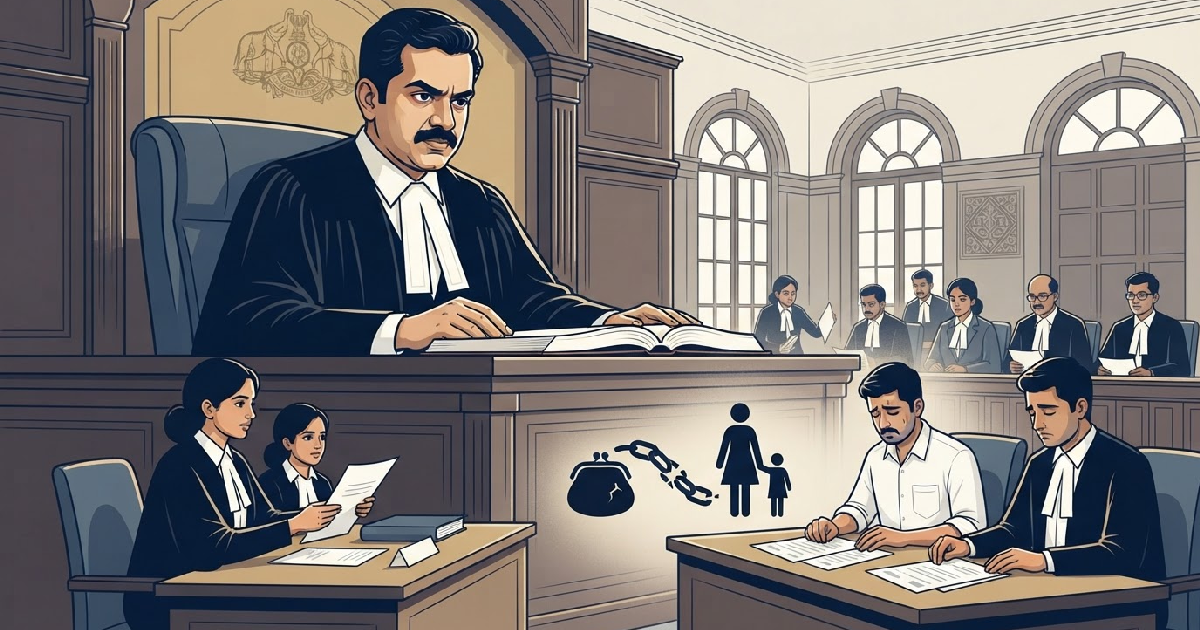
Today, July 28, 2026, the Kerala High Court delivered a pivotal ruling, affirming that a husband’s failure to provide maintenance to his wife and child constitutes economic abuse. This action, the court declared, amounts to domestic violence under the Protection of Women from Domestic Violence Act, 2005. Justice Jobin Sebastian made this observation while dismissing a husband’s criminal revision petition challenging existing maintenance orders.
The decision reinforces a consistent judicial trend in India. It highlights the judiciary’s commitment to safeguarding women’s financial independence within domestic relationships. The ruling clarifies that withholding essential economic resources is a serious form of abuse with significant legal consequences.
Defining economic abuse as domestic violence
The recent judgment by Justice Jobin Sebastian is a crucial addition to the Kerala High Court’s stance. It consistently interprets economic deprivation as a form of domestic violence, ensuring victims have legal recourse under the Protection of Women from Domestic Violence Act, 2005 (PWDVA).
This ruling specifically rejected a husband’s attempt to overturn maintenance orders. The court firmly upheld the directives, emphasizing the clear legal obligation for financial support.
The legal framework for economic abuse
The PWDVA, enacted on October 26, 2006, significantly broadened the definition of domestic violence in India. It moved beyond physical harm to include sexual, verbal, emotional, and, importantly, economic abuse.
Section 3(iv) of the Act explicitly defines economic abuse. It covers the deprivation of financial resources, which include household necessities, stridhan, shared property, and maintenance. This comprehensive definition aims to address the various ways financial control can be used to dominate and subjugate an individual.
Broader judicial precedent on financial neglect
Indian courts have consistently recognized the withholding of maintenance as a form of economic abuse. This interpretation reflects an evolving understanding of domestic violence, with various High Courts across the country reinforcing this definition.
These rulings collectively create a robust legal framework designed to provide financial protection within marriages and domestic partnerships. They demonstrate a growing awareness of the subtle but damaging impact of economic control.
Kerala High Court’s consistent stance
The Kerala High Court has a strong record of similar pronouncements. In March 2025, Justice G. Girish ruled that compelling a wife to resign from her job, thus depriving her of income, constitutes economic abuse under the PWDVA.
Justice G. Girish also affirmed that a husband’s failure to provide maintenance is economic abuse, as seen in the case of K.M. Mathew v Jiji Mathew. Justice Dr. Kauser Edappagath, in April 2022, ruled that non-payment of maintenance falls under Section 3(iv) of the PWDVA.
Other high court rulings on maintenance
Across India, other courts have taken similar positions. In February 2015, an Additional Sessions Judge, Pulastya Pramachala, in a Delhi court, ruled that refusing maintenance to an estranged wife with no income amounts to economic abuse.
The Delhi High Court, in March 2026, explicitly stated that failure to provide maintenance to a wife and child is a classic form of economic abuse, referencing Section 3(iv) of the PWDVA. Similarly, in June 2026, Additional Sessions Judge Sheetal Chaudhary Pradhan of Saket Court in Delhi identified a husband’s 10-year failure to pay child support as economic abuse.
The Madhya Pradesh High Court, in the case of Surya Prakash v. Rachna, also found that non-payment of maintenance constitutes a breach of protection orders under the DV Act. The Tripura High Court has also stated that denying maintenance allowance to a wife constitutes economic abuse.
Evolving rights: earning capacity and waiver
These judicial decisions are part of a larger movement to strengthen women’s financial autonomy. They aim to prevent women from being trapped in abusive situations due to economic dependency within marriage.
Indian law provides multiple avenues for women to seek maintenance. This reflects society’s evolving understanding of marital obligations and the need for comprehensive legal safety nets.
Waiver of maintenance rights unenforceable
A significant development occurred in May 2025 when Justice A. Badharudeen of the Kerala High Court ruled on the unenforceability of prior maintenance waivers. He held that any agreement where a wife waives her right to maintenance is against public policy and cannot be enforced under the PWDVA.
This decision prevents husbands from using old settlement agreements to avoid their financial responsibilities. The court emphasized that fundamental rights to sustenance cannot be overridden by such agreements, providing crucial protection for women.
Entitlement despite earning capacity
Justice Dr. Kauser Edappagath of the Kerala High Court further clarified women’s rights in November 2025. She stated that a wife’s ability to earn, or even earning some income, doesn’t automatically disqualify her from maintenance.
The key factor is whether her income is sufficient for a dignified life. A highly qualified but jobless wife, for instance, remains entitled to support until she can secure adequate means. This interpretation of “unable to maintain herself” acknowledges that dignified living requires more than mere survival.
| Court / Judge | Date of Ruling | Key Principle Affirmed | Case Outcome Summary |
|---|---|---|---|
| Kerala High Court (Justice Jobin Sebastian) | July 28, 2026 | Failure to pay maintenance = Economic Abuse/Domestic Violence | Dismissed husband’s revision petition, upheld maintenance orders |
| Kerala High Court (Justice G. Girish) | March 5 & 9, 2025 | Compelling job resignation, maintenance failure = Economic Abuse | Upheld maintenance, reduced amount for children who attained majority |
| Kerala High Court (Justice Dr. Kauser Edappagath) | April 22, 2022 | Non-payment of maintenance is economic abuse | Upheld monthly maintenance of ₹15,000 for wife |
| Delhi Court (Addl. Sessions Judge Sheetal Chaudhary Pradhan) | June 2026 | Failure to pay child support for 10 years = Economic Abuse | Emphasized maintenance prevents vagrancy and destitution |
Impact and enforcement of maintenance orders
The consistent affirmation that a husband’s failure to pay maintenance constitutes domestic violence empowers women to seek timely and adequate financial support. It also sends a clear message to husbands that neglecting financial obligations can lead to severe legal consequences.
However, translating legal pronouncements into effective enforcement still presents challenges. Victims often face social stigma, procedural delays, and the emotional toll of protracted legal battles.
Addressing enforcement challenges
Despite strong legal provisions, enforcing maintenance orders remains a critical hurdle for many women. Non-payment can lead to further proceedings under Section 31 of the PWDVA, but these can be time-consuming.
The courts are constantly working to streamline these processes and ensure timely justice. Ensuring effective implementation is key to realizing the full protective potential of these laws.
Statistical context of economic dependency
Economic dependency is a significant factor perpetuating domestic violence in India, trapping many women in abusive relationships. The National Family Health Survey (NFHS-5) 2019-2021 revealed that around 32% of ever-married Indian women aged 15-49 years experienced physical, sexual, or emotional violence from their husbands.
Notably, in Andhra Pradesh, 78% of domestic violence victims were financially dependent on their husbands. This highlights how vital economic independence, or guaranteed financial support through maintenance, is for women to escape abuse. Rulings like this from the Kerala High Court provide a crucial lifeline for them.
The path forward for women’s financial security
The cumulative effect of these rulings creates a strengthened legal environment for women seeking maintenance in India. It underscores that financial neglect is not a minor marital dispute but a serious act of domestic violence, bringing with it all the protections and remedies available under the PWDVA.
Advocates believe these judgments will further deter husbands from evading their financial responsibilities. This fosters greater accountability and promotes gender equality within domestic partnerships, reinforcing the judiciary’s role in safeguarding fundamental rights.
These legal developments offer hope for countless women striving for financial independence. They signify a progressive step towards ensuring that economic abuse is recognized and addressed with the seriousness it deserves.
What does economic abuse mean under Indian law?
Economic abuse, as defined by Section 3(iv) of the Protection of Women from Domestic Violence Act, 2005, includes depriving an aggrieved person of financial resources they are entitled to. This encompasses household necessities, property, rent payments for a shared home, and maintenance.
Can a wife claim maintenance if she is capable of earning?
Yes, the Kerala High Court has clarified that a wife’s capability to earn or even a small income does not automatically disentitle her from maintenance. The key factor is whether her income is sufficient to live a dignified life, not merely to survive.
Does a prior waiver of maintenance affect future claims?
No, a wife’s waiver or relinquishment of her right to maintenance in an earlier agreement is considered against public policy and unenforceable under the PWDVA. Courts emphasize that fundamental rights to sustenance cannot be overridden by such agreements.