
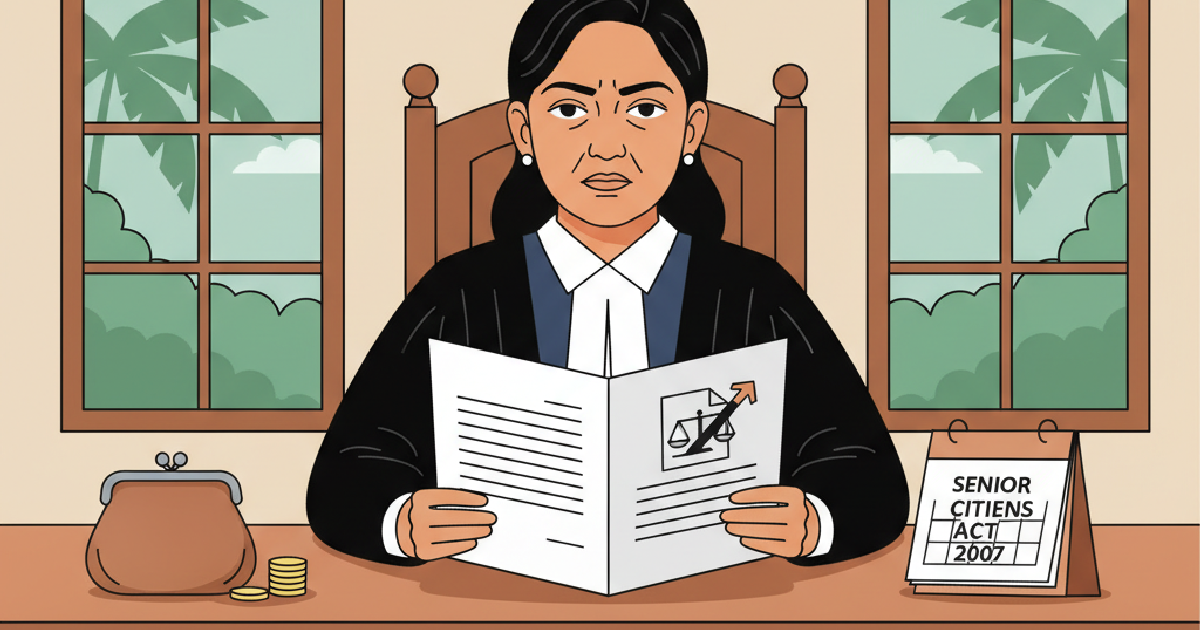
Justice Neela Gokhale ruled that family discord between a man’s parents and his wife is not a valid legal ground to stop paying monthly maintenance to elderly parents. Neela Gokhale of the Bombay High Court has ruled that family discord between a man’s parents and his wife is not a valid legal ground to stop paying monthly maintenance to elderly parents.
The decision, delivered by the court’s Goa bench, upholds a previous order from a Senior Citizens’ Tribunal requiring the son to provide financial support for his aging and ill parents.
High Court upholds parents’ right to maintenance
The court dismissed the son’s argument that ongoing domestic disputes absolved him of his statutory duties under the Maintenance and Welfare of Parents and Senior Citizens Act, 2007. This landmark ruling by Justice Dr. Neela Gokhale came on July 6, 2026, and was officially recorded as 2026 LiveLaw (Bom) 324.
The petitioner, Altaf Shaikh, who currently works in Dubai, had challenged a tribunal order directing him to pay ₹8,000 per month to his parents. His 70-year-old father is bedridden following a sudden paralysis attack, while his 62-year-old mother was forced to appear as a party-in-person because the couple could not afford professional legal representation.
Despite these circumstances, Shaikh had stopped financial contributions, citing a domestic violence case filed by his wife against his parents. The court found this justification severely lacking, noting that the son had previously shown “reverence” by buying property in his parents’ name but had since abandoned his responsibilities.
The intersection of marital friction and parental care is a common flashpoint in Indian family law. In this case, Justice Dr. Neela Gokhale observed that the disputes had escalated to a Magistrate hearing cases under the Protection of Women from Domestic Violence Act, 2005.
However, the bench clarified that such litigation does not override the biological child’s obligation to ensure their parents do not face destitution. com/delhi-high-court-property-disputes-in-laws-jurisdiction-ruling/”>Delhi High Court property disputes with in-laws, the Bombay High Court focused on the immediate medical necessity of the bedridden father.
The Maintenance and Welfare of Parents and Senior Citizens Act 2007
This case highlights the critical role of the Maintenance and Welfare of Parents and Senior Citizens Act, 2007 (MWP Act, 2007), a pivotal piece of legislation in India. The Act was specifically designed to address the growing issue of elder neglect and ensure that senior citizens receive proper care and financial support from their children or legal heirs.
Enacted following an initiative by the Ministry of Social Justice and Empowerment, its core objective is to provide a swift and cost-effective mechanism for parents to claim maintenance. It also includes provisions for the protection of property and the establishment of old age homes.
The Act imposes a legal obligation on children, including sons, daughters, grandsons, and granddaughters, to provide monthly maintenance to their parents if the parents are unable to support themselves. This obligation is not diminished by marital disputes or personal animosity. Tribunals established under the Act have the authority to issue orders for monthly allowances, with a maximum limit typically set by state governments, not exceeding ₹10,000 per month.
Additionally, the Act criminalizes the abandonment of a senior citizen by anyone responsible for their care, underscoring the severity with which the law views such neglect.
Societal implications of recent judgments
The Bombay High Court’s decision holds significant weight, especially considering India’s demographic shift towards an aging population. The elderly P-population (60 and above) is projected to reach 12.5% by 2026, marking a substantial increase from just 8% in 2011. This demographic trend, coupled with the decline of the traditional joint family system, leaves many seniors vulnerable to emotional, physical, and financial neglect. The case of Altaf Shaikh’s parents is a stark reminder of these broader societal challenges.
The ruling reinforces the principle that personal disagreements, even those leading to legal actions such as domestic violence cases, do not override the fundamental duty of children to care for their elderly parents. This legal stance is crucial in a country where financial insecurity affects a substantial portion of the older population; a 2024 HelpAge India National Survey found that 65% of older Indians felt financially insecure, with one in three lacking independent income in the previous year. The court’s firm judgment helps to solidify a safety net for vulnerable seniors.
The petitioner’s previous conduct and obligations
The court also considered Altaf Shaikh’s prior actions, noting that he had previously purchased property in his parents’ name, a gesture he himself admitted stemmed from “reverence.” This history contradicted his sudden cessation of support, particularly given his father’s bedridden condition due to paralysis and his mother’s inability to afford legal representation.
Justice Dr. Neela Gokhale highlighted the stark contrast: “Now, the petitioner son, who at one time admitted to buying property in his parents’ name out of reverence, has refused to pay a paltry sum of Rs 8,000 towards his father’s medical expenses. The family discord between the petitioner’s wife and his parents is not a justification enough to refuse payment of maintenance.” This statement encapsulates the court’s strong disapproval of using personal disputes as an excuse for shirking filial responsibilities.
The broader context of elder abuse and neglect
This case also sheds light on the alarming statistics surrounding elder abuse in India. The National Crime Records Bureau (NCRB) documented a 17% to 18% increase in elder abuse and crime cases between 2023 and 2024. Sons and daughters-in-law are frequently identified as primary perpetrators, accounting for 52% and 34% of abuse cases, respectively, according to a 2018 HelpAge India report. The most common forms of abuse include disrespect, verbal abuse, and neglect.
The unfortunate situation of Altaf Shaikh’s parents, where familial discord led to the husband stopping payments, mirrors a wider societal issue. Many elderly individuals, despite facing abuse or neglect, are hesitant to pursue legal action against their children due to emotional attachment or societal pressure. This reluctance underscores the importance of clear legal precedents, such as the one set by Justice Dr. Neela Gokhale, to protect seniors.
Comparing legal avenues for parental maintenance
Parents in India have several legal avenues to seek maintenance, primarily under the Maintenance and Welfare of Parents and Senior Citizens Act, 2007 (MWP Act, 2007), and Section 125 of the Code of Criminal Procedure, 1973 (CrPC). The MWP Act is specifically designed for the maintenance and protection of parents and senior citizens, offering a streamlined process through Maintenance Tribunals. It places a direct and explicit obligation on children to support their parents if they cannot support themselves.
Section 125 of the CrPC provides a more general remedy for various dependents, including parents, who are unable to maintain themselves. It allows a Magistrate to order a person with sufficient means to pay a monthly allowance to their parents if they neglect or refuse to do so. While the CrPC offers a quick remedy, the MWP Act offers stronger provisions tailored to the unique circumstances and vulnerabilities of seniors.
The Hindu Adoption and Maintenance Act, 1956, also imposes an obligation on children to maintain parents who are financially unable to do so, though its scope is limited to individuals governed by Hindu law. These various legal frameworks collectively underscore the unwavering legal and moral duty of children to support their elderly parents. The Supreme Court of India in 2021 further solidified this, emphasizing that providing sustenance to parents in old age is both a moral duty and a legal obligation.
It’s worth noting that awareness of these protective laws remains relatively low. Only 9% of elderly people are aware of the MWP Act, 2007, indicating a significant gap in legal literacy. This lack of awareness can impede seniors from seeking the justice and support they are entitled to, making rulings like the one by Justice Dr. Neela Gokhale even more vital in setting clear judicial precedents.
| Legal Provision / Act | Key Features | Maximum Monthly Maintenance |
|---|---|---|
| Maintenance and Welfare of Parents and Senior Citizens Act, 2007 | Specific to parents/senior citizens, speedy tribunal process | Up to ₹10,000 (State Government prescribed) |
| Section 125, Code of Criminal Procedure, 1973 | General provision for dependents, including parents; quick remedy | No specific maximum; determined by court based on needs and means |
| Hindu Adoption and Maintenance Act, 1956 | Applicable to Hindus; obligation on children to maintain parents | No specific maximum; reasonable amount based on circumstances |
Outlook for family law and elder care
The Bombay High Court’s ruling reaffirms the robust legal protection afforded to elderly parents in India, particularly when facing neglect due to internal family conflicts. It sends a clear message that personal disputes, including those between a son’s wife and his parents, cannot serve as an excuse to abdicate one’s legal and moral responsibilities for elders’ well-being. The legal framework, specifically the MWP Act, is designed to cut through such complexities and ensure basic dignity and financial security for seniors.
This decision might also encourage more elderly individuals to come forward and seek legal recourse. With a constantly evolving societal structure and the increasing challenges faced by senior citizens, judicial interventions like this one are crucial in maintaining social welfare and upholding ethical duties within families. The ruling is a critical step towards better enforcement of existing laws and fostering a greater sense of accountability among adult children.
As India’s older adult population continues to grow, cases like this will likely become more frequent. The judiciary’s continued emphasis on upholding the rights of the elderly, regardless of domestic friction or NRIs being detained at airports for various legal reasons, sets an important precedent. It reinforces the idea that an adult child’s obligation to their parents is paramount.
Frequently Asked Questions
Can a son stop paying for his parents’ care if they fight with his wife?
No. The Bombay High Court ruled that discord between a man’s parents and his wife is not a legal justification to withhold maintenance or medical expenses under the 2007 Act.
What is the monthly maintenance amount in this specific case?
The Bombay High Court upheld an order from the Senior Citizens’ Tribunal directing the son to pay ₹8,000 per month for his parents’ maintenance.
Does working in a foreign country exempt a son from paying maintenance?
No. Even though the petitioner, Altaf Shaikh, works in Dubai, the court upheld his legal obligation to pay for the medical and survival needs of his parents in India.