
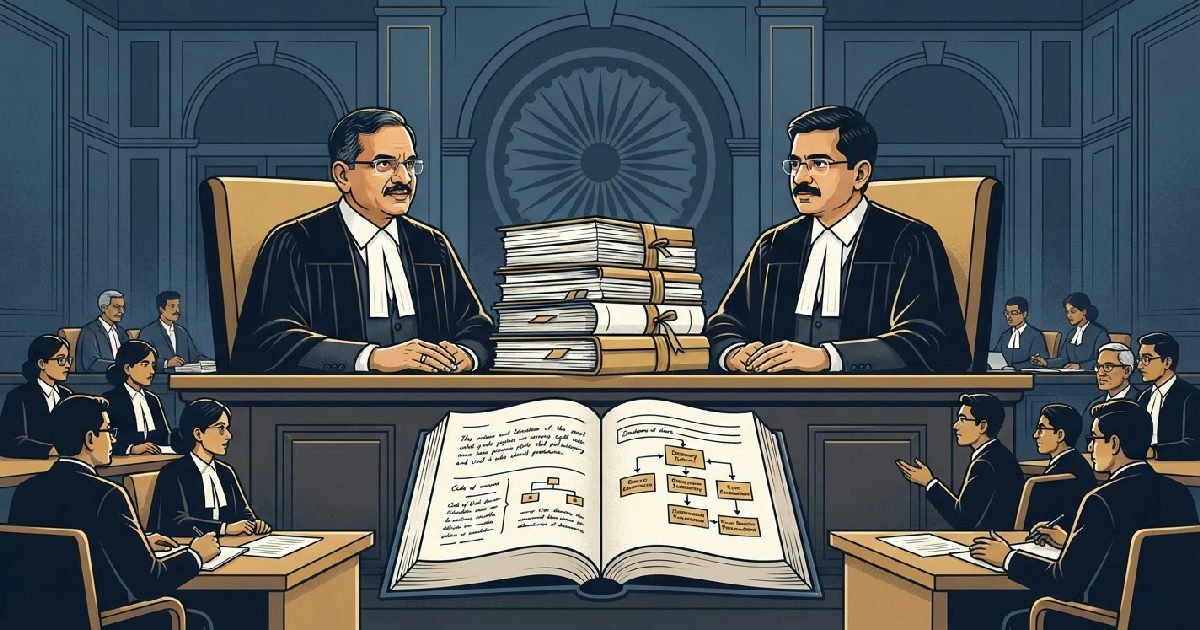
In a pivotal decision delivered on December 16, 2023, India’s Supreme Court definitively streamlined procedures for civil trial document production. The ruling affirms that documents can be presented during cross-examination to confront either a party to the suit or a witness. This judgment, issued by a bench of Justices B.R.
Gavai and Sanjay Karol, sets aside a restrictive view previously held by the Bombay High Court.
Supreme Court clarifies civil trial document production rules
The Court’s unanimous decision in Mohammed Abdul Wahid v. Nilofer & Anr. eliminates a contentious distinction. It ensures that litigants can now use documentary evidence more freely to challenge testimony, prioritizing the discovery of truth in civil proceedings. This move carries significant implications for judicial practice across the nation.
The Supreme Court has mandated a uniform approach to presenting documents during cross-examination. This means there’s no longer a legal difference between how a party to a suit and an ordinary witness can be confronted with evidence.
This landmark ruling aims to enhance fairness and efficiency within India’s civil judicial system. It specifically addresses a long-standing procedural ambiguity that had led to conflicting interpretations in lower courts. The Court emphasized that all individuals in the witness box serve the same function.
Overturning a restrictive Bombay High Court judgment
The Supreme Court’s decision directly overturns a judgment from the Bombay High Court. That previous ruling had created a significant barrier, allowing documents to be produced during cross-examination only for witnesses who were not actual parties to the lawsuit.
Essentially, the Bombay High Court had concluded that plaintiffs or defendants, when testifying, could not be “surprised” with fresh documents. This distinction limited the scope of cross-examination for key individuals. It often hindered efforts to fully challenge their testimony using new evidence, creating an uneven playing field for litigants.
| Aspect of Document Production | Bombay High Court (Previous Stance) | Supreme Court (Current Ruling) |
|---|---|---|
| Applicability During Cross-Examination | Only for non-party witnesses. | For both parties to the suit and all witnesses. |
| Introduction of Unpleaded Documents | Restricted for parties, to prevent “surprise.” | Permitted for cross-examination, even if not previously filed. |
| Underlying Legal Principle | Protection against ambush for parties. | Discovery of truth, uniform evidentiary standards. |
| Impact on Trial Dynamics | Limited scope for confronting parties. | Enhanced ability to challenge testimony effectively. |
Interpreting key procedural rules for evidence
The core of this legal debate revolved around the interpretation of specific provisions within the Code of Civil Procedure (CPC), 1908. Specifically, the Court examined Order VII, Rule 14(4), Order VIII, Rule 1A(4), and Order XIII, Rule 1(3).
These rules outline when documents must be filed with pleadings or before issues are settled. However, they also include crucial exceptions for documents used during cross-examination or to refresh memory. The Bombay High Court had interpreted these exceptions narrowly, leading to its now-overturned distinction.
The Supreme Court clarified that these exceptions are intended to facilitate the truth-finding process, not to create artificial barriers. It asserted that the CPC’s language does not support a rigid segregation between parties and other witnesses in this context. This broader interpretation allows for a more flexible and robust examination process.
No distinction between parties and witnesses in court
Justice Karol, the author of the Supreme Court’s judgment, delivered a clear rejection of the Bombay High Court’s restrictive view. He asserted that a plaintiff or defendant, while testifying in their own case, performs the same function as any other witness.
Therefore, they must be subject to the same procedural rules governing evidence. The Court explicitly stated, “witnesses and parties to a suit, for the purposes of adducing evidence, either documentary or oral are on the same footing.” This declaration establishes a unified approach to evidentiary challenges.
Unifying procedural law and evidentiary rules
The judgment emphasized that differentiating between a party and a witness for evidentiary purposes lacks firm legal ground. Provisions within the Code of Civil Procedure and the Indian Evidence Act, 1872, do not support such a rigid separation.
This means that when a party takes the stand, their testimony and the manner in which it can be challenged, particularly through new documents, should be treated identically to any other individual providing evidence. This unified stance promotes a more consistent and equitable application of justice.
The Supreme Court referenced Section 120 of the Indian Evidence Act, which confirms that parties are competent witnesses. Order XVI Rule 21 of the CPC also applies witness rules to parties when they testify. These provisions collectively underscore the unified treatment of parties and witnesses in adducing evidence, reinforcing the Court’s conclusion.
The core purpose: discovery of truth in civil cases
The Supreme Court unequivocally underscored that the ultimate goal of any civil trial is the thorough discovery of truth. Restricting the use of documents during cross-examination, especially when confronting parties, would gravely compromise this fundamental objective.
If one side is prevented from using documents to effectively question the other party, it risks undermining the entire proceeding. Such restrictions could obscure the full veracity of a claim, hindering the court’s ability to reach a just conclusion. The Court stressed the importance of effective questioning to ensure all relevant facts emerge clearly.
Preventing procedural handicaps in litigation
Justice Karol’s judgment, particularly in paragraph 26, articulates this principle with precision. He wrote, “The freedom to produce documents for either of the two purposes i.e. cross examination of witnesses and/or refreshing the memory would serve its purposes for parties to the suit as well.” He further clarified that restricting this freedom would “fatally compromis[e] the said proceedings.”
This means that procedural barriers to truth-seeking are deemed untenable. The Court affirmed the necessity of allowing documents to be introduced when they are relevant for refreshing memory or for effective cross-examination. This ensures that legal proceedings do not inadvertently suppress crucial information.
The Court acknowledged that allowing documents not previously pleaded could introduce an “element of surprise.” However, it deemed this a necessary consequence for the pursuit of truth. This approach prioritizes substantive justice over strict procedural formalism in certain contexts.
Broader implications for Indian civil litigation
This ruling is expected to have profound and far-reaching implications for civil litigation across India. By removing the artificial distinction between parties and witnesses, the Supreme Court has made the rules of evidence more straightforward and uniformly applicable for all.
This clarity will likely reduce the legal uncertainty that arose from conflicting High Court judgments. It provides a clear and authoritative precedent for lower courts to follow, promoting consistency in judicial practice. Litigants can now prepare for cross-examination knowing that relevant documents, even if not previously pleaded, can be introduced to challenge testimony.
Enhanced procedural rights for litigants
Legal experts view this judgment as a significant step towards enhancing procedural rights for all litigants. The ability to introduce documents during cross-examination without requiring prior court leave offers a more dynamic and effective examination process.
This change empowers parties to more vigorously pursue their claims and uncover inconsistencies in opposing testimony. It reflects a shift towards prioritizing the substantive merits of a case over potentially rigid procedural technicalities. The ruling also brings greater harmonization to India’s evidentiary rules.
The ruling clarifies that documents can be produced during cross-examination to further an “element of surprise,” but only within the bounds of cross-examination. The judgment clarified that, “save and except the cross-examination part of a civil suit,” such confrontation with documents is not allowed without the document having accompanied the plaint or written statement filed before the court.
Expert insights and future outlook
Legal analysts have widely welcomed the Supreme Court’s decision, highlighting its practical benefits for the judicial system. They believe it will reduce delays caused by disputes over document admissibility during trials. This streamlined approach allows courts to focus more on the substantive issues of a case.
The ruling reinforces India’s common law tradition, which emphasizes robust cross-examination as a cornerstone of adversarial justice. It contrasts with civil law systems where judges often play a more active, inquisitorial role in evidence gathering. This decision aligns India’s practice more closely with other common law jurisdictions.
Promoting transparency and accountability
By ensuring that all parties and witnesses can be equally confronted with relevant documents, the judgment promotes greater transparency and accountability in civil proceedings. It discourages evasion and encourages a more forthright presentation of facts.
This measure serves to strengthen public confidence in the judicial process. It assures litigants that the courts are committed to uncovering the full truth, rather than being constrained by procedural loopholes. The Supreme Court’s ruling represents a progressive interpretation of existing laws.
The judgment also considered previous precedents like *Purushottam v. Gajanan*, which restricted document production, and *Vinayak M Dessai v. Ulhas N. Naik*, which suggested equating parties with witnesses. This comprehensive review solidifies the Court’s current stance on the issue. It further considered *Upper India Couper Paper Mills Co. Ltd. v.
Mangaldas and Sons*, which argued for permissibility of document production without prior court leave during cross-examination.
What was the key decision made by the Supreme Court?
The Supreme Court ruled on December 16, 2023, that documents can be produced during cross-examination in a civil trial to confront either a party to the suit or a witness. It explicitly eliminated any distinction between the two roles regarding document production.
Why was this Supreme Court judgment necessary for civil litigation?
This judgment was necessary because a previous Bombay High Court ruling had created a distinction, preventing parties from being confronted with new documents during cross-examination. This led to procedural uncertainty and hindered the full discovery of truth in civil cases.
What are the primary benefits of this Supreme Court ruling?
The ruling offers several benefits, including enhanced procedural rights for litigants and a more uniform application of evidentiary rules. It streamlines civil proceedings by reducing legal uncertainties and reinforces the principle that the main goal of a civil trial is the unfettered discovery of truth.