
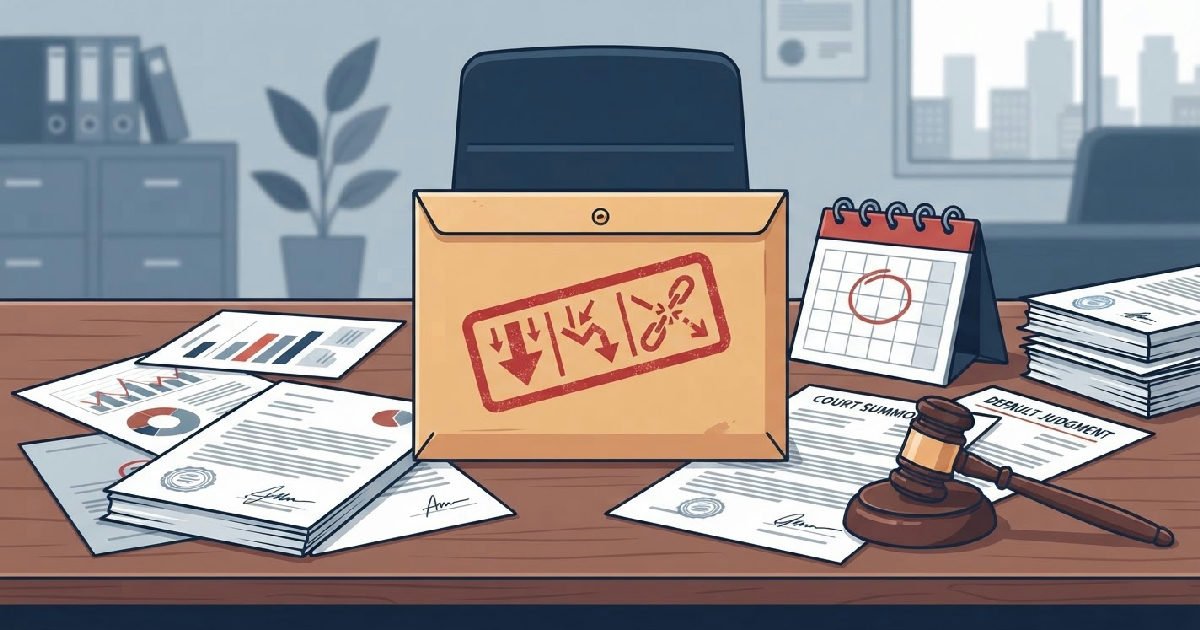
Understand the consequences of ignoring a legal notice
The severe consequences of ignoring a legal notice often transform a manageable business dispute into an expensive and unavoidable legal battle. This formal communication acts as a mandatory precursor to legal action, serving to notify the recipient of a claim or grievance before a commercial suit is filed.
When a company opts for silence, failing to reply, acknowledge receipt, or take steps to contest the claim, it risks severe legal and practical consequences that drastically weaken its defense in future proceedings.
Escalation is the immediate and costliest outcome
The most pressing risk for any company choosing to ignore a legal notice is the almost guaranteed escalation to formal legal proceedings. A legal notice isn’t merely a threat; it’s a procedural step, giving the recipient a final chance to comply or negotiate before the sender proceeds with litigation or arbitration.
Most notices specify a clear time period for a response, typically ranging from 7, 15, or 30 days, depending on the dispute’s complexity and jurisdiction. Once this window expires without engagement, the sender is legally free to move forward, often filing a commercial suit in court or initiating binding arbitration proceedings.
In fact, many legal experts view the initial notice as a formal first step in a dispute resolution strategy. Ignoring this olive branch signals to the opposing party that litigation is the only remaining viable option, removing any informal barriers to court action.
This forced escalation immediately ramps up the cost and complexity of the dispute. Early engagement offers the best opportunity for amicable settlement, but silence ensures the issue moves into the resource-intensive court system.
Understanding critical response deadlines
The time limit specified in the legal notice is not merely a suggestion; it’s a deadline that dictates the sender’s next move. These specific deadlines, often just 15 to 30 days, are central to the legal strategy of the claimant.
In certain specialized areas, such as cases involving the dishonor of a cheque under specific statutes like Section 138 of the Negotiable Instruments Act in India, these timelines can be extremely rigid. Failure to respond within the stipulated time confirms to the claimant that the recipient is non-compliant, justifying the immediate filing of a case.
Even if the notice is vague or seems frivolous, failing to consult counsel and acknowledge the notice prevents the company from establishing a paper trail demonstrating good faith. That paper trail is essential if the company eventually finds itself defending the matter in a courtroom.
Adverse inferences and loss of legal advantage
One of the most damaging consequences of ignoring formal legal communication is the creation of adverse inferences that can undermine a company’s entire defense strategy. Judges and arbitrators rely on parties demonstrating a willingness to engage and resolve matters.
The fact that a company received a formal notice outlining claims and chose to remain silent can be highlighted aggressively by the opposing counsel. Courts may interpret this silence not as strategic positioning, but as an indication that the company lacks a strong substantive defense or is deliberately avoiding the matter.
In some jurisdictions and under certain circumstances, this lack of response may be presumed as an admission of the claims made in the notice. While this is not an automatic legal ruling, it significantly shifts the burden of proof and forces the company to spend considerable resources undoing the perception that they were unwilling to cooperate or resolve the issue amicably.
Erosion of the defense narrative in court
A properly drafted reply to a legal notice is the company’s first opportunity to formally deny incorrect allegations, clarify facts, and raise preliminary legal objections or defenses. By ignoring the notice, the company forfeits this critical early opportunity.
Instead, the defense is forced to be mounted entirely reactively after the suit is filed, often under tighter court timelines and with the narrative already framed by the claimant’s notice. When it comes time for litigation, the court records will clearly show a timeline where the claimant made a demand and the company offered no counter-narrative until forced to do so.
Choosing the appropriate venue for dispute resolution is also a key strategic decision, balancing the technicalities of commercial litigation against arbitration. Companies must be proactive in deciding the best path forward, a decision that cannot be made effectively if the initial notice is ignored.
Increased financial exposure and risk of injunction
Ignoring a legal notice doesn’t just damage a company’s reputation and defense; it directly increases its financial liabilities and operational risks. The resulting litigation is expensive, but the refusal to engage early can compound the costs significantly.
In recovery matters, continued non-payment after the formal demand strengthens the opposing party’s future claim for higher interest and recovery of legal costs. Many contracts and statutory frameworks allow for the recovery of attorney’s fees, which mount rapidly once a reasonable, pre-litigation demand was ignored without proper justification.
But the financial risk extends beyond simple costs. Companies face a heightened risk of damaging interim relief being granted against them if they demonstrate non-cooperation early on.
Granting of easier interim relief
When a company ignores a notice, the claimant can more easily persuade a judge that urgent interim protection is necessary. The argument centers on the company’s demonstrated unwillingness to engage or cooperate, making the court’s intervention mandatory to protect the claimant’s interests.
This interim relief can take severe forms, including temporary injunctions that prevent core business operations, such as selling specific property, transferring assets, or continuing certain business activities until the matter is resolved. The immediate impact on liquidity and operational continuity can be catastrophic.
Furthermore, in cases of monetary recovery, the court may grant attachment before judgment, essentially freezing company assets based on the argument that the company’s prior non-cooperation suggests a risk of them moving or dissipating funds before a final judgment can be enforced.
Comparative Cost Implications of Ignoring a Legal Notice
The true cost of ignoring a legal notice isn’t just the eventual judgment; it’s the escalating legal spend and related losses incurred by avoiding early resolution. This decision moves the dispute from a negotiation phase to a formal, costly litigation track.
| Dispute Resolution Stage | Likely Cost & Resource Impact | Likelihood of Adverse Inference |
|---|---|---|
| Pre-Notice/Negotiation | Low (Internal time, basic legal counsel fees) | Negligible |
| Response to Legal Notice (30 Days) | Medium (Strategic counsel, well-crafted reply) | None |
| Post-Ignored Notice/Litigation Filed | High (Court fees, discovery, extensive attorney hours) | High |
| Post-Interim Injunction | Very High (Operational disruption, bonding costs, defense of injunction) | Significant |
For small and medium enterprises, the immediate shock of an injunction can halt operations entirely. Managing this type of risk requires vigilant contract compliance, as poor contract vetting often exposes businesses to these unexpected liabilities.
The dangers of running the limitation period clock
A specific technical risk associated with inaction is the ticking clock of the limitation period. This period defines the maximum time an aggrieved party has to legally initiate a lawsuit or claim.
Crucially, ignoring a legal notice does absolutely nothing to stop the limitation clock from running. The claimant has preserved their right to sue simply by delivering the notice, which is typically well before the expiration of the limitation period for their primary claim.
Jeopardizing counter-claims and future action
The problem arises if the company decides much later, perhaps after the claimant has filed a case, that it wishes to pursue a counter-claim or initiate separate action against the opposing party. If the company’s own claim related to the same facts is nearing its limitation deadline, the time spent ignoring the initial notice could be fatal.
Once the statutory limitation period has expired, generally two or three years for most civil matters depending on the jurisdiction, the company’s counter-claim becomes time-barred and legally unenforceable. The choice to ignore the notice thus sacrifices the company’s right to seek its own remedy.
This technicality highlights why immediate legal consultation is mandatory. A competent lawyer assesses not just the merits of the claimant’s case, but also the company’s own potential claims and the relevant statutory deadlines.
Damage to reputation, credibility, and settlement prospects
Beyond the courtroom consequences, ignoring a formal legal notice can severely damage a company’s business reputation and long-term financial credibility. Commercial relationships depend on trust and a predictable commitment to contractual obligations.
If a dispute escalates because of willful non-response, it signals to future partners, investors, and stakeholders that the company is uncooperative and prone to costly, protracted legal battles. Public records of legal actions, easily accessible in most modern judicial systems, can affect investor confidence and overall public perception, especially if they reveal a pattern of ignoring valid claims.
Settlement becomes less likely and more expensive
One of the clearest practical results of ignoring a notice is that settlement becomes significantly more difficult and expensive down the road. A legal notice often represents the peak of a willingness to negotiate before hardening positions.
Once the claimant has incurred the expense and hassle of filing a full lawsuit, their incentive to settle for a favorable pre-litigation amount vanishes. They are typically less willing to compromise on terms and will seek full recovery of all accrued costs, including the new litigation expenses.
This dynamic ensures that the period immediately following receipt of the notice is the “sweet spot” for resolution. By missing this opportunity, the company ensures that any eventual resolution—whether by settlement or judgment—will be reached from a position of weakness and at a far greater financial cost.
Navigating the strategic exceptions to replying
While the blanket advice is never to ignore a legal notice, there are limited, strategically calculated situations where a company might decide against sending a full, substantive reply. This decision, however, must only be made after consultation with a legal professional, not by default.
These rare exceptions generally occur when the notice is clearly frivolous, vague, or fundamentally defective. For instance, if the claims are demonstrably time-barred, meaning the limitation period has already expired, or if the notice fails to disclose a proper cause of action, a legal strategy might involve a minimal response or calculated silence.
Why silence is still a risk, even in exceptions
Even when a claim is patently vexatious, outright silence is generally frowned upon by legal experts. Instead of ignoring it entirely, the best practice is almost always to send a short, carefully worded communication drafted by a lawyer. This reply should formally deny the allegations, reserve all rights, and potentially point out the jurisdictional or procedural defects in the claimant’s notice.
This strategy achieves two goals: it avoids the adverse inference of total non-cooperation and creates a formal record that the company considered the claim and rejected it on specific legal grounds. It prevents the claimant from later arguing that the company failed to engage entirely.
The mandatory steps after receiving a legal notice
For commercial entities, the process immediately following the receipt of a legal notice must be methodical and swift. Panic and inaction are the two most costly reactions.
Failing to establish a structured, immediate response protocol often results in missed deadlines and lost opportunities for early resolution. When an organization treats these notices with casual disregard, it inadvertently surrenders its control over the narrative, forcing its legal team to work under extreme pressure once court proceedings are officially initiated.
Establishing a clear internal chain of command ensures that any formal notice is routed to the appropriate decision-makers without delay. This proactive stance not only preserves critical legal defenses but also demonstrates to potential adversaries that the company possesses the operational readiness to defend its commercial interests vigorously.
Consult a lawyer immediately for assessment
The single most important step is to engage competent legal counsel immediately. A lawyer is equipped to read the notice, verify its authenticity (checking for proper letterhead and bar registration, where applicable), and explain the precise legal implications of the demands, deadlines, and potential statutes involved.
Responding without legal guidance is highly dangerous. An untrained response might inadvertently admit liability, waive defenses, or provide the opposing side with ammunition that can be used later in court.
Preservation of documents and communication
Upon receiving the notice, the company must institute a strict document preservation protocol. All relevant records, contracts, payment histories, correspondence, receipts, and internal communications related to the dispute must be immediately gathered and secured.
This evidence is critical for the legal team to assess the strength of the claim and formulate a robust strategy, whether that strategy involves denial, negotiation, or preparation for formal litigation. Missing or disorganized documents only slow down the process and increase costs.
Strategic decision-making and formal reply
With counsel, the company must strategically decide whether to fully reply, negotiate a settlement, or prepare to defend the imminent litigation. If a reply is deemed necessary, it must be well-drafted, clarifying facts and denying specific, incorrect allegations.
The reply’s goal is to protect the company’s legal position and preserve all future rights. It demonstrates a willingness to engage professionally, which can often force the opposing party to reconsider the strength of their position before committing to expensive litigation.
Frequently Asked Questions
Navigating the complexities of formal legal disputes often brings up critical questions regarding procedural rules, strategic options, and potential operational risks. Understanding these core concepts early helps businesses protect their valuable assets and avoid costly errors when responding to incoming claims.
Many corporate entities fail to realize how heavily their initial conduct and response strategy weigh in subsequent court litigation. Addressing these common concerns about response deadlines, adverse inferences, and statutory limitation periods allows business leaders to make informed, highly strategic decisions when a dispute first arises.
What is the typical timeframe for replying to a legal notice?
The timeframe to reply generally ranges from 15 to 30 days, though the precise deadline depends on the nature of the dispute, the jurisdiction, and the specific terms stated by the claimant in the notice. It is crucial to adhere strictly to the deadline specified in the document.
Can silence be treated as an admission of the claims in the notice?
While silence is not automatically a legal admission, courts may presume that the recipient has accepted the claims or had no valid defense if no response is provided. The opposing party will certainly use the failure to reply to argue that the non-responsive company lacked a genuine defense.
Does ignoring a notice stop the limitation period from running?
No, ignoring the notice does not stop the limitation clock. The limitation period, which dictates the deadline for filing a lawsuit, continues to run, and a company risks having its own counter-claims become time-barred if it delays action while the initial notice is ignored.