
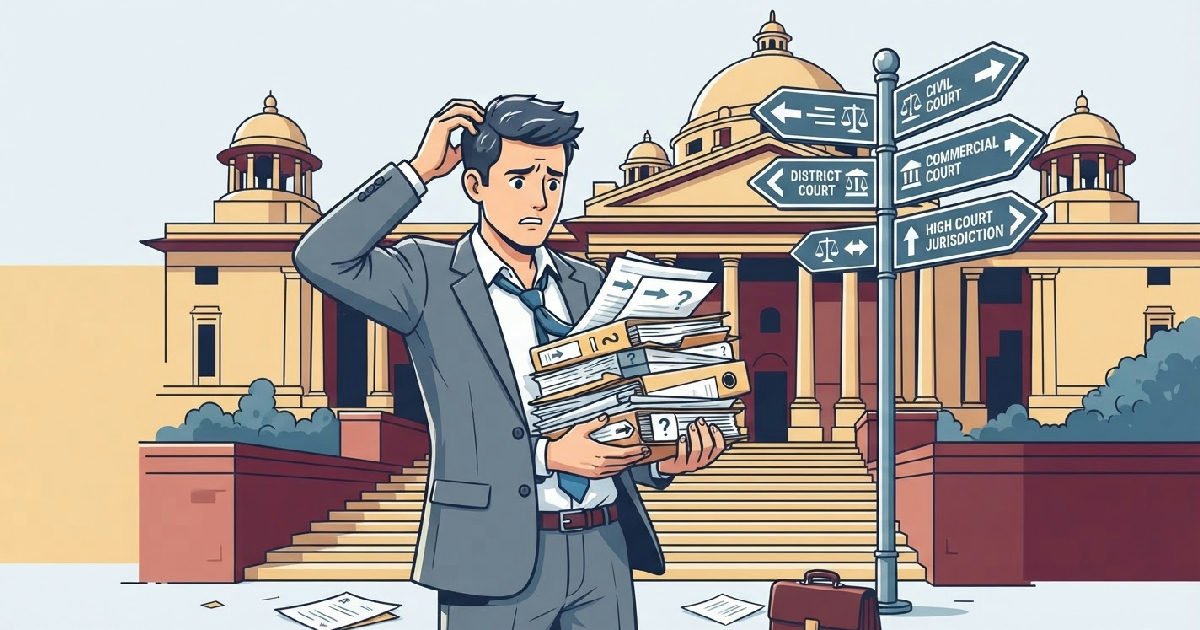
Companies operating in Delhi frequently encounter substantial delays in legal proceedings, often sacrificing the initial six months of a case, simply because their matters were filed in the wrong court. This common misstep can derail recovery efforts and complicate dispute resolution for businesses across the capital.
The appropriate judicial forum for a company’s claim isn’t solely determined by the company’s name on the plaint or the claim being for recovery. Instead, it hinges critically on the nature of the dispute itself and the monetary value of the claim, requiring a careful assessment before any legal action is initiated.
Delhi Commercial Court Civil practice
Delhi’s legal framework designates specific courts for commercial disputes, aiming to streamline and expedite resolutions for businesses. However, correctly identifying these cases requires adherence to two primary conditions: the nature of the dispute and its specified monetary value. Failing to meet these criteria can divert a case to an ordinary civil court, leading to objections and protracted delays.
The Commercial Courts Act, 2015, as amended in 2018, established clear guidelines for what constitutes a commercial dispute eligible for these specialised courts. These guidelines are crucial for companies seeking efficient legal recourse for business-related issues in the National Capital Territory.
Defining Commercial Disputes
For a dispute to qualify for a Commercial Court, it must be inherently commercial. This encompasses a broad spectrum of business-related conflicts, moving beyond mere financial transactions. Key examples include issues stemming from ordinary business transactions, disputes involving the supply of goods or services, and complexities arising from mercantile contracts.
Additionally, partnership or business agreements, along with certain construction and similar commercial contracts, typically fall under the purview of Commercial Courts. Understanding these classifications is fundamental to avoiding jurisdictional errors that can plague legal proceedings.
Navigating Claim Value Thresholds
Beyond the nature of the dispute, the monetary value of the claim, known as the “specified value,” is another critical determinant. In India, the minimum specified value for a commercial suit is set at ₹3,00,000 (three lakh rupees) under the Commercial Courts Act. This threshold dictates the initial filing forum.
In Delhi, commercial disputes valued between ₹3 lakh and ₹2 crore are heard by the District Commercial Courts. Cases exceeding ₹2 crore are escalated to the Commercial Division of the Delhi High Court. This tiered system ensures that designated commercial courts handle disputes commensurate with their financial significance, preventing lower courts from being overwhelmed by high-value claims.
The Pitfalls of Incorrect Court Filings
Misfiling a case isn’t just an administrative inconvenience; it can have severe repercussions for a company’s legal standing and its chances of a swift resolution. The initial decision on where to file can dictate the entire trajectory of a legal battle, potentially costing businesses time, resources, and leverage.
Many companies mistakenly believe that any claim involving a business automatically warrants a commercial court. This assumption often overlooks the intricate details of dispute nature and monetary thresholds, setting the stage for significant procedural hurdles.
Jurisdiction Objections and Delays
One of the most immediate and damaging consequences of an incorrect filing is the inevitable jurisdiction objection raised by the opposing party. Such an objection can bring the entire case to a standstill, delaying substantive arguments and diverting focus to procedural skirmishes. These initial months, often wasted on establishing jurisdiction, could otherwise be spent advancing the actual merits of the claim.
These objections are not minor procedural hiccups; they can force a case to be transferred or even re-filed, initiating a fresh cycle of paperwork and legal costs. The uncertainty created by jurisdictional challenges can also diminish a company’s bargaining position in settlement negotiations.
Impact on Legal Timelines
While a case is stalled by jurisdictional disputes, the limitation period for the claim continues to run. This can be particularly perilous if the underlying cause of action is nearing its statutory expiry, potentially leaving a company without legal recourse altogether. Moreover, crucial witnesses may become unavailable or their memories may fade over prolonged periods of inaction, further weakening the case.
Such delays also erode settlement leverage. A party facing a case stuck in jurisdictional limbo is less likely to feel pressure to negotiate, knowing that a resolution remains distant. Timely action is critical for commercial claims to maintain their strength and urgency in the legal system.
When Ordinary Civil Courts Are Appropriate
Not every financial claim by a company automatically falls under the jurisdiction of a Commercial Court. There are distinct scenarios where an Ordinary Civil Court remains the appropriate forum. Recognizing these distinctions is vital to avoid misdirection and ensure cases are heard by the correct judicial body from the outset.
These situations often involve disputes that don’t meet the commercial criteria or are specifically assigned to alternative, specialised tribunals. Understanding these exceptions can save companies from protracted legal battles over jurisdiction.
Non-Commercial and Low-Value Claims
Firstly, if the dispute is not inherently commercial in nature, it belongs in an Ordinary Civil Court. This distinction can sometimes be subtle but is critical. Secondly, claims with a value below the specified commercial threshold of ₹3,00,000 must also be filed as ordinary civil suits.
The legal system mandates that these lower-value disputes are handled by civil courts, preventing the Commercial Courts from being burdened by smaller claims.
Attempting to force a non-commercial or low-value claim into a Commercial Court will invariably lead to objections and eventual re-direction, prolonging the legal process unnecessarily.
Specialised Forums: Cheque Bounces and RERA
Certain types of disputes are specifically carved out for specialised forums, even if they involve commercial entities. A prominent example is a cheque bounce complaint under Section 138 of the Negotiable Instruments Act, 1881. This is a quasi-criminal proceeding, distinct from a civil recovery suit, initiated when a cheque issued for a legally enforceable debt is dishonoured due to insufficient funds.
Similarly, consumer or RERA (Real Estate (Regulation and Development) Act, 2016) disputes fall under special laws designed to protect specific interests. RERA, for instance, governs real estate projects over 500 square meters or with more than eight apartments, ensuring transparency and providing dispute resolution through Real Estate Appellate Tribunals. These matters are not typically heard in general Commercial Courts.
Pre-Filing Essentials for Delhi Businesses
Before any company in Delhi initiates legal action, a thorough pre-filing checklist is indispensable. This proactive approach can prevent significant delays and ensure the dispute is directed to the most appropriate legal forum. Ignoring these preliminary steps often results in wasted time and resources.
A meticulous review of the dispute’s characteristics and contractual terms can clarify the correct path, helping businesses navigate the complex Indian legal landscape efficiently.
Assessing Dispute Nature and Value
The first step involves a precise determination: Is this genuinely a commercial dispute under the law, or is it a general civil claim? This assessment must go beyond surface-level assumptions. Simultaneously, establishing the exact claim value is paramount, as this figure directly dictates whether the matter falls within the Commercial Court’s jurisdiction or below its minimum threshold.
An accurate valuation prevents premature rejections or transfers that can occur if the claim value is misjudged or not clearly articulated from the outset.
Contractual Clauses and Cause of Action
Companies must also scrutinise their contracts for an arbitration clause. If such a clause exists, arbitration might be the mandated first step, bypassing traditional court litigation. Furthermore, identifying precisely where the cause of action arose is crucial, as this determines territorial jurisdiction. Many contracts also include specific jurisdiction clauses, which legally bind the parties to a particular court location.
Finally, businesses should evaluate whether a cheque bounce complaint under Section 138 is a more appropriate, additional, or separate step, especially for cases involving dishonoured payments.
Strategic Considerations: Recovery vs. Pressure Tactics
It’s crucial for companies to distinguish between legal actions primarily aimed at recovering dues and those designed to exert pressure. A Section 138 cheque bounce case, while capable of creating significant pressure on the defaulter due to its quasi-criminal nature, is fundamentally different from a commercial suit, which is squarely aimed at financial recovery.
Confusing these two approaches can lead to an incorrect forum selection, ultimately compromising the company’s primary objective, whether it’s recovery or enforcement. Both serve distinct purposes and operate under different legal frameworks.
For instance, a criminal proceeding for cheque bounce may result in imprisonment or substantial fines, which can expedite payment, but it doesn’t directly secure the recovery of the original debt in the same way a civil decree from a Commercial Court does. Understanding these strategic nuances is key to effective litigation.
Data on Commercial Court Jurisdiction in Delhi
The jurisdiction for commercial disputes in Delhi is clearly demarcated by monetary value, a system designed to allocate cases appropriately across judicial levels. This structure ensures that courts are not overburdened and that cases receive the attention suitable to their financial scale.
Businesses need to be acutely aware of these thresholds to prevent procedural errors that could otherwise stall their legal proceedings for months on end. The table below outlines the current jurisdictional breakdown for commercial cases in Delhi.
| Court Type | Minimum Claim Value | Maximum Claim Value |
|---|---|---|
| District Commercial Courts | ₹3,00,000 | ₹2,00,00,000 |
| Commercial Division of Delhi High Court | >₹2,00,00,000 | No Upper Limit |
| Ordinary Civil Courts | Up to ₹2,99,999 | ₹2,99,999 |
Ensuring Judicial Efficiency for Delhi Companies
The cost of legal missteps for Delhi-based companies isn’t merely financial; it includes lost time, opportunity costs, and a potential erosion of trust in the legal system. Ensuring that a case begins in the correct forum is the single most effective way to safeguard judicial efficiency and achieve a timely resolution.
Businesses can significantly mitigate these risks by adopting a disciplined pre-filing strategy that involves a thorough legal review before approaching the courts. This proactive stance is critical in a busy metropolitan legal environment like Delhi.
The phrase “file the case” should always be preceded by “file where.” This simple re-ordering of priorities reflects a more strategic and informed approach to litigation, one that ultimately dictates the speed and efficacy of the entire legal process. Companies should consult with experienced commercial lawyers to navigate these complex decisions effectively.
What makes a dispute “commercial” for Delhi courts?
A dispute is considered commercial if it arises from ordinary business transactions, supply of goods or services, mercantile contracts, partnership agreements, or certain construction contracts. It’s the nature of the transaction, not just that a company is involved, that defines its commercial character.
What is the minimum claim value for a Commercial Court in Delhi?
The minimum specified value for a commercial suit in India is ₹3,00,000 (three lakh rupees). In Delhi, claims between ₹3 lakh and ₹2 crore go to District Commercial Courts, while those above ₹2 crore are heard by the Commercial Division of the Delhi High Court.
Can a cheque bounce case be filed instead of a commercial suit?
A cheque bounce complaint under Section 138 of the Negotiable Instruments Act is a quasi-criminal proceeding aimed at penalties and pressure, distinct from a commercial suit which focuses on civil recovery. While it can create pressure, it doesn’t automatically replace the recovery aim of a commercial suit, and each has its own legal process and forum.
Call or Whatsapp for free consultation.
Related Service: https://arpitmarwah.com/commercial-lawyers-in-delhi/