
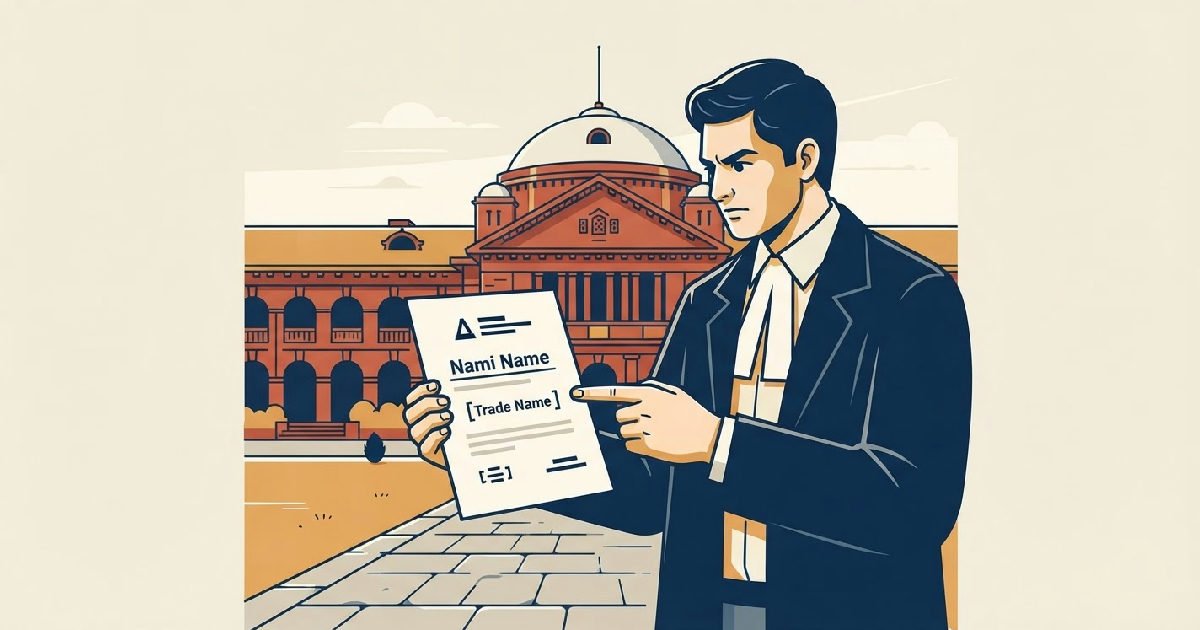
The Allahabad High Court clarified that for cheque bounce cases under Section 138 of the NI Act, 1881, only the sole proprietor, not the trade name, is liable. This clarification specifically addresses who must be named as the accused, asserting that only the individual proprietor, not the trade name, holds legal liability.
This ruling underscores the fundamental legal principle that a sole proprietorship does not possess a separate legal identity from its owner. Consequently, any complaint filed solely against a business name like “Sharma Traders” without identifying the proprietor risks being quashed, as there is no legal person to summon before the court.
Cheque in a proprietors trade name and distinct legal identities
A sole proprietorship, often operating under a distinctive trade name, is legally inseparable from its owner. This means the proprietor and their business are considered one and the same entity in the eyes of the law, a crucial distinction that impacts liability in financial disputes.
Unlike companies or partnership firms, which are recognized as juristic persons with their own legal standing, a proprietorship functions merely as the proprietor’s business name. This lack of a separate legal identity fundamentally shapes how legal proceedings, especially those concerning financial liabilities, are conducted.
Dispelling the myth of vicarious liability
Section 141 of the NI Act outlines provisions for vicarious liability, allowing directors or partners to be held responsible for offenses committed by companies or firms. However, the Delhi High Court and Tis Hazari Courts in New Delhi have consistently affirmed that this principle does not extend to sole proprietorships.
There is no concept of vicarious liability when dealing with a proprietorship concern because it lacks the corporate structure that Section 141 addresses. This legal position ensures that accountability rests squarely with the individual who owns and operates the business.
Naming the actual accused in Section 138 complaints
When initiating a Delhi 138 complaint against a proprietorship, the complaint must explicitly name the individual proprietor. The trade name, such as “Sharma Traders,” should be mentioned in brackets or within the body of the complaint to identify the business context.
Failing to name the proprietor directly can lead to significant procedural hurdles, including the potential quashing of the summoning order. This reinforces the need for meticulous drafting of legal documents to ensure the correct party is held accountable.
The complainant’s burden of proof and essential documentation
For a Section 138 complaint to be legally maintainable when filed by a proprietorship, the complainant must be the proprietor themselves. Alternatively, an individual with a valid power of attorney or a proper resolution from the proprietor can file the complaint.
Mere assertions of being a “manager” or relying on post-facto authority letters are generally deemed insufficient to establish legal standing. The courts demand clear evidence that the person initiating the complaint has the legitimate authority to do so on behalf of the proprietorship.
Essential documentation for substantiating claims
Complainants must provide robust documentation to link the proprietor with the business trade name. This includes official records such as GST registration, Udyam registration certificates, current account passbooks, tax-related papers, and trade licenses.
These documents serve as vital evidence, helping to prove that the accused firm is indeed a proprietorship concern. Any unsubstantiated variations in names across cheques, invoices, and bank account titles can significantly weaken the complainant’s case and raise questions about identity.
Curing minor defects in legal filings
In instances where a proprietor files a complaint using only the assumed trade name instead of their individual legal name, courts often consider this a curable defect. The Bombay High Court, in Doshi Brothers Vs. The State of Maharashtra and Ors., held that such an error can be amended.
This flexibility is typically granted if the error is deemed clerical and does not cause prejudice to the accused party. It highlights the judiciary’s practical approach to minor procedural discrepancies, allowing for corrections where the true intent and identity are clear.
Section 138 of the Negotiable Instruments Act in detail
Section 138 of the NI Act is a critical legal provision designed to ensure financial discipline and deter the issuance of cheques without sufficient funds. It criminalizes the dishonor of a cheque if specific conditions are met, making it a powerful tool for creditors.
The law aims to bolster the credibility of negotiable instruments as a reliable mode of payment. Understanding its intricacies is vital for both businesses and individuals engaged in cheque-based transactions.
Key conditions for a valid complaint
An offense under Section 138 is considered complete if several crucial conditions are satisfied. First, the cheque must have been drawn to discharge a debt or other legal liability. Second, it must be presented to the bank within its period of validity, which is typically six months from its issue date.
Third, the bank must dishonor the cheque due to insufficient funds or other specified reasons. Fourth, the payee must issue a statutory notice demanding payment within 30 days of receiving information about the dishonor. Finally, the drawer must fail to make the payment within 15 days of receiving this notice.
The role of the statutory notice and complaint timeline
The statutory notice plays a pivotal role in a Section 138 complaint. It formally notifies the drawer of the cheque’s dishonor and provides a final opportunity to settle the debt before legal action escalates. Adherence to the 30-day timeline for sending this notice is critical for the maintainability of the case.
Once the cause of action arises, meaning after the 15-day period for payment following the notice expires, a written complaint must be filed by the payee. This complaint needs to be lodged with a Metropolitan Magistrate or a Judicial Magistrate of First Class within one month from that date.
Strategic implications for businesses in Delhi
The Delhi High Court’s consistent stance on proprietorship liability carries significant implications for business operations in the capital. Proprietors must understand that their personal assets are not shielded by their business’s trade name when it comes to cheque bounce cases.
This also means that complainants need to conduct due diligence to correctly identify the proprietor before filing a complaint. Relying solely on a trade name can lead to wasted time and resources, as the case may be dismissed on technical grounds.
Furthermore, this legal clarity emphasizes the importance of proper record-keeping for all proprietorships. Documents like GST registration and bank statements become crucial proof of identity, ownership, and the specific individual responsible for business debts.
| Entity Type | Legal Identity | Liable under Section 138 NI Act | Vicarious Liability (Section 141) |
|---|---|---|---|
| Sole Proprietorship | No separate identity from owner | Proprietor only | Not Applicable |
| Partnership Firm | Separate entity (juristic person) | Firm and Partners | Yes |
| Company | Separate entity (juristic person) | Company and Directors/Officers | Yes |
Navigating the nuances of trade names and legal standing
A trade name, also known as a “doing business as” (DBA) or assumed name, allows a sole proprietor to operate under a moniker distinct from their personal legal name. While it offers branding advantages, it does not confer separate legal entity status.
Registering a trade name, often required by state authorities, primarily serves to inform the public about who is behind a business. It does not create a distinct legal person capable of being sued independently of its owner.
For proprietors, acknowledging that “it is only a trade name” is not a valid defense in a cheque bounce case once the account and signature are confirmed as theirs. The courts will always trace the liability back to the individual owner.
What defines a sole proprietorship’s legal identity?
A sole proprietorship does not possess a separate legal identity from its owner. It functions as an extension of the individual, meaning the proprietor and their business are legally considered one entity.
Can a company’s director be held responsible for a cheque bounce?
Yes, under Section 141 of the NI Act, directors or other officers of a company can be held vicariously liable for a cheque bounce if it’s proven they were in charge of and responsible for the company’s business conduct at the time of the offense.
What documentation is critical for a complainant in a Section 138 case against a proprietorship?
Crucial documents include GST registration, Udyam registration, current account passbooks, tax records, and trade licenses. These help establish the link between the proprietor and the trade name, proving the business’s legal status.
Cheque is in a shop name and there is no company? Call or Whatsapp for consultation.
Related: https://arpitmarwah.com/cheque-bounce-lawyers-in-delhi/