
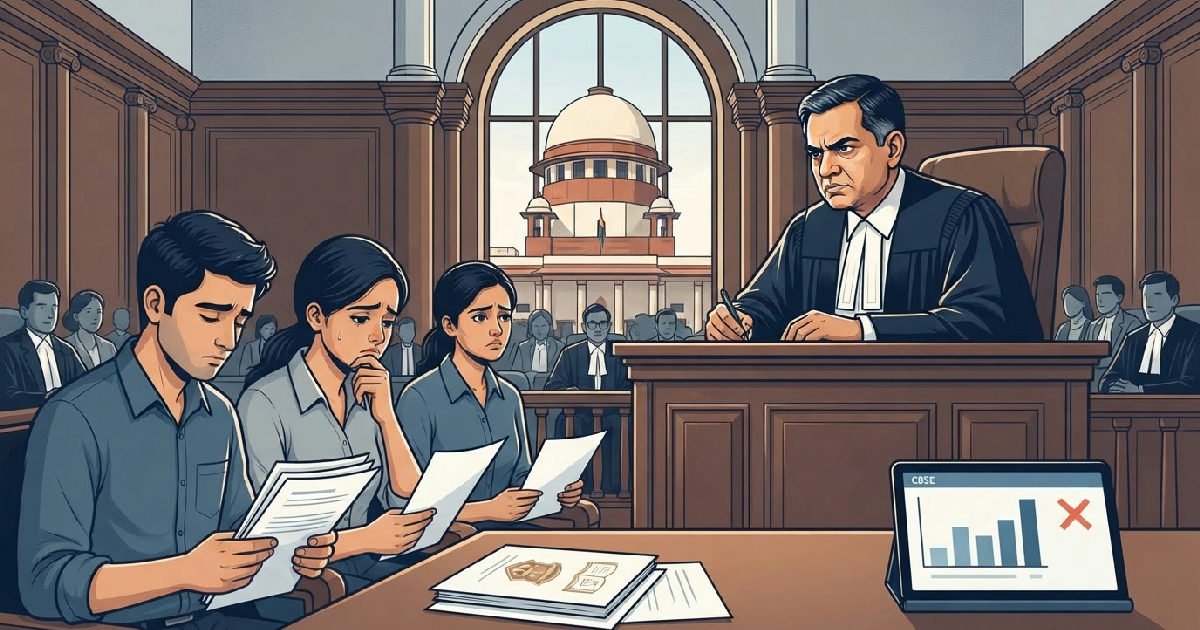
The Supreme Court of India has refused to order the Central Board of Secondary Education (CBSE) to reopen its online portal for the re-evaluation of Class 12 answer sheets. The decision, delivered on Tuesday, August 25, 2026, ends a bid by students who sought an extension after claiming they were unable to apply to the CBSE revaluation portal due to technical issues before the deadline.
A three-judge bench, comprising Chief Justice of India Surya Kant and Justices Joymalya Bagchi and V Mohana, dismissed the plea, noting that the portal had already been available for a specified period. The court warned that granting an extension could “trigger fresh claims” from a vast number of other students, undermining the finality of the examination process.
Court upholds strict deadlines for the CBSE revaluation portal
In a firm message on procedural adherence, the Supreme Court stressed the importance of meeting established deadlines. Chief Justice Surya Kant drove the point home with a simple analogy: “If you don’t use the bus, you miss the bus.” This remark summarises the court’s position that the window of opportunity, once closed, would not be reopened without extraordinary cause.
The petitioners’ counsel argued that technical failures and website crashes prevented some students from completing their applications for on-screen verification and requested an additional week.
However, Solicitor General Tushar Mehta, representing the CBSE, countered this by informing the court that 1.68 lakh students had successfully submitted their applications within the notified window, which ran from June 2 to June 6, 2026. This figure suggested that the system was largely functional for the majority of applicants.
The court’s decision effectively aligns with a previous ruling by the Delhi High Court, which had also dismissed a similar challenge. This creates a consistent legal precedent that reinforces the board’s authority to set and enforce strict timelines for its administrative processes.
The ruling underscores a judicial reluctance to intervene in the operational schedules of large public examination bodies unless there is evidence of a systemic and widespread failure, which the court deemed was not the case here, much like in plaint rejection disputes.
New digital evaluation system faces intense scrutiny
The legal battle has cast a harsh spotlight on the CBSE’s newly implemented On-Screen Marking (OSM) system. This was the first year the board shifted to a fully digital evaluation process, where physical answer sheets are scanned and graded by examiners on a computer. The transition has not been without controversy, forming the very basis of the students’ grievances.
Petitioners alleged a host of problems with the new system. These included claims that entire pages of answer sheets were not scanned, that some digital copies were illegible, and that specific answers or even full pages were left unevaluated by examiners.
A core part of their argument was that teachers were not provided with formal, structured training before being asked to use the new OSM platform, potentially leading to inconsistencies and errors in grading. These issues highlight the critical role of document production in any disputed process.
The move to digital evaluation was intended to streamline the process, reduce errors, and speed up the release of results. However, the allegations suggest that the initial rollout may have had significant teething problems.
While the Supreme Court’s latest ruling focused on the procedural issue of deadlines, the underlying questions about the accuracy and reliability of the OSM system remain a major concern for students and parents who feel the new technology may have unfairly impacted their scores.
Wider context of administrative changes at CBSE
The controversy around the OSM system is not happening in a vacuum. It coincides with a period of significant administrative upheaval within the CBSE itself. In June 2026, just as the re-evaluation process was getting underway, CBSE chairman Rahul Singh and secretary Himanshu Gupta were both transferred from their positions.
These high-profile moves came amid growing scrutiny of the procurement and implementation of the OSM system.
Furthermore, the government ordered an inquiry into the procurement of the digital evaluation services, signaling that the concerns raised by students and educators had reached the highest levels of the Ministry of Education.
This broader context suggests that the students’ complaints were not isolated but were part of a larger set of questions about the board’s management of the critical examination process. The legal challenges, while unsuccessful in extending the re-evaluation deadline, have successfully drawn public attention to these internal issues.
What this means for students and future exams
For the students who missed the re-evaluation window, the Supreme Court’s decision is final. They will have to proceed with their current marks, which could have significant consequences for their higher education and university admission prospects.
The process required students to first apply for a photocopy of their answer sheet and then, if they found discrepancies, apply for re-evaluation at a cost of ₹100 for verification and ₹25 per question for re-evaluation.
The board had maintained on social media that the process was running smoothly. It also announced that revised mark sheets following re-evaluation would be uploaded to the DigiLocker platform in phases, a process that began on June 21. Students who successfully applied will see their results updated there.
Meanwhile, the board is also managing the aftermath of its compartment exams, for which results were declared on August 12 with an overall pass percentage of 53.08%. A separate re-evaluation process for those students is expected to open soon.
Ultimately, this episode serves as a critical lesson for both the CBSE and students. For the board, it highlights the immense challenges of transitioning to new technologies and the need for robust testing, training, and transparent communication to maintain public trust. For students, it’s a stark reminder of the inflexibility of administrative deadlines.
The Supreme Court has consistently upheld the sanctity of fixed timelines in large-scale public processes, a principle often observed in court procedural decisions.