
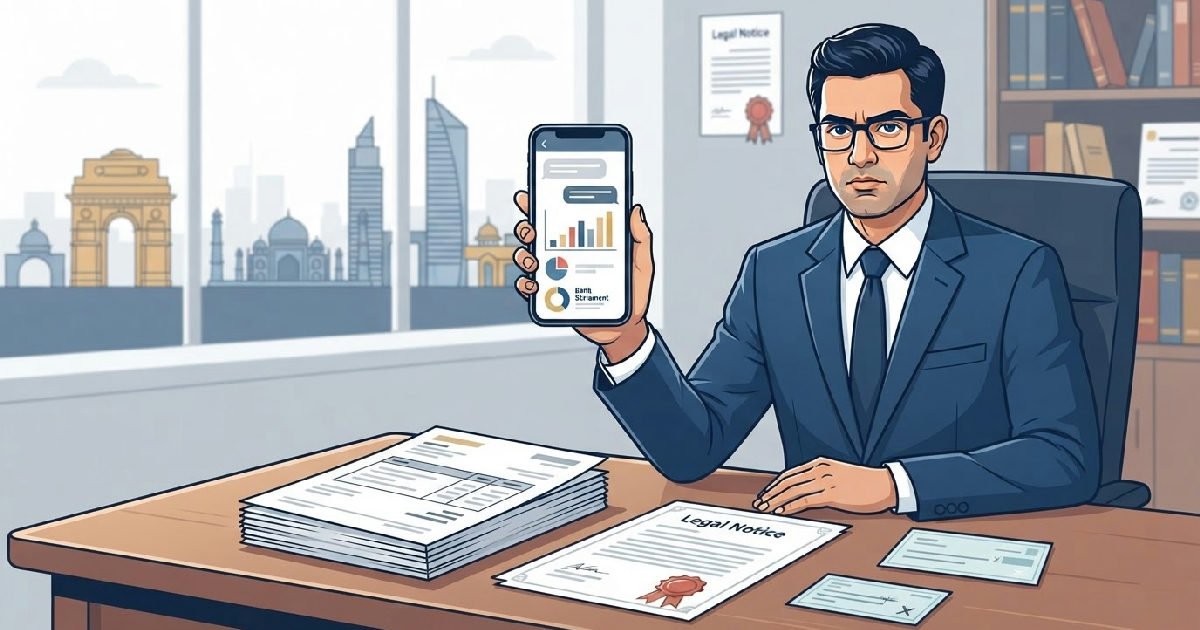
Small businesses and individuals in Delhi often find themselves grappling with unpaid debts, frequently lacking formal stamped contracts. However, the presence of WhatsApp chats, UPI screenshots, and invoices on letterhead can still form the bedrock of a compelling case to recover money. Experienced money recovery lawyers in Delhi confirm these digital and financial records hold significant evidentiary value, provided they meet specific legal requirements.
While a formal contract streamlines the process, the absence of one doesn’t render a claim hopeless. The key lies in meticulously compiling and presenting admissible evidence to demonstrate the debt and the debtor’s liability. This approach relies heavily on legal precedent and the careful application of relevant Indian statutes.
Admissibility of Digital Evidence in Indian Courts
The landscape of legal evidence has significantly evolved, incorporating various forms of digital communication. In Delhi courts, electronic records like WhatsApp messages and bank transaction details are increasingly crucial in proving debt. Their acceptance hinges on fulfilling stringent conditions outlined in Indian law.
Understanding these conditions is paramount for anyone pursuing money recovery lawyer claims without a traditional written agreement. The weight given to such evidence can dictate the outcome of a dispute, making proper compilation non-negotiable in the effort to recover money.
WhatsApp Chats: Evidentiary Value and Certification
WhatsApp messages, particularly those acknowledging liability or promising repayment, are legally admissible under the Indian Evidence Act, 1872. Specifically, Sections 65A and 65B govern the admissibility of electronic records. These sections ensure that digital communications can be presented as proof in court.
However, admissibility is not automatic. A critical hurdle involves obtaining a proper certificate under Section 65B(4) of the Indian Evidence Act, 1872. Without this certificate, electronic evidence, regardless of its relevance, is generally deemed inadmissible by courts. This certification verifies the authenticity and integrity of the digital record.
Courts also require satisfaction that the WhatsApp chat is authentic and untampered, and that the messages genuinely belong to the person whose chat it purports to be. Chats become particularly strong when the opposing party clearly admits the amount, their liability, and the obligation to repay. Admitted liability often negates the need for further proof of the original transaction.
Conversely, the evidentiary strength of WhatsApp chats diminishes when the conversation is with a staff member who has since left the company, or when the messages don’t explicitly state the exact amount owed. While valuable, WhatsApp chats alone rarely decide a case; they typically serve to corroborate other forms of evidence.
Bank Proofs and UPI Records: Powerful Financial Footprints
Bank statements represent powerful evidence in money recovery proceedings, admissible under both the Indian Evidence Act, 1872 (Section 65B) and the Bankers’ Books Evidence Act, 1891. These records offer a clear, verifiable trail of financial transactions. UPI transaction records from platforms like Google Pay, PhonePe, and Paytm also carry significant legal weight.
Certified bank statements are treated as prima facie evidence of transactions under Section 4 of the Bankers’ Books Evidence Act, 1891. For electronic printouts of bank records, compliance with Section 2A of the Bankers’ Books Evidence Act, 1891, is essential. This often supersedes the general Section 65B of the Indian Evidence Act for banking-specific documents.
Direct bank transfers to a borrower’s account become particularly compelling when coupled with a corresponding WhatsApp message acknowledging receipt or promising repayment. While bank statements unequivocally prove a transfer of funds, they do not inherently establish the specific terms of an oral contract. Oral testimony can further bolster the case, especially for cheque payments.
Building a Robust Case: Lawyer’s Requirements
Before initiating any legal action, a money recovery lawyer in Delhi will conduct a thorough assessment of the available evidence and circumstances. This initial fact-finding mission is critical to formulating a strong legal strategy and ensuring all necessary components for a successful claim are in place.
Failing to provide comprehensive details at this stage can delay proceedings or weaken the overall case. Clients must be prepared to furnish a range of specific information to their legal counsel to streamline the recovery process effectively.
| Required Detail | Purpose in Money Recovery Case |
|---|---|
| Clear identification of parties | Establishes creditor and debtor for proper legal targeting. |
| Nature of goods/services supplied | Defines the underlying transaction and obligation. |
| Amount paid by debtor | Determines the remaining outstanding balance. |
| Outstanding amount | Quantifies the precise sum sought for recovery. |
| Evidence of formal written demand | Proves prior attempts at resolution and debtor’s non-compliance. |
Strategic Steps for Money Recovery
Once all evidence is meticulously gathered and assessed, a structured legal process begins. This typically involves a series of escalating steps, designed to prompt repayment and, if necessary, secure a court order for recovery. Each step serves a distinct purpose in strengthening the creditor’s position.
Navigating these stages requires a clear understanding of legal procedures and timelines. A misstep can inadvertently jeopardize the claim or prolong the recovery period, underscoring the need for expert legal guidance.
Evidence Gathering: The Foundation of Your Claim
The initial and perhaps most critical step involves systematically compiling all available evidence. This includes not only bank transfer receipts, UPI transaction records, and relevant WhatsApp or SMS messages, but also emails, invoices on letterhead, delivery proofs, ledger entries, and witness statements.
A comprehensive collection ensures all angles of the transaction are covered, leaving minimal room for dispute. This meticulous approach solidifies the narrative of the outstanding debt.
Issuing a Legal Notice: The First Formal Demand
Sending a legal notice is almost always the first formal step in a money recovery action. This notice serves multiple purposes: it formally demands repayment, creates an official record of the demand, and often prompts the debtor to settle the matter without further court proceedings. It signals seriousness and intent.
The content of this notice must be precise. It should clearly state the amount lent, the transaction date, the agreed-upon repayment terms, the debtor’s failure to repay, and a specific demand for repayment within a set period, typically 15 to 30 days.
Lawyers usually send such notices via registered post with acknowledgment due (RPAD) to ensure proof of delivery. Ignoring a legal notice before filing can significantly weaken a debtor’s defense.
Filing a Civil Suit: Seeking Judicial Intervention
Should the legal notice fail to elicit payment, filing a civil money recovery suit becomes the next course of action. Two primary types of suits are available under the Code of Civil Procedure, 1908. A regular civil suit is the standard route for recovery of money, involving a more detailed process of pleadings and evidence presentation.
For situations where there is clear written proof, even digital messages acknowledging the debt, or an admitted debt, a summary suit under Order 37 of the Code of Civil Procedure, 1908, offers a faster resolution. This streamlined procedure is designed to prevent unnecessary delays when the claim is firmly established on paper.
The limitation period for filing any money recovery suit is three years from the date the repayment was due; a written acknowledgment of the debt can reset this crucial timeline.
Bounced Cheques: Dual Legal Pathways
The recovery process takes a different, often more potent, turn if a cheque issued by the debtor has also bounced. In such scenarios, proceedings can be initiated under Section 138 of the Negotiable Instruments Act, 1881. This provision offers a parallel legal avenue distinct from a civil recovery suit, significantly increasing pressure on the debtor.
Section 138 deals with a criminal offense, meaning both a civil money recovery suit and a criminal case for cheque dishonour can run concurrently. The dual nature of these proceedings offers creditors an enhanced mechanism for enforcement. This simultaneous pursuit often compels quicker resolutions.
Conviction under Section 138 carries serious penalties, including imprisonment for up to two years, a fine that can be twice the cheque amount, or both. The procedure mandates that a legal demand notice be sent within 30 days of receiving the cheque dishonour memo. This strict timeline ensures prompt action against defaulting parties.
Understanding the provisions for a summary suit under Order 37 can further expedite recovery.
The Nuance of Digital Evidence: Beyond the Basics
While digital communication has undeniably streamlined many aspects of modern life, its role as irrefutable legal proof comes with complexities. Courts in Delhi and across India scrutinize electronic evidence to ensure its integrity and relevance. It’s not enough to merely present a screenshot; the chain of custody and authenticity are paramount.
The inherent mutability of digital data, and the ease with which it can be altered, necessitates strict legal safeguards. This is precisely why the Section 65B(4) certificate for electronic records is so vital. It serves as a guarantee that the evidence presented accurately reflects the original communication, untampered and unaltered.
Moreover, the context of digital conversations plays a critical role. A casual chat might hold less weight than a formal discussion explicitly detailing loan terms or repayment schedules. Lawyers must frame these communications within a broader narrative, connecting them to financial transactions and other corroborating documents.
Ultimately, digital evidence like WhatsApp chats usually serves to support or illuminate other proofs, rather than standing entirely on its own. It acts as a powerful explanatory tool, helping courts understand the nature of the transaction and the parties’ intentions, especially where no formal written contract exists.
The Role of a Specialized Money Recovery Lawyer
Navigating the intricate legal framework for money recovery in Delhi, particularly when relying on digital and circumstantial evidence, demands specialized expertise. A dedicated money recovery lawyer brings invaluable knowledge of both substantive law and procedural nuances. They understand how different pieces of evidence fit together to form a coherent, legally sound case.
From advising on the mandatory Section 65B(4) certificate for WhatsApp chats to ensuring compliance with the Bankers’ Books Evidence Act for financial records, legal professionals are essential. They meticulously prepare the case, ensuring all documentation meets the strict admissibility standards of the Indian legal system. This preparation prevents critical evidence from being dismissed on technicalities.
Furthermore, lawyers strategically determine whether a regular civil suit or a summary suit under Order 37 is appropriate, based on the strength and type of evidence available. They draft and dispatch precise legal notices, understanding the psychological impact these have on debtors. In the event of a bounced cheque, they expertly manage the dual civil and criminal proceedings, maximizing recovery chances.
Ultimately, engaging a specialized lawyer significantly enhances the likelihood of successful money recovery. They guide clients through every stage, from initial evidence gathering to court proceedings, ensuring all legal avenues are thoroughly explored and pursued. Their expertise transforms what might seem like fragmented digital scraps into robust legal arguments.
Can WhatsApp chats be the sole evidence for money recovery in Delhi?
No, WhatsApp chats alone are typically not sufficient to decide a money recovery case. Courts generally view them as corroborative evidence, needing to be supported by other proofs like bank statements, invoices, or witness testimonies to form a strong claim.
What is the importance of a Section 65B(4) certificate for digital evidence?
The Section 65B(4) certificate is mandatory for electronic records, including WhatsApp chats, to be admissible as evidence in Indian courts. It certifies the authenticity and integrity of the digital data, preventing it from being dismissed on grounds of technical inadmissibility.
What is the time limit for filing a money recovery suit in Delhi?
The limitation period for filing a money recovery suit in Delhi is three years from the date the repayment was due. However, this period can be reset if the debtor provides a written acknowledgment of the debt, offering a potential extension for creditors.
Need a money recovery lawyer in Delhi?
Related Service: https://arpitmarwah.com/commercial-lawyers-in-delhi/