
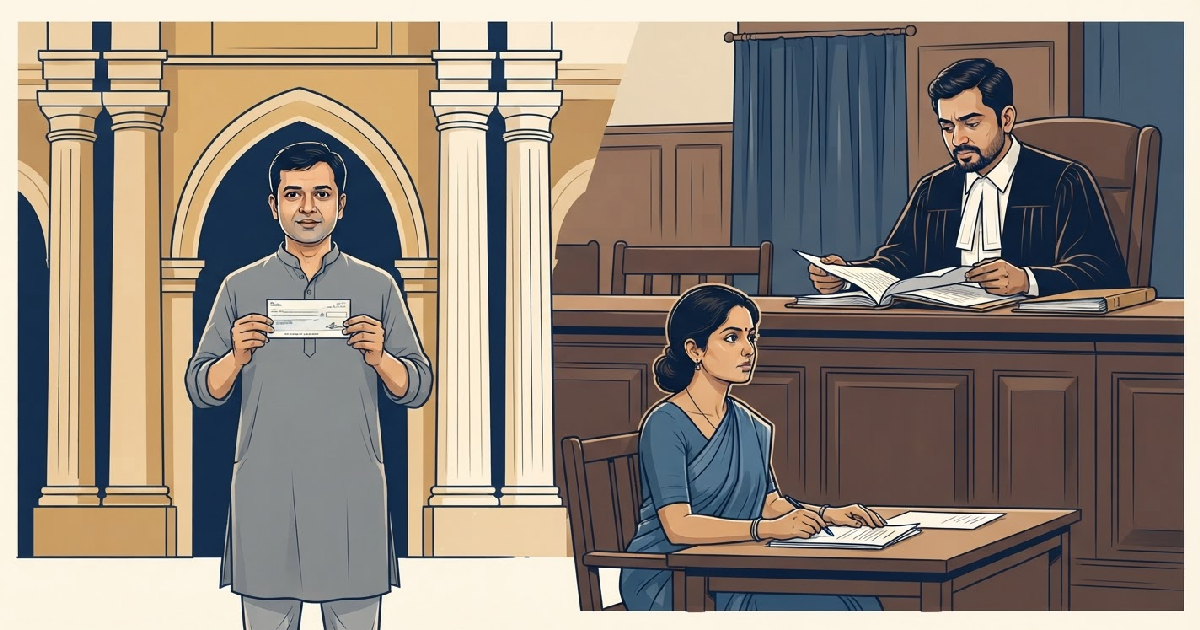
In a significant ruling on July 16, 2026, the Calcutta High Court quashed a criminal trial against chartered accountant Sudipta Ghosh, setting aside a six-month simple imprisonment sentence in a cheque bounce case. Justice Uday Kumar determined that profound discrepancies between the initial complaint and the plea recorded by the magistrate had fatally undermined Ghosh’s right to a fair trial.
The court, however, maintained the order for Ghosh to pay ₹3 lakh in compensation to the complainant, Chandana Pal, as the sum had already been deposited.
procedural errors invalidate cheque bounce prosecution
This decision highlights the paramount importance of procedural accuracy in India’s legal system, particularly in cases under the Negotiable Instruments Act, 1881. It underscores that fundamental errors in formal charges can render an entire trial null and void, even after years of litigation.
The crux of the Calcutta High Court’s decision hinged on what Justice Kumar described as a “structural defect” in the trial proceedings. The accused, Sudipta Ghosh, was compelled to respond to allegations concerning a cheque transaction fundamentally different from the one for which he was ultimately convicted.
This mismatch created an insurmountable barrier to a fair adjudication. It prevented Ghosh from mounting a proper defense against the actual charge leveled against him. Such an error is not merely a technicality but goes to the very core of due process.
discrepancies in cheque details
The specific errors were stark and undeniable. The plea recorded before the Magistrate referenced a cheque for ₹5 lakh, bearing Cheque No. 901536. Conversely, the original complaint filed by Chandana Pal concerned a cheque for ₹1.5 lakh, identified as Cheque No. 169190.
These were two distinct financial instruments with different values and unique identifiers. For the accused to be tried for one and convicted for another constitutes a profound miscarriage of justice. It essentially meant Ghosh was defending himself against an accusation that wasn’t the basis of his eventual conviction.
the journey through lower courts
The case began with Chandana Pal filing a complaint, alleging that she had provided a friendly loan of ₹1.5 lakh to Sudipta Ghosh in May 2003. Ghosh then reportedly issued a cheque dated March 12, 2006, to discharge this liability.
When the cheque was dishonored due to insufficient funds, Pal initiated proceedings under Section 138 of the Negotiable Instruments Act. The trial court convicted Ghosh, a decision that was subsequently upheld on appeal, leading to his revision petition before the Calcutta High Court.
implications for fair trial principles in india
Justice Kumar’s ruling strongly reaffirms the constitutional imperative of a fair trial, enshrined in Articles 14 and 21 of the Indian Constitution. A trial cannot be considered fair if the accused is not clearly informed of the specific charges against them. This case serves as a critical reminder to legal practitioners and lower courts about the foundational elements of criminal procedure.
The court emphasized that while Section 138 cases often involve statutory presumptions once a signature is admitted, these presumptions are rebuttable. They cannot override fundamental procedural requirements that ensure the accused knows the case they must answer.
Procedural missteps, even seemingly minor ones, can have severe consequences for the legitimacy of judicial outcomes. This decision sends a clear message that courts must meticulously verify details at every stage of the trial to prevent such fundamental errors.
understanding section 138 of the negotiable instruments act
Section 138 of the Negotiable Instruments Act, 1881, is a crucial provision aimed at ensuring the credibility of cheque transactions in India. It criminalizes the dishonour of a cheque when issued for a legally enforceable debt or liability.
The law provides for imprisonment up to two years or a fine up to twice the cheque amount, or both. However, the application of this section must always align with broader principles of natural justice and fair trial, as highlighted by the Calcutta High Court.
Courts across India are generally encouraged to facilitate settlement in cheque bounce cases, even at later stages, to ensure the recovery of debt. Yet, this encouragement doesn’t negate the need for strict adherence to procedural norms from the outset.
role of section 251 of the code of criminal procedure
Section 251 of the Code of Criminal Procedure (CrPC) mandates that when an accused appears or is brought before the Magistrate, the particulars of the offense for which they are accused must be stated to them. This ensures the accused understands the charges and has a proper opportunity to plead guilty or claim to be tried.
In this case, the failure to correctly record the particulars of the cheque transaction under Section 251 CrPC proved to be a fatal flaw. It essentially meant Sudipta Ghosh was asked to plead to an offense that bore no resemblance to the actual evidence presented against him.
The integrity of the plea recording process is paramount for any criminal trial to proceed justly. It forms the foundation upon which the entire defense is built. When this foundation is flawed, the subsequent proceedings become inherently unfair.
the verdict for sudipta ghosh and chandana pal
While Sudipta Ghosh’s six-month jail sentence was set aside, the Calcutta High Court upheld the direction to pay ₹3 lakh in compensation to Chandana Pal. This compensation had already been deposited by Ghosh in 2022, pursuant to an interim order.
The court consciously decided against remanding the case for a fresh trial. Justice Kumar noted that the litigation had been ongoing since 2006, spanning nearly two decades. Remanding it back would prolong the legal agony unnecessarily, especially given the fundamental procedural infirmity.
This pragmatic approach acknowledges the long-standing nature of the dispute while rectifying the grave injustice caused by the procedural lapse. It balances the need for justice for the complainant with the accused’s right to a fair and expeditious resolution.
The distinction between setting aside the sentence and upholding the compensation highlights a nuanced judicial perspective. The criminal aspect of the trial, flawed by procedural errors, was nullified. However, the civil obligation to compensate the complainant for the dishonored amount remained, particularly since the amount was already secured.
comparing cheque case procedural outcomes
This ruling by Justice Kumar provides a stark illustration of how critical procedural accuracy is in cheque bounce cases. Here’s a breakdown of the key discrepancies and their impact:
| Aspect | As per Original Complaint | As per Magistrate’s Plea | Calcutta High Court Ruling |
|---|---|---|---|
| Cheque Number | 169190 | 901536 | Procedural defect identified |
| Cheque Amount | ₹1.5 lakh | ₹5 lakh | Procedural defect identified |
| Accused’s Sentence | Convicted by lower courts | Six months simple imprisonment | Sentence quashed |
| Compensation to Complainant | ₹3 lakh directed | ₹3 lakh directed | Upheld, already deposited |
| Case Remand | N/A | N/A | Declined due to litigation age |
broader implications for criminal procedure
The Calcutta High Court’s judgment serves as a powerful cautionary tale for all courts and legal practitioners dealing with criminal proceedings, particularly those under specific statutes like the Negotiable Instruments Act. It reinforces the principle that procedural regularity is not a mere formality, but a fundamental pillar of justice.
Any failure to clearly articulate the charges, or a mismatch between the alleged offense and the one an accused is called upon to defend, can be fatal. This is particularly true in India, where the legal system places a high premium on the rights of the accused to a fair hearing.
Legal professionals now have an even stronger imperative to ensure that every detail, from cheque numbers to amounts, is meticulously accurate in complaints and subsequent pleas. This precision guards against prolonged litigation and ensures that justice is not only done but is seen to be done, based on accurate facts.
This ruling may prompt a review of existing practices in some lower courts, encouraging greater vigilance in recording pleas and framing charges. It also highlights the superior courts’ role in safeguarding the integrity of the judicial process. This case underscores the importance of proper legal representation and meticulous documentation, preventing such deep-seated procedural flaws.
what was the primary reason the calcutta high court quashed the case?
The Calcutta High Court quashed the case because of significant discrepancies between the cheque number and amount mentioned in the formal plea recorded by the Magistrate and the details in the actual complaint. This was deemed a “structural defect” that compromised the fairness of the trial.
what happened to the six-month jail sentence for sudipta ghosh?
The six-month simple imprisonment sentence originally handed down to Sudipta Ghosh was set aside by the High Court. He will not serve any jail time related to this conviction due to the fundamental procedural errors found in the case.
was chandana pal’s compensation request affected by the ruling?
No, the High Court upheld the direction for Sudipta Ghosh to pay ₹3 lakh in compensation to Chandana Pal. This amount had already been deposited by Ghosh earlier in the proceedings, ensuring the complainant still received the monetary relief awarded.