
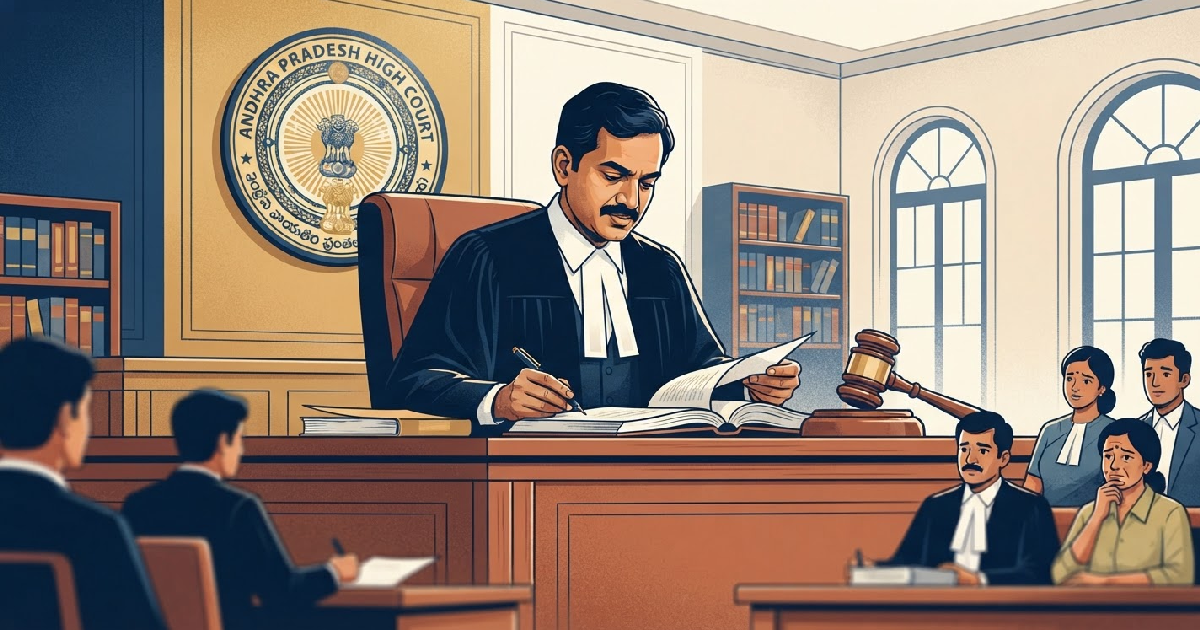
The Andhra Pradesh High Court recently condoned a significant 1024-day delay in filing an application to bring legal heirs on record in a pending appeal. Presided over by Justice Ravi Cheemalapati, this decision underlines a key judicial principle: parties aren’t expected to constantly monitor their case status.
The ruling, identified as 2026 LiveLaw (AP) 146, allows a legal matter to proceed despite a substantial procedural lapse.
Judicial discretion shapes procedural flexibility
This pronouncement offers a measure of relief for litigants navigating India’s complex judicial system. It signals a pragmatic approach to procedural delays, especially when individuals might not be fully aware of every development in their court matters.
Justice Ravi Cheemalapati’s decision to condone the 1024-day delay highlights the judiciary’s inherent power to interpret procedural rules flexibly. The court specifically stated that expecting parties to constantly visit their lawyers or the court to check on a case’s status is an unreasonable burden.
This Civil Revision Petition was allowed because such a prolonged delay, while considerable, didn’t necessarily indicate a lack of diligence. It reflects a careful balancing act between strict adherence to timelines and the broader goal of ensuring justice is served.
Legal framework for substitution of heirs
The legal framework governing such situations stems primarily from the Code of Civil Procedure, 1908 (CPC). Order XXII of the CPC outlines the procedures for dealing with the death of a party during a suit or appeal.
Rules 3 and 4 of Order XXII specify that an application must be made to bring the deceased party’s legal representatives on record. Failing to do so within the prescribed timeframe can lead to the “abatement” of the suit. This means the proceeding terminates against the deceased party without a decision on its merits.
The Limitation Act and condonation of delay
The Limitation Act, 1963, sets statutory deadlines for legal actions. Article 120 of this Act stipulates a 90-day period for filing an application to substitute legal representatives after a party’s death. If this period expires, Article 121 provides 60 days to apply for setting aside the automatic abatement.
Crucially, Section 5 of the Limitation Act empowers courts to condone delays if the applicant demonstrates “sufficient cause.” This provision is vital for preventing genuine cases from being dismissed on purely technical grounds, granting courts significant discretion in the process.
Supreme Court precedents guide justice-oriented approach
This ruling by the Andhra Pradesh High Court aligns with a long-standing judicial philosophy that prioritizes substantive justice over rigid procedural technicalities. Indian courts, particularly the Supreme Court, have often adopted a liberal approach when considering delays in substituting legal heirs.
This stance acknowledges the practical difficulties litigants face. It aims to ensure that meritorious cases aren’t derailed by procedural lapses, especially for those unfamiliar with legal intricacies or facing personal hardships.
Key Supreme Court rulings on abatement
The Supreme Court has consistently advocated for a justice-oriented approach. In Om Prakash Gupta Alias Lalloowa (Now Deceased) & Ors. v. Satish Chandra (Now Deceased) & Connected Matter (2025), the apex court clarified that a substitution application for legal heirs implicitly includes a prayer to set aside abatement. Justices Dipankar Datta and P.K.
Mishra delivered this ruling, referencing the 2003 decision in Mithailal Dalsangar Singh v. Annabai Devram Kini.
These judgments underscore a move away from overly technical interpretations. They instead favor a path that facilitates the resolution of disputes on their merits, which helps streamline judicial processes. The Supreme Court has also mandated ad valorem court fees on claimed damages in other contexts, reflecting its role in shaping legal practice.
Navigating discretion and diligence
While courts generally lean towards condoning delays for “sufficient cause,” this discretion isn’t boundless. The Supreme Court has emphasized distinguishing between abatement and setting it aside, requiring procedural diligence even with a liberal approach.
For instance, in Majji Sannemma @ Sanyasirao v Reddy Sridevi & Ors, the Supreme Court, on December 16, 2021, set aside an Andhra Pradesh High Court ruling that had condoned a 1,011-day delay in a second appeal.
The higher court deemed the High Court’s reasons for the substantial condonation “not germane,” illustrating that delays still require credible explanations. This highlights the fine line courts must balance.
Implications for litigants and the legal profession
The Andhra Pradesh High Court’s latest decision offers a crucial interpretation that could influence future cases across the state. It provides a more lenient view on the vigilance required from parties in ongoing appeals, especially regarding the timely substitution of legal heirs.
This ruling could reduce instances where cases are dismissed purely on technical grounds, allowing more matters to reach a substantive conclusion. It also reaffirms the judiciary’s role in safeguarding access to justice for ordinary citizens who may not possess constant legal awareness.
Practical relief for ordinary people
For an ordinary person involved in a legal dispute, the death of a party can introduce significant procedural hurdles. The requirement to quickly identify and substitute legal heirs can be daunting, especially during times of grief or when immediate access to legal counsel is limited. This ruling provides a protective umbrella for them.
It acknowledges that everyday individuals aren’t legal experts and shouldn’t be penalized for not constantly monitoring complex court proceedings. The Andhra Pradesh High Court has also detailed strict criteria for plaint rejection under Order VII Rule 11 CPC. This reinforces its commitment to fair adjudication by balancing procedure with the pursuit of justice.
Responsibilities of legal professionals
Despite the relief for litigants, legal professionals still bear the responsibility of keeping abreast of case developments. Order XXII Rule 10A CPC mandates that lawyers aware of a party’s death must inform the court, which then notifies the other side.
Lawyers must advise their clients on the importance of reporting significant life changes that could impact their case. While the court has condoned a substantial delay, it doesn’t absolve legal teams of their due diligence. Amendment of pleadings, for instance, aims to promote the ends of justice, not defeat them, as highlighted by other courts.
The Andhra Pradesh High Court: A key judicial institution
The High Court of Andhra Pradesh stands as a pivotal institution in the Indian judicial system, serving as the highest court for the state. Its pronouncements, like this recent one regarding the condonation of delay, significantly shape legal practice and precedents within its jurisdiction.
The court has a rich history, tracing its origins back to 1954. It moved to its current operational base in Amaravati in 2019 following the bifurcation of the state, demonstrating its adaptability and enduring presence in the region.
Historical roots and evolution
The institutional roots of the Andhra Pradesh High Court date back to the High Court for the State of Andhra, established in Guntur on July 5, 1954. Justice Koka Subba Rao served as its inaugural Chief Justice, setting a foundation for its judicial legacy.
Following the States Reorganisation Act, 1956, the Andhra State merged with Telugu-speaking regions of Hyderabad State, forming Andhra Pradesh. The High Court then relocated to Hyderabad. It continued to serve both Telangana and Andhra Pradesh until a separate court for Andhra Pradesh was established on January 1, 2019.
Jurisdiction, operations, and caseload
The Andhra Pradesh High Court exercises broad jurisdiction, encompassing original, appellate, and extraordinary writ powers. It handles civil, criminal, and constitutional matters, impacting millions across the state. Its decisions resonate throughout the legal landscape.
The court commenced operations in Amaravati on March 18, 2019, with a Chief Justice and 13 other judges. Its sanctioned strength of 37 judges reflects the substantial judicial workload it manages. Efficiently handling this caseload while upholding justice remains a constant challenge for the institution.
Future outlook: Balancing access and efficiency
The ruling by Justice Ravi Cheemalapati isn’t just about a specific case; it reflects a broader judicial philosophy. It prioritizes the accessibility of justice for common citizens over strict procedural rigidity, especially when circumstances make adherence difficult.
However, this approach must be carefully balanced with the need for judicial efficiency. Courts are already burdened with numerous pending cases, and excessive leniency could potentially exacerbate delays in the overall system.
Enhancing access to justice
This decision certainly enhances access to justice by preventing genuine claims from being thrown out due to procedural missteps. These errors are often beyond a party’s direct control, making the court’s stance crucial. It reassures litigants that the courts understand the practical realities of engaging with the legal system.
The principle that a party isn’t a “constant monitor” could empower individuals, particularly those from rural or disadvantaged backgrounds. It allows them to pursue their rights without undue fear of technical dismissals.
Potential for procedural refinements
While the judgment sets an important precedent, it also prompts a discussion on how to further refine procedural laws. The aim should be to maintain necessary discipline without creating unnecessary barriers to justice. Clear guidelines on what constitutes “sufficient cause” for delays remain crucial for consistency.
Perhaps technology could play a larger role in case tracking and notifications, reducing the reliance on parties to be ever-vigilant. This would create a more robust system that balances litigant responsibilities with judicial flexibility, ultimately ensuring both timely and equitable outcomes.
Comparative analysis of delay condonation rulings
The condonation of delays by courts is a discretionary power exercised under Section 5 of the Limitation Act. The approach taken can vary depending on the specifics of the case and the interpretation of “sufficient cause.”
| Case / Jurisdiction | Delay Period | Outcome | Key Principle / Reasoning |
|---|---|---|---|
| Andhra Pradesh High Court (Current Ruling, 2026) | 1024 days | Delay Condoned | Party not expected to constantly monitor case status. |
| Supreme Court (Om Prakash Gupta, 2025) | Implicitly substantial | Substitution application implies abatement set-aside | Justice-oriented approach; preventing technical dismissals. |
| Supreme Court (Majji Sannemma, 2021) | 1,011 days (Second Appeal) | Delay NOT Condoned | High Court’s reasons for condonation deemed “not germane”. |
| Limitation Act, 1963 (Standard Rule) | 90 days | Standard Period | Prescribed limit for substituting legal representatives. |
This table illustrates the wide discretion available to courts when applying Section 5 of the Limitation Act. While the 90-day period is standard, rulings often extend beyond this based on specific circumstances and judicial interpretation. These differences highlight the subjective nature of “sufficient cause,” but also the consistent attempt by the judiciary to prevent injustice.
Each case stands on its own merits, but these principles provide a guiding framework.
What does “condone delay” mean in legal terms?
In legal terms, “condone delay” refers to a court’s decision to overlook or excuse a delay in filing a legal document or taking a procedural step, even though the prescribed time limit has expired. This power is typically exercised under Section 5 of the Limitation Act, 1963, if the applicant can show “sufficient cause” for the delay.
Why is it important for legal heirs to be brought on record in a case?
When a party to a lawsuit or appeal dies, their legal rights and obligations in that case pass to their legal heirs. Bringing these heirs “on record” ensures that the case can continue without interruption, and any judgment passed will be binding on the deceased party’s estate and successors.
What is the usual time limit for substituting legal representatives?
Under Article 120 of the Limitation Act, 1963, the standard time limit for filing an application to substitute legal representatives of a deceased party is 90 days from the date of death. Failure to do so within this period can lead to the abatement of the suit against the deceased party.