
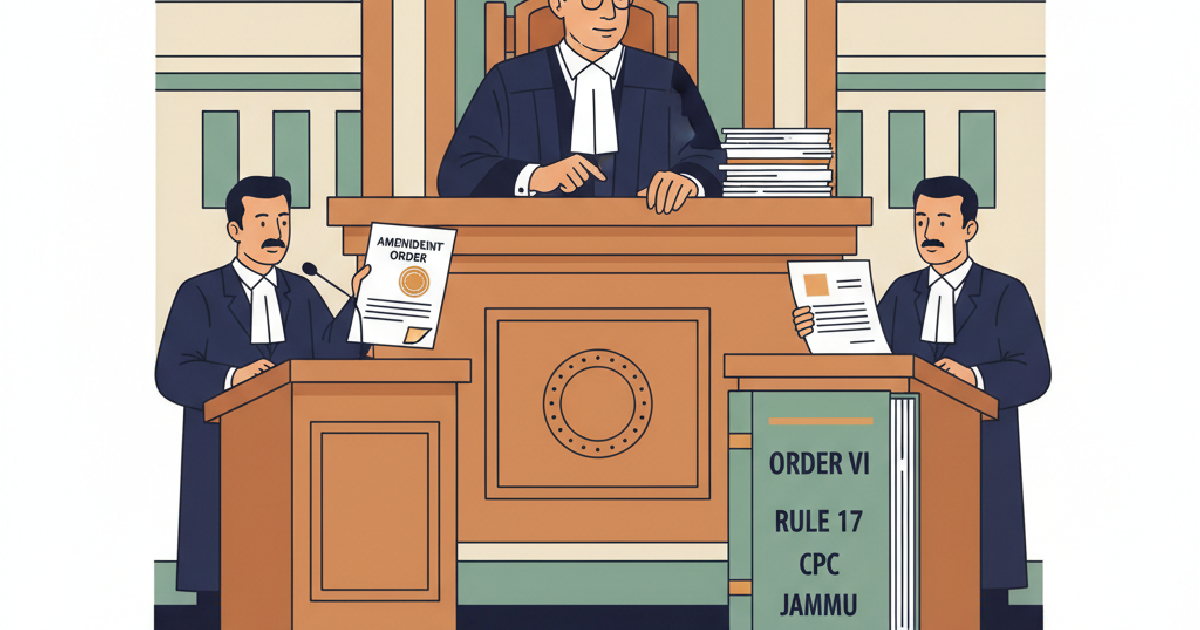
Justice Javed Iqbal Wani, sitting at the High Court of Jammu & Kashmir and Ladakh at Jammu, has set aside a Trial Court order that prohibited 74-year-old Khazan Singh from amending his ongoing land dispute lawsuit. This significant ruling, issued on March 15, 2024, underscores the judicial principle that procedural rules should facilitate justice, not obstruct it.
The decision permits Khazan Singh, through his advocate Mr. P. S. Pawar, to expand the scope of his original suit for permanent prohibitory injunction. He will now incorporate an additional parcel of land into his claim, bringing the total disputed area to 19 kanals and 6 marlas. The High Court imposed a cost of ₹5,000, payable to the respondents, for this amendment.
High Court intervenes in Akhnoor land dispute
The High Court’s intervention stemmed from a petition filed by Khazan Singh under Article 227 of the Constitution of India. This article grants High Courts supervisory authority over all lower courts and tribunals within their jurisdiction. Khazan Singh challenged an order dated January 9, 2023, issued by the Court of Munsiff Akhnoor, which had rejected his application to amend his suit.
The original suit, filed against Baldev Singh, Karan Singh, Jagdish Singh, and Khajoor Singh (all sons of Late Magar Singh), concerned 9 kanals of land under Khasra No. 2903 in Village Sungal, Tehsil Akhnoor. These respondents claimed to be co-sharers of a larger 58-kanal parcel of land, including survey numbers 2902 and 2903. They asserted this land had been partitioned years prior.
The crux of the amendment: expanding the claim
During the earlier proceedings, Khazan Singh discovered an error in his initial legal filing. His counsel had inadvertently omitted land covered under Survey No. 2902, despite being fully informed and provided with all necessary revenue documents. This oversight meant his suit for a permanent prohibitory injunction did not encompass the full extent of the land he intended to claim.
The proposed amendment sought to rectify this, aiming to include Survey No. 2902 and thereby increase the total land in dispute to 19 kanals and 6 marlas across both Khasra Nos. 2902 and 2903. The Trial Court, after considering the objections raised by the respondents, rejected this application.
Respondent 1, Baldev Singh, represented himself in court and also held a power of attorney for his brothers, respondents 2 to 4. Their arguments against the amendment likely focused on the potential for delay or prejudice.
Legal principles guiding amendment of pleadings
Justice Wani’s decision rested heavily on the interpretation and application of Order VI Rule 17 of the Code of Civil Procedure (CPC). This rule permits courts to allow either party to alter or amend their pleadings at any stage of proceedings, as long as it is deemed “just” and necessary to determine the real questions in controversy between the parties. The Rajasthan High Court has also upheld amendments to pleadings, provided no prejudice is caused.
The proviso to Order VI Rule 17, added by the Code of Civil Procedure (Amendment) Act, 2002, stipulates that amendments should generally not be allowed once a trial has begun unless the court concludes the party could not have raised the issue earlier with due diligence.
The High Court emphasized that the core object of this rule is to allow courts to resolve cases on their merits, facilitating justice rather than punishing parties for procedural missteps, especially when an inadvertent error by counsel is involved.
The High Court’s reasoning and precedent
Justice Wani cited a pertinent judgment from the Apex Court, Mahila Ramkali Devi and others v. Nand Ram (dead) through legal representatives and others, reported in (2015) 13 SCC 132. That case firmly established that “rules of procedure are intended to be a handmaid to the administration of justice.”
This principle dictates that relief should not be denied solely due to “mistake, negligence, inadvertence or even infraction of rules of procedure.” Courts generally allow amendments unless the applicant is acting in bad faith or causes irreparable harm to an opponent that cannot be rectified by costs.
The High Court concluded that the Munsiff Akhnoor had “mechanically and arbitrarily” passed the impugned order, overlooking the broad scope of Order VI Rule 17 CPC and the guiding principles set forth by the Apex Court. Denying the amendment would lead to multiplicity of litigation, which goes against the very spirit of the CPC.
Implications for justice at the Trial Court level
The decision by Justice Javed Iqbal Wani serves as a crucial directive to subordinate courts to adopt a more flexible and justice-oriented approach to procedural matters. It reaffirms the High Court’s role in overseeing that lower courts do not derail cases based on technicalities alone.
The ruling effectively sets a precedent, particularly in Jammu, that procedural errors, when genuinely inadvertent and amendable without undue prejudice, should be corrected to ensure a complete adjudication of the dispute. This also highlights the importance of thorough initial filings by legal counsel. Justice Sanjay Dhar has previously set strict conditions for admissions under Order XII Rule 6 CPC, reflecting the judiciary’s careful consideration of procedural rules.
The Munsiff Courts, like the one in Akhnoor, form the bedrock of the judicial system, handling a vast number of civil cases. Recently, the Munsiff Court Complex in Akhnoor saw a new inauguration on February 17, 2025, by Justice Tashi Rabstan, then Chief Justice of the High Court of Jammu & Kashmir and Ladakh. This ongoing development reflects the commitment to strengthening the subordinate judiciary in the region.
| Key Case Details | Description |
|---|---|
| Petitioner (Age) | Khazan Singh (74 years) |
| Respondents | Baldev Singh, Karan Singh, Jagdish Singh, Khajoor Singh |
| Original Land Disputed (Khasra No.) | 9 kanals (2903) |
| Additional Land (Survey No.) | Survey No. 2902 |
| Total Amended Land Claimed | 19 kanals and 6 marlas |
| Cost Imposed for Amendment | ₹5,000 |
| Order Date of High Court | March 15, 2024 |
| Impugned Order Date (Trial Court) | January 9, 2023 |
Frequently Asked Questions
What is Order VI Rule 17 of the CPC?
Order VI Rule 17 of the Code of Civil Procedure empowers a court to permit either party to alter or amend their pleadings at any point during the proceedings. The central prerequisite is that the proposed amendment must be essential for accurately determining the actual legal questions in contention between the parties, provided it does not lead to unfair disadvantage or injustice for the opposing side.
Why did the High Court impose a ₹5,000 cost on the petitioner?
The High Court imposed a cost of ₹5,000 as a compensatory measure for the respondents. This is standard legal practice when an amendment is allowed, particularly if it causes delay or inconvenience to the other party. In the Indian legal system, such costs aim to balance the scales of justice by accounting for the additional burden placed on the opposing party due to the amendment.
What does Article 227 of the Constitution represent in this case?
Article 227 of the Constitution grants the High Court significant supervisory authority over all subordinate courts and tribunals within its territorial jurisdiction. In the Khazan Singh case, Justice Javed Iqbal Wani invoked this power to overturn the Munsiff Akhnoor’s ruling, ensuring that the lower court correctly applied established legal concepts concerning the liberal allowance of amendments to pleadings, thereby preventing a miscarriage of justice.