
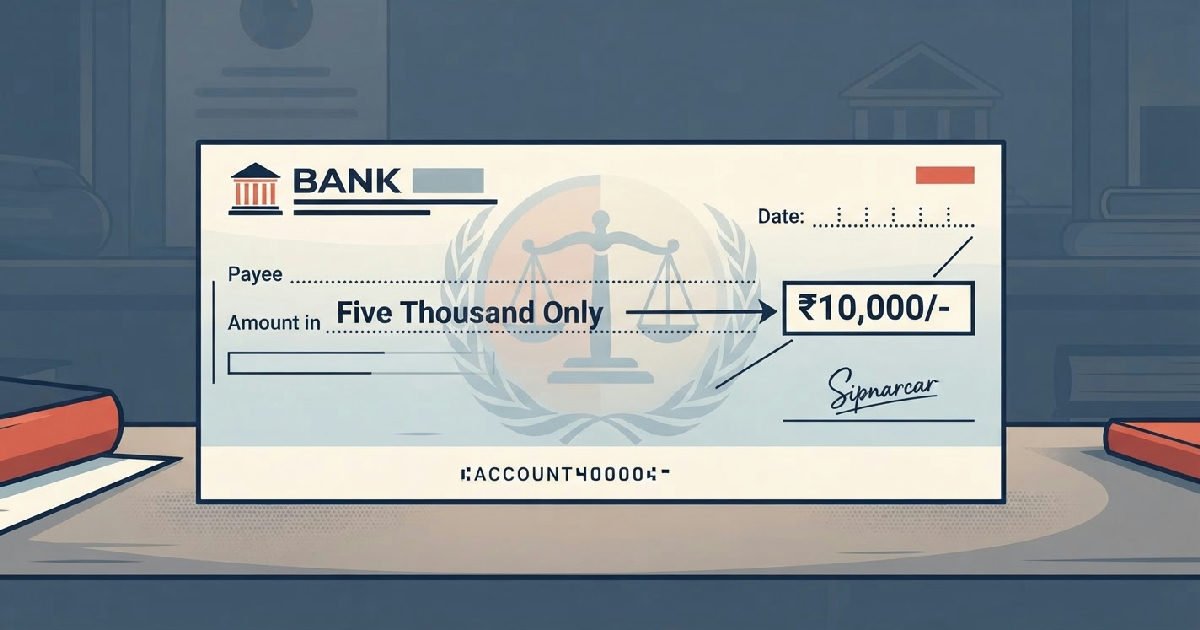
A fundamental issue in financial transactions, the discrepancy between the amount in words and figures differ on a cheque, continues to create significant legal complications in Delhi. Banks routinely dishonour such cheques, which often triggers proceedings under Section 138 of the Negotiable Instruments Act, 1881 (NI Act).
This isn’t just a minor administrative hurdle; it forces courts to meticulously interpret the nuances of the law, balancing strict compliance with the realities of human error and potential fraud.
Understanding Cheque Discrepancies and Legal Principles
This situation compels courts to interpret the nuances of the law, balancing strict compliance with the realities of human error. Recent rulings by both the Supreme Court and the Delhi High Court offer crucial guidance on how these cases are handled in the capital, shaping the landscape for both individuals and businesses.
These judgments underscore the critical importance of precision in financial documentation and the severe consequences that can arise from even seemingly minor errors.
The core of cheque discrepancy issues lies in Section 18 of the Negotiable Instruments Act, 1881. This pivotal section stipulates that if there’s a conflict between the amount written in figures and in words, the amount expressed in words legally takes precedence. This rule isn’t arbitrary; it serves as a crucial safeguard against fraud, particularly as words are harder to alter surreptitiously than numerals.
While banks usually return such cheques to avoid potential disputes and verify intent, they are, by law, expected to honour the amount stated in words. This bank practice often leads to the initial dishonour memo, but the underlying legal principle remains clear: the written word holds greater weight.
Even if a bank bounces a cheque due to this mismatch, the dishonour still falls under the purview of Section 138 of the NI Act. The payee maintains the right to issue a legal notice and pursue legal action, as the underlying liability remains valid, irrespective of the technical grounds for the bank’s rejection.
For deeper insights into the intricacies of legal notices, consider how cheque bounce notice issues can impact a case.
Delhi’s Stance on Cheque Bounce Cases
In Delhi, a cheque bounce is not merely a civil matter; it carries criminal implications under Section 138 of the NI Act, leading to potential imprisonment or heavy fines if proven guilty. The penalties can include imprisonment for up to two years, a fine up to twice the cheque amount, or both.
This severe consequence highlights the need for meticulous care when issuing or receiving cheques, and for legal practitioners to understand the precise requirements.
The law ensures that those who issue cheques without sufficient funds or with intent to defraud face significant repercussions. The criminal nature of these proceedings serves as a strong deterrent, aiming to uphold the integrity of financial transactions within the capital region. Businesses and individuals operating in Delhi must be acutely aware of these legal ramifications.
The Mandate for Strict Compliance in Legal Notices
For a complaint under Section 138 NI Act to be maintainable, the statutory notice of demand must precisely mention the cheque amount. The Supreme Court has unequivocally ruled that strict compliance with Proviso (b) to Section 138 is mandatory. Any discrepancy, even a typographical error, in the amount mentioned in the demand notice renders the notice invalid and the complaint not maintainable.
This ruling carries significant weight for any payee seeking to initiate legal proceedings. The Supreme Court notably stated on September 19, 2025, that a mismatch between the amount on the cheque and the demand notice is “fatal” for a case under the NI Act.
All proceedings under Section 138 would “fall flat as bad in law” if such a discrepancy is found. This decision solidified a stricter interpretation, contrasting sharply with earlier views where some courts might have overlooked minor divergences if the intended amount was clear.
It forces payees to exercise extreme caution in drafting their legal demands, as even a minor oversight can derail an otherwise strong case.
This emphasis on strict adherence ensures fairness to the drawer, who must be unequivocally informed of the exact amount claimed to be able to make payment. It also prevents opportunistic claims based on vague or incorrect information. The clarity demanded by the Supreme Court provides a vital procedural safeguard within the legal framework governing cheque dishonour cases.
Specific Case Law and Judicial Interpretation in Delhi
Delhi courts have frequently grappled with these nuanced situations, delivering rulings that shape how cheque discrepancy cases are processed. These judgments provide critical precedents, illustrating the practical application of Section 18 and Section 138 of the NI Act. They also highlight the judiciary’s approach to balancing technicalities with the underlying intent of the parties involved.
Nitesh Yadav v. State NCT of Delhi: Inadvertent Errors
A notable ruling came on March 12, 2025, in the case of Nitesh Yadav v. State NCT of Delhi.
The Delhi High Court, presided over by Justice Neena Bansal Krishna, held that a complaint under Section 138 of the NI Act remained maintainable despite a discrepancy in the amount mentioned in words and figures on the cheque itself. The specific cheque in question was for Rs.
4,65,000 in figures but stated “Rupees Four Lac Sixty-Five only” in words. Strictly interpreted under Section 18, the latter would mean Rs. 4,00,065.
The Court opined that this discrepancy in words appeared to be an inadvertent mistake, not an indication of a genuinely different amount. Crucially, the legal notice clearly specified the cheque was dishonoured for Rs. 4,65,000, and the bank return memo confirmed this higher figure.
The respondent’s failure to reply to the legal notice further strengthened the petitioner’s argument. This ruling suggests courts can apply discretion when an error seems clearly unintentional and other evidence supports the actual intended amount.
Furthermore, the court also addressed an overwritten date on the cheque, noting that since the bank had not treated it as a material alteration, it couldn’t be a ground for discharge without a full trial.
This demonstrates the court’s willingness to look beyond minor technicalities if the intent is clear and not predatory, contrasting somewhat with the Supreme Court’s stance on demand notices. For cases involving a blank signed cheque, additional complexities often arise.
Patiala House Court Ruling: The “Absurd” Amount
Conversely, a ruling from the Patiala House Court on August 3, 2020, provided a different perspective on what constitutes a valid cheque. Additional Sessions Judge Praveen Singh determined that an instrument couldn’t be classified as a “cheque” if it failed to specify a “certain amount.”
The case involved a cheque with an “absurd” amount written in words, such as “Forty Four Lacs Eighteen Lacs Eight Hundred and Ninety Six only” for Rs. 44,18,896/-.
The bank had dishonoured this cheque with the reason “cheque irregularly drawn/ amount in words and figures differ.” Judge Singh held that such an instrument, due to its unintelligible wording, could not draw legal consequences under the NI Act.
This decision, also discussed in an article on TaxGuru.in in July 2020, underscores that while Section 18 prioritises words, those words must still be clear and unambiguous. An unreadable or absurd amount in words essentially nullifies the instrument as a legal cheque, preventing Section 138 proceedings.
The Cheque Bounce Process: Navigating Legal Recourse in Delhi
Understanding the procedural steps involved in a cheque bounce case in Delhi is paramount for both payees and drawers. Adherence to these stages is critical for the complaint to be legally maintainable and for justice to be served.
Key Stages in Cheque Dishonour Cases
| Step | Description | Timeline |
|---|---|---|
| Dishonour Memo | Drawee bank sends ‘Cheque Return Memo’ to payee’s bank, stating the reason for non-payment. | Upon cheque bounce |
| Legal Notice | Payee sends written legal demand notice to the drawer, precisely mentioning the cheque amount. | Within 30 days of receiving bank’s dishonour memo |
| Payment Window | Accused (drawer) has the opportunity to make the full payment of the cheque amount. | Within 15 days of receiving legal notice |
| Criminal Complaint | If payment is not made, a criminal complaint can be filed before the Metropolitan Magistrate. | Within 30 days after the 15-day payment window (i.e., within 45 days of service of notice) |
| Court Proceedings | Defaulting party may face a monetary penalty up to twice the cheque amount or imprisonment up to two years, or both, if found guilty. | Following criminal complaint filing |
The journey of a cheque bounce case typically begins with the unfortunate event of a dishonoured cheque, leading to the drawee bank issuing a ‘Cheque Return Memo’. This memo serves as official documentation for the non-payment.
Following this, the payee must act swiftly, dispatching a written legal demand notice to the drawer within 30 days, accurately specifying the amount owed. It’s a critical initial step, where precision in the notice can significantly impact the case’s maintainability.
Once served, the drawer receives a 15-day period to settle the full cheque amount, offering a final chance to avoid court action. Failure to pay within this timeframe allows for a criminal complaint to be filed before the Metropolitan Magistrate.
This complaint must be lodged within a subsequent 30 days—meaning 45 days from the legal notice’s service. It’s important to note that a stop payment instruction does not automatically negate Section 138 applicability.
Penalties and Legal Outcomes
If the defaulting party is found guilty in court, the consequences can be severe. The law allows for a monetary penalty up to twice the original cheque amount, or imprisonment for a term that can extend up to two years, or both.
These penalties are designed to compensate the payee for their loss and to punish the drawer for the financial misconduct. The aim is to ensure that financial commitments made through cheques are respected and upheld.
The court proceedings involve presenting evidence, cross-examination, and legal arguments from both sides. The ultimate verdict depends on the specific facts and legal interpretations. These cases can be protracted and involve substantial legal fees, making out-of-court settlements often preferable if possible.
Preventing Discrepancies and Mitigating Risks
Given the strict legal implications, particularly in Delhi, both individuals and businesses should adopt best practices to prevent cheque discrepancies and associated legal battles. Prevention is always better than navigating the complexities and costs of litigation.
When writing a cheque, always double-check that the amount in figures matches the amount written in words exactly. Use clear handwriting for both sections to avoid any ambiguity. If a mistake occurs, it’s often safer to draw a new cheque rather than attempting alterations, which can raise suspicion or invalidate the instrument.
The purpose of writing the amount in both words and figures is primarily for cross-verification, preventing mistakes and deterring fraud.
Remember, a cheque must contain the amount written in both words and figures to be considered valid. Legal fees for cheque bounce cases in Delhi can fluctuate significantly based on the case’s complexity and the court proceedings involved.
Therefore, clear and accurate cheque issuance is a simple yet crucial step to mitigate financial and legal risks. Parties should remain vigilant about the precision of their financial documents.
What happens when Amount in Words and Figures Differ on a Cheque?
If the amount written in words and figures on a cheque differs, banks typically dishonour the cheque. However, according to Section 18 of the Negotiable Instruments Act, 1881, the amount stated in words is legally considered the correct amount to be paid.
Can a cheque dishonoured due to a discrepancy lead to legal action under Section 138 NI Act?
Yes, a cheque dishonoured because of a mismatch in words and figures is still treated as a cheque dishonour under Section 138 of the NI Act. The payee can issue a legal notice and initiate legal proceedings, as the liability remains valid even if the bank rejected the cheque on technical grounds.
What is the impact of a discrepancy in the demand notice for a cheque bounce case?
The Supreme Court has ruled that strict compliance with the demand notice requirement is mandatory. Any discrepancy, even a minor typographical error, in the amount mentioned in the legal demand notice can render the notice invalid, and the entire complaint under Section 138 NI Act not maintainable.
Words and figures do not match on the bounced cheque? Call or Whatsapp for consultation.
Related: https://arpitmarwah.com/cheque-bounce-lawyers-in-delhi/