
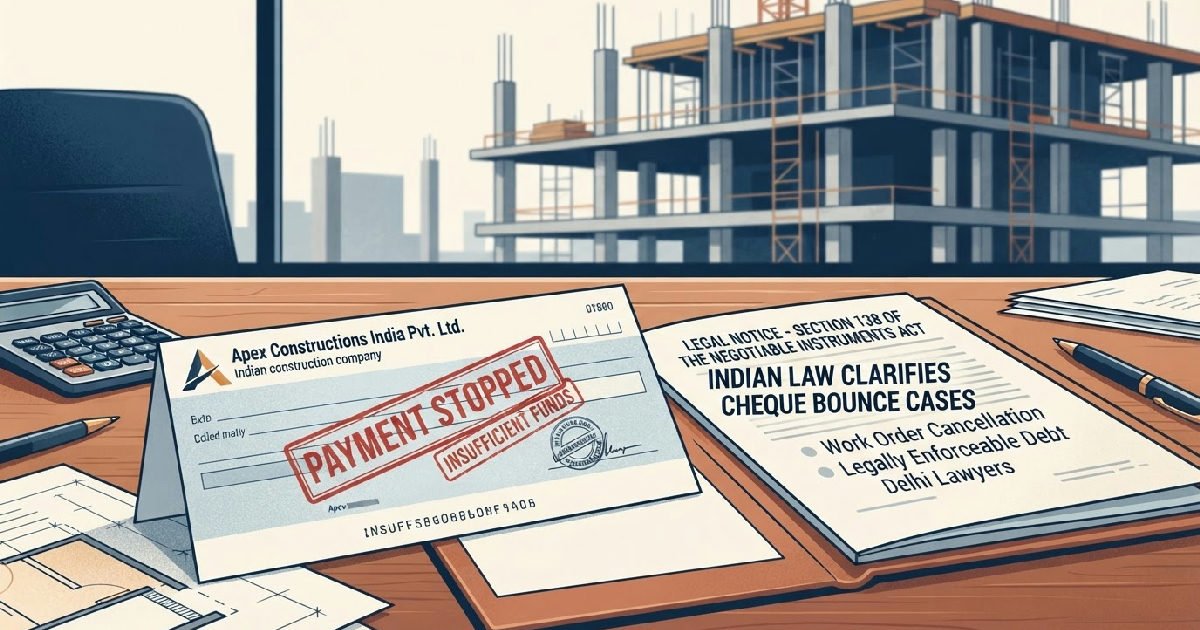
Construction company cheque bounces after work is cancelled
Indian law clarifies Construction Company Cheque Bounces After the Client Cancels the Work Order Midway
A hypothetical scenario highlights a complex legal issue in construction: a client issues a cheque for a running bill, then cancels the remaining work order midway through the project and stops the payment. This action leads to the construction company’s cheque bouncing upon presentation. Indian law clarifies the legal standing in such situations, particularly concerning payment refusal.
Such incidents immediately trigger legal considerations under India’s Negotiable Instruments Act, 1881. Section 138 of this Act specifically aims to uphold the sanctity of cheque transactions, making dishonour a serious matter.
The Critical “Debt on Date of Presentation” Principle
Under Section 138 of the Negotiable Instruments Act, a cheque bounce case hinges on whether a “legally enforceable debt or liability” existed when the cheque was presented. This principle is nuanced when a work order is cancelled after a cheque’s issuance but before its presentation.
If the cheque was for work already completed and invoiced, the client remains liable for that sum. The law recognizes the contractor’s entitlement to payment for services rendered up to the cancellation point.
This means the claim can proceed for the portion of the cheque amount directly corresponding to the executed work. It’s a key distinction in these types of legal challenges.
However, if a part of the cheque was for work that never materialized due to a valid project cancellation, the client can present this as a legitimate defence. The crucial distinction lies in separating executed work from anticipated work.
It’s a common misconception that stopping a cheque automatically absolves the drawer of all liability. That’s rarely the case if an underlying debt genuinely exists for completed services.
Client’s Strategic Defence Against Cheque Bounce Notices
Clients who cancel a work order and stop payment on a cheque must be prepared to formally respond to any legal notice issued by the payee. A well-structured defence is paramount to avoid penalties under the Negotiable Instruments Act.
Upon receiving a legal notice for cheque dishonour, the client should reply promptly. This response must detail the circumstances of the work order cancellation, ideally including a copy of the cancellation letter.
It should also provide documented measurement of work completed before activities ceased. This demonstrates the stop payment instruction wasn’t arbitrary, but rather tied to a contractual change.
The objective is to establish that any cheque portion for unexecuted work doesn’t constitute a “legally enforceable debt.” Stopping payment might fall under cheque bounce, but proving a valid reason connected to contract termination can alter the outcome.
For instance, if the client demonstrates the stop payment on a cheque instruction stemmed from legitimate grievances, and funds were available, it could mitigate the Section 138 offence.
Contractor’s Approach to Claiming Executed Work Value
For a construction company facing a cheque bounce after a client cancels a work order, the legal recourse strategy is critical. The contractor, as payee, must precisely plead the value of work executed before cancellation.
Their claim should not indiscriminately demand the entire cheque amount if a significant portion was intended for future, unundertaken work. Specificity strengthens the legal position.
Accurate documentation of completed stages, material usage, and labour hours becomes invaluable here. Legal professionals in Delhi often advise contractors to conduct a thorough assessment.
This assessment separates the “executed portion” from the “cancelled portion” of the work before drafting the legal notice and subsequent complaint. Failing to do so could weaken the case.
Courts focus on the actual outstanding liability. If the cheque was an advance for unperformed work, similar principles apply regarding the debt’s enforceability for the unfulfilled contract part, like with cheque given as advance payments.
This meticulous approach ensures that the claim is aligned with the legally enforceable debt, which is a cornerstone for a successful prosecution under Section 138. The goal is to recover the rightful dues for services already provided, not to unjustly claim for work that was legitimately cancelled.
Navigating India’s Cheque Bounce Legal Process
The legal framework for cheque bounce cases in India is primarily governed by Section 138 of the Negotiable Instruments Act, 1881. This legislation outlines a stringent process.
This process must be followed by the aggrieved party, typically the payee, to secure redress and impose penalties on the drawer for dishonoured cheques.
The process is designed to ensure financial discipline and deter the casual issuance of cheques without sufficient backing. It involves several critical steps, each with specific timelines, which must be adhered to strictly to maintain the validity of the complaint.
The penalty for being found guilty under Section 138 can be significant, including imprisonment and substantial fines. Courts may also order interim compensation to the payee.
This acknowledges the immediate financial impact of the dishonoured cheque. These provisions underscore the seriousness with which cheque dishonour is treated in the Indian legal system.
| Step | Description | Timeline |
|---|---|---|
| 1. Cheque Dishonour | Bank returns cheque unpaid with a memo stating the reason. | Immediate |
| 2. Legal Notice | Payee sends written demand notice to drawer. | Within 30 days of receiving return memo |
| 3. Payment Period | Drawer must pay the cheque amount as demanded. | Within 15 days of receiving notice |
| 4. Complaint Filing | Payee files criminal complaint in Magistrate’s court. | Within 1 month after 15-day notice period expires |
| 5. Court Proceedings | Summons, evidence presentation, arguments. | Varies |
| 6. Penalties | Imprisonment up to 2 years, fine up to twice cheque amount, or both. Interim compensation may also be ordered. | Upon conviction |
Understanding “Stop Payment” and Legally Enforceable Debt
When a client issues a “stop payment” instruction on a cheque, it generally falls under a bounced cheque. This can potentially lead to legal action under the Negotiable Instruments Act.
However, the legal outcome varies significantly based on the instruction’s circumstances. It’s not an automatic guarantee of liability for the drawer.
If the drawer can credibly demonstrate sufficient funds were available but the stop payment was for valid, justifiable reasons, the Section 138 offence might not be established.
Such valid reasons include a fraudulent transaction or, pertinent here, legitimate cancellation of the underlying purchase order or work agreement. Courts scrutinize intent and contractual basis.
This distinction is crucial. Not all dishonoured cheques automatically lead to conviction under the Act, emphasizing the need for robust defence.
Furthermore, for Section 138 to apply, the cheque must have been issued to discharge a “legally enforceable debt or liability.” This serves as a fundamental prerequisite for prosecution.
Cheques issued as gifts, advance security deposits without underlying debt, or for illegal considerations do not attract Section 138 liability. This highlights the importance of a clear debt.
Proving the actual amount of outstanding work therefore becomes critical for a construction company in these disputes. While the implications of a part payment after the Section 138 notice are complex, the provided research does not detail how such a payment specifically shifts the legal landscape.
The Indispensable Role of Cheque Bounce Lawyers in Delhi
Given the complexities and strict procedural timelines in cheque bounce cases, especially with work order cancellations, the expertise of cheque bounce lawyers in Delhi becomes invaluable.
These legal professionals specialize in navigating the intricacies of the Negotiable Instruments Act and its application in real-world scenarios, offering crucial guidance.
Lawyers play a crucial role from initial stages, meticulously drafting and dispatching legal notices that accurately reflect the legally enforceable debt.
They also undertake filing the criminal complaint in the appropriate Magistrate’s court. This ensures all statutory timelines are met and the complaint contains necessary details for judicial scrutiny.
Their experience helps differentiate between legitimate claims for executed work and those related to cancelled portions. This distinction is vital for a strong case.
Moreover, legal practitioners represent clients throughout court proceedings, presenting evidence, cross-examining witnesses, and arguing points of law effectively.
They also often facilitate negotiations for out-of-court settlements. This can be a more expedient and cost-effective resolution for both parties, avoiding prolonged litigation.
Their guidance ensures compliance with legal procedures, helping both contractors and clients effectively present their cases and protect their interests in court.
What happens if a client cancels a work order after issuing a cheque?
If a client cancels a work order after issuing a cheque, and the cheque bounces, the liability under Section 138 of the Negotiable Instruments Act depends on the value of work executed before cancellation. The construction company can claim payment for work already done.
Can a “stop payment” instruction prevent a cheque bounce case?
A “stop payment” instruction generally constitutes a bounced cheque. However, if the client can prove that sufficient funds were available and the stop payment was for a valid reason, such as a legitimate work order cancellation, it may serve as a defence against Section 138 liability.
How should a contractor determine the claim amount in such a scenario?
A contractor should meticulously calculate and plead only the value of the work that was executed before the work order cancellation. Claiming the entire cheque amount, if it included payment for unperformed work, could weaken their legal standing in court.
Cheque stopped after the client cancelled the balance work? Call or Whatsapp for consultation.
Related: https://arpitmarwah.com/cheque-bounce-lawyers-in-delhi/