
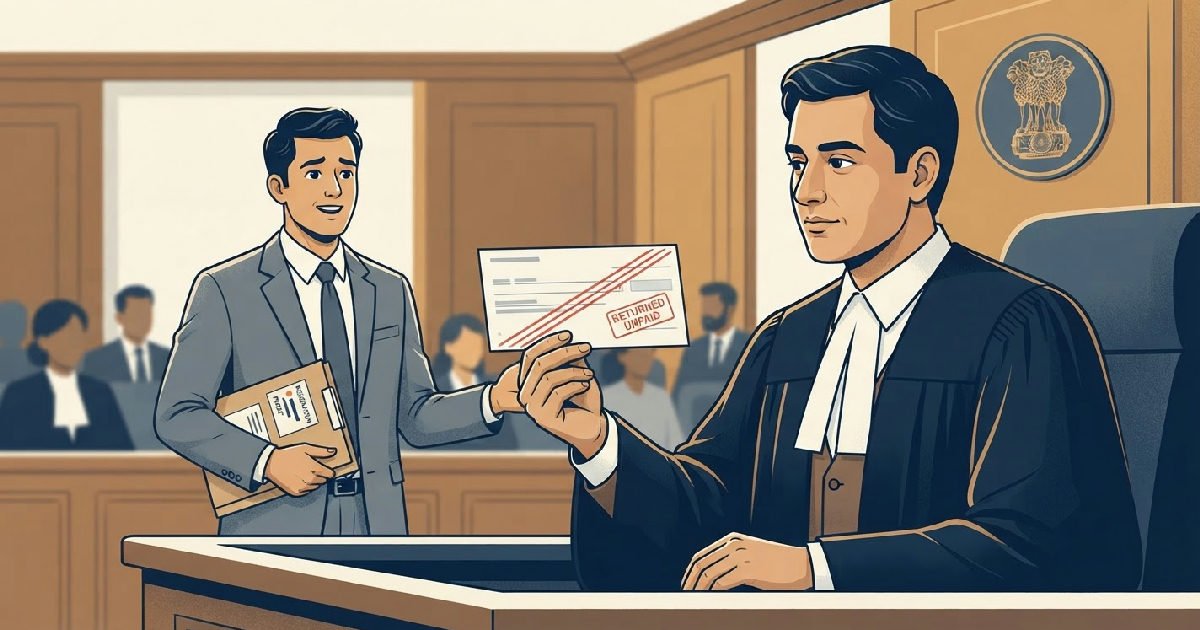
India’s Supreme Court has recently provided crucial clarity on the liability of resigned directors in bounced cheque cases, establishing that the timing of a director’s departure is paramount. These rulings offer significant relief to former company officials wrongfully implicated under Section 138 of the Negotiable Instruments Act, 1881, particularly when they had no oversight of the company’s affairs at the time of the offence.
The apex court’s pronouncements underscore a fundamental principle: a director cannot be held responsible for a cheque issued by a company after their official resignation. This protection applies provided the departure was properly documented and recorded. This distinction is vital for businesses and former executives across India, including those facing legal challenges in jurisdictions like Delhi.
Resigned director still named in a cheque bounce case
Cheque bounce cases in India fall primarily under Section 138 of the Negotiable Instruments Act, 1881 (NI Act). This statute is designed to ensure the sanctity of commercial transactions. It penalises the drawer of a cheque if it is dishonoured due to insufficient funds or other specified reasons.
When a company is involved, Section 141 of the NI Act extends this liability to individuals. It stipulates that every person “who, at the time the offence was committed, was in charge of, and was responsible to the company for the conduct of the business of the company,” can also be deemed guilty. The company itself is, of course, also liable.
This provision has historically led to complexities, often ensnaring individuals who had minimal or no active role in the company’s operations. This includes those individuals who were no longer associated at the time a cheque was issued and subsequently dishonoured.
Resignation Timing: The Decisive Factor in Liability
The core of recent judicial clarifications revolves around the precise timing of a director’s resignation. This timing is always relative to the issuance of the dishonoured cheque. Courts are now rigorously examining whether a director was genuinely “in charge” of the company’s affairs when the offence occurred.
If a director officially resigned and their departure was duly recorded before the company issued the impugned cheque, they generally escape liability. This principle contrasts sharply with situations where the resignation occurs after the cheque’s issuance, or where the director was the cheque’s signatory. Who is in charge of a company in these cases becomes the central question.
Establishing the exact date of disassociation is therefore critical for any former director. This proof is essential for those seeking to quash criminal proceedings. Merely being a director does not automatically lead to liability; specific involvement must be clearly shown.
Supreme Court Clarifies Post-Resignation Immunity
Several landmark Supreme Court judgments have reinforced the protection for resigned directors. One notable case is Adhiraj Singh v. Yograj Singh & Ors., decided on December 2, 2024. This ruling significantly shapes the understanding of director liability.
In this instance, the Supreme Court quashed criminal proceedings against Adhiraj Singh. His resignation dated June 21, 2019, was filed with the Registrar of Companies (ROC) on June 26, 2019. The cheques in question were issued by the company on July 12, 2019, well after his official departure. The Court found him not liable for instruments issued post-resignation.
Similarly, in Rajesh Viren Shah v. Redington (India) Limited, a Supreme Court judgment dated February 14, 2024, clarified the position. Directors who resigned on December 9, 2013, and March 12, 2014, respectively, were held not liable.
These individuals could not be held responsible for cheques issued on March 22, 2014, as their resignations clearly preceded the cheque issuance. Their relevant Form 32 filings were accepted on December 9, 2013, and February 20, 2013, reinforcing the official nature of their departure.
Distinction from Previous Precedents
The Supreme Court has also drawn clear lines, distinguishing these scenarios from cases where directors resigned after the cheques were issued. For instance, the Court noted that in the Malwa Cotton & Spinning Mills Ltd. v. Virsa Singh Sidhu case, the director’s resignation came subsequent to the cheques being drawn. This critical difference highlights the importance of the specific event timing.
Liability hinges on the director’s status and involvement at the specific moment of the alleged offence. The mere existence of an underlying debt during their tenure isn’t sufficient to establish liability for a later-issued cheque. The date the cheque was actually issued is the determinative factor.
Delhi High Court’s Stance on Signatories
While former directors who resigned before a cheque’s issuance typically find legal protection, the situation is markedly different for those who actually signed the dishonoured instrument. The Delhi High Court has consistently ruled that a director who is an admitted signatory to a cheque cannot easily evade prosecution.
This holds true even if they claim resignation, particularly when the authenticity and timing of that resignation are disputed. The act of signing the cheque itself establishes a direct link to the transaction, making the signatory primarily liable for its eventual dishonour.
In the case of Dinesh Kumar Pandey vs. M/S Singh Finlease Pvt. Ltd. & ANR. (Delhi High Court, 2025:DHC:11999), Justice Sanjeev Narula observed that a signatory stands on a different footing. Such an individual is “clearly responsible for the incriminating act,” even without detailed averments regarding their day-to-day management of the company.
The petitioner’s admitted role in negotiating loans, executing documentation, and signing cheques, coupled with disputed resignation timing, prevented the quashing of proceedings.
This judicial stance underscores the heightened responsibility associated with being the drawer of the cheque. It confirms that specific actions like signing can override subsequent claims of disassociation, especially when the resignation itself is not unequivocally proven to precede the cheque’s issuance.
Importance of Resignation Documentation and Proof
For any director contemplating resignation, or one already facing a cheque bounce case, meticulous documentation is paramount. The official date of resignation is a critical determinant of liability. Proper filing ensures legal disassociation.
Key proofs include formal resignation letters, minutes from board meetings acknowledging the resignation, and statutory filings with the Registrar of Companies (ROC). Forms like DIR-11 and DIR-12 are essential under current corporate law. The older Form 32, used under the Companies Act, 1956, also served this purpose.
Form 32, for instance, had to be filed within 30 days of resignation to register a director’s departure. The Supreme Court has affirmed that if a director’s resignation is undisputed and officially filed with the ROC before the cheques were issued, they cannot be held responsible.
This legal requirement necessitates prompt and proper administrative actions upon a director’s exit, distinguishing liability. Understanding post-dated cheque legality can also be crucial in these scenarios.
| Key Aspect | Resigned Before Cheque Issued | Resigned After Cheque Issued/Signed |
|---|---|---|
| Liability under Section 138/141 NI Act | Generally NOT liable (Supreme Court confirmed) | Generally LIABLE (especially if signatory) |
| Crucial Evidence | Official ROC filings (DIR-11/12, Form 32), board minutes, resignation letter | No defence based on resignation alone; signatory status is key |
| Relevant Cases | Adhiraj Singh v. Yograj Singh & Ors. (SC, 2024), Rajesh Viren Shah v. Redington (India) Limited (SC, 2024) | Dinesh Kumar Pandey vs. M/S Singh Finlease Pvt. Ltd. & ANR. (Delhi HC, 2025) |
| Requirement for Accused | Prove genuine disengagement at trial; present proof early | Must contest the grounds of dishonour or dispute debt |
Implications for Complainants and Accused Directors
These judicial pronouncements carry significant implications for both parties in cheque bounce disputes. Complainants are now expected to exercise greater diligence when naming accused parties. Merely listing every past director from an outdated company master data sheet is insufficient and can lead to proceedings being quashed.
The complaint must explicitly link the director or authorized signatory to the conduct of the company’s business. This includes demonstrating involvement in the issuance of the cheque, or the underlying transaction at the time the offence occurred. Failure to establish this link means genuinely disassociated directors may see proceedings against them quashed.
For an accused director, proactive action is key. If facing charges, they should present proof of their resignation at the earliest possible stage, ideally at the first court hearing. Delaying this proof can prolong legal battles and add unnecessary financial and emotional burden, even if their position is legally sound. The accused director must prove their genuine disengagement at the trial court.
Preventing Abuse of Legal Process
The courts have also indicated that forcing a resigned director to face trial when their timely resignation is demonstrably proven can constitute an abuse of the legal process. Criminal law, while robust, should not be misused to settle what are essentially civil disputes or to harass former company personnel.
This judicial stance encourages a more judicious application of Section 138/141 NI Act. It ensures that only those truly responsible for the company’s financial conduct at the material time are held accountable. This places a greater burden on complainants to conduct thorough due diligence before initiating proceedings.
Broader Impact on Corporate Governance in India
These recent rulings are likely to have a ripple effect on corporate governance practices across India. Companies may face increased pressure to ensure that director resignations are processed and filed with the Registrar of Companies promptly and correctly. This mitigates future legal risks for all involved parties.
Furthermore, the clarity provided by the Supreme Court encourages directors to be more diligent in ensuring their exit from a company is fully documented and publicly recorded. This proactive approach safeguards them from potential future legal entanglements stemming from the company’s post-resignation activities. Accurate and timely records are now indispensable.
The distinction between the underlying debt and the actual cheque issuance date is also crucial. While the debt may have originated during a director’s tenure, their liability for a dishonoured cheque issued later depends entirely on their official association with the company at the time the cheque was drawn.
This emphasis on the specific act of cheque issuance helps prevent the dragnet effect where past directors are indiscriminately targeted.
It reinforces the principle that criminal liability should attach only to those with demonstrable control and responsibility. The Bombay High Court, in Suhas Bhand Petitioner v. State Of Maharashtra & Anr. (August 18, 2009), previously touched upon aspects of contested resignation genuineness.
It noted that merely presenting a certified copy of Form 32 doesn’t automatically discharge a director if the resignation is disputed. However, the Supreme Court’s recent pronouncements offer a more definitive stance where the resignation is undisputed and officially recorded before cheque issuance, providing greater certainty.
Understanding the role of submitting evidence by affidavit can be critical for both parties in these matters.
This evolution in jurisprudence offers greater certainty and protection to individuals who have genuinely severed ties with a company. It ensures that the spirit of the Negotiable Instruments Act is upheld without unduly penalising those no longer in positions of corporate responsibility.
Future cases will undoubtedly build upon these precedents, refining the nuances of director liability further. But for now, the message is clear: meticulous documentation of a director’s exit is a powerful shield against unforeseen legal challenges.
Can a director be held liable for a cheque bounce if they resigned before the cheque was issued?
No, generally not. Recent Supreme Court rulings, such as in Adhiraj Singh v. Yograj Singh & Ors., confirm that if a director officially resigned and filed the necessary documentation with the Registrar of Companies before the cheque was issued, they cannot be held liable under Section 138 of the NI Act.
What documentation is crucial to prove a director’s resignation in court?
Key documents include a formal resignation letter, minutes from board meetings acknowledging the resignation, and statutory filings with the Registrar of Companies (ROC). Forms like DIR-11, DIR-12, or the older Form 32 are essential in establishing the official date of departure, and should be filed promptly.
Does signing the cheque before resigning still make a director liable for its dishonour?
Yes, absolutely. If a director signed the cheque, they are primarily liable for its dishonour, even if they resigned afterwards. The Delhi High Court has specifically ruled that a signatory cannot escape prosecution based on a subsequent resignation, especially if the timing and genuineness are contested.
Named in a 138 case after you left the company? Call or Whatsapp for consultation.
Related: https://arpitmarwah.com/cheque-bounce-lawyers-in-delhi/